
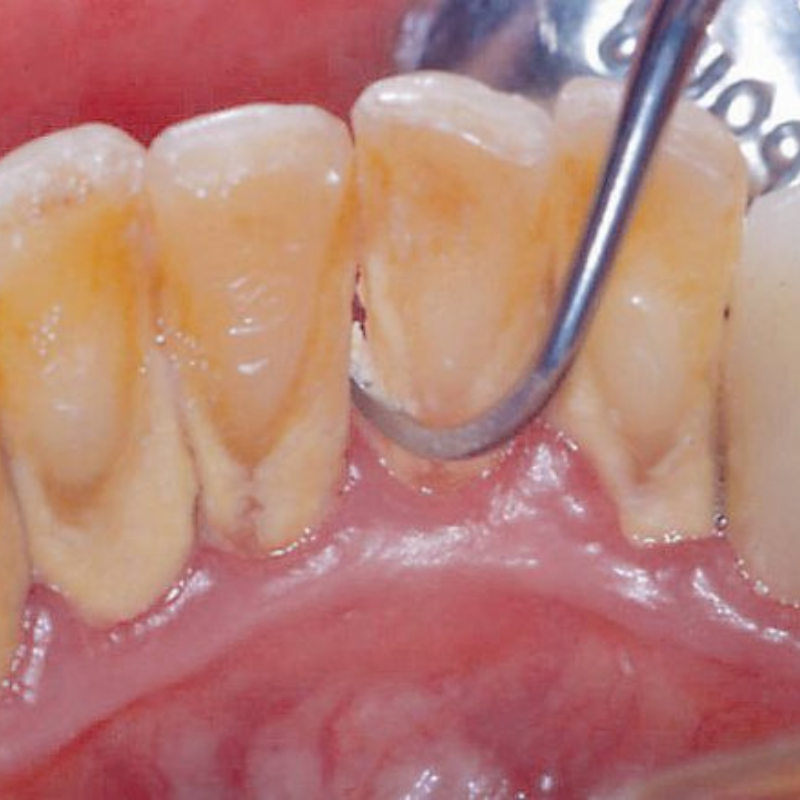
You brush your teeth twice a day. And yet, at every visit, your dentist tells you there’s tartar to remove. Behind the lower incisors. Around the molars. Sometimes under the gums.
You are not alone in this. Dental tartar is the most universal oral health problem among adults — and one of the least well understood.
Understanding why tartar forms despite regular brushing, and above all how to significantly slow its buildup, can transform your visits to the dentist—less frequent, shorter, less expensive.
According to Health Insurance data, scaling is the most commonly performed dental procedure in France. A full scaling costs €43.38 at a sector 1 dentist in 2026, and is recommended twice a year. (Source: Ircem.com — CCAM effective 01/01/2026)
What exactly is dental tartar?
The tartar — or dental calculus — is bacterial plaque calcified. It is not food residue. It is a bacterial biofilm that has mineralized through the accumulation of calcium and phosphate salts present in saliva.
The mineralization process begins within 24 to 72 hours after plaque builds up. Plaque that is not removed within this time starts to turn into tartar—and once calcified, tartar adheres to the tooth surface so firmly that your toothbrush, even an electric one, can no longer dislodge it.
The critical distinction:
| Plate | Tartar | |
|---|---|---|
| Composition | Soft bacterial biofilm | Hard calcified plaque |
| Color | Transparent / yellowish white | Dark yellow to brown |
| Texture | Soft, sticky | Hard, grippy |
| Can be brushed off | ✅ Yes — within 48 hours | ❌ No |
| Requires a professional | ❌ No | ✅ Yes |
| Formation period | Immediate | 24 to 72 hours after the plaque |
Why You Have More Tartar Than Others — Individual Factors
Two people with the same brushing routine can accumulate very different amounts of tartar. Here's why.
Facteur 1 — Saliva composition
The saliva contains calcium and phosphate ions that help remineralize enamel — a beneficial function. But in some people, this concentration is higher, which speeds up the mineralization of plaque into tartar. This is partly genetic.
Factor 2 — Oral pH
A basic oral pH promotes the precipitation of calcium salts — and therefore the formation of tartar. An acidic pH promotes enamel erosion. Neither is ideal, but for “heavy tartar formers,” a basic pH is often the cause.
The 3rd factor — Preferred accumulation zones
The most common places for tartar to form are areas where saliva is richest in mineral salts and where brushing is least effective:
- Behind the lower incisors : opposite the sublingual salivary glands
- Around the first upper molars : opposite the parotid glands
- In between the teeth : areas inaccessible to brushing
The 4 Key Factors — Brushing Technique and Frequency
Plaque removed in less than 48 hours cannot calcify. Insufficient brushing—too brief, poorly targeted, too infrequent—leaves areas of plaque intact that gradually mineralize.
Factor 5 — Diet
A diet high in refined sugars feeds cavity-causing bacteria that produce acids—worsening the oral environment. Foods rich in calcium may theoretically contribute to mineralization, but their effect on tartar formation remains modest compared with behavioral factors.
The anti-scale protocol — What really slows its formation
Action 1 — High-frequency sonic brushing
It's the most impactful action. A sonic toothbrush at 40,000-45,000 vibrations per minute creates a hydrodynamic effect that loosens plaque, including in nearby areas not directly touched by the bristles.
Documented anti-scale effect: comparative studies of manual toothbrushes vs. sonic toothbrushes show a significant reduction in tartar among users of high-frequency sonic toothbrushes after 3 months of regular use. (Source: Journal of Dentistry — comparative studies of sonic vs. manual toothbrushes)
What makes the difference in technique:
- Brush for at least 2 minutes — the last 30 seconds often cover the most frequently forgotten areas
- Target particularly areas where tartar tends to build up (behind the lower incisors)
- Do not press — the hydrodynamic effect only works with the recommended light pressure
Action 2 — Daily interdental cleaning
The greatest buildup of tartar forms in the spaces between teeth—areas completely unreachable by brushing. A daily water flosser removes plaque from these areas before it calcifies.
Timing criticism: the evening is the most important time. At night, saliva decreases and the mineralization of residual plaque accelerates.
Action 3 — Tartar-control toothpaste with stannous fluoride or pyrophosphate
Anti-tartar toothpastes generally contain zinc pyrophosphate or of the stannous fluoride which inhibit the precipitation of calcium salts on the plaque — slowing calcification.
Their effectiveness is real but modest — they reduce tartar buildup but do not eliminate it completely. They must be combined with effective brushing for a significant effect.
Action 4 — Rinsing with water after meals
A simple rinse with water after meals removes some food residue and dilutes bacteria before they have time to cling to tooth surfaces. Simple, free, and effective in addition to brushing.
Action 5 — Adequate hydration
A normal salivary flow provides a natural cleansing and protective action. Dehydration reduces this flow and encourages plaque buildup. 1.5 to 2 litres of water per day maintain optimal salivary flow.
What You CANNOT Do Yourself
I must be honest on this point: Once it has formed, tartar cannot be removed at home.
Home "tartar removers" sold online can scratch enamel and cause gum injuries if they are not used with the proper professional technique. Their use is not recommended without training.
SonicSmile Pro™ — ultrasonic scaler for home use — is designed for gentle use on accessible light deposits. It does not replace professional subgingival scaling but can help maintain enamel between sessions.
⚠️ Its use should remain gentle and superficial. If in doubt, consult your dentist before use.
Chart: Recommended descaling frequency based on your profile
| Profile | Recommended frequency | } |
|---|---|---|
| Low tartar buildup, good hygiene | 1x/year | Maintenance |
| Average build, proper hygiene | 2x/year | Standard |
| Rapid buildup or sensitive gums | 2-3x/year | Prevention of periodontal disease |
| Periodontitis currently being treated | 3-4x/year | Active monitoring |
| Braces wearer | 2–3x/year | Multiple retention zones |
FAQ
Can tartar disappear on its own?
No. Once mineralized, tartar does not dissolve and does not disappear on its own. Only professional scaling can remove it. Prevention — removing plaque before calcification — is the only effective at-home strategy.
Can apple cider vinegar dissolve limescale?
No, and using it is dangerous for enamel. Apple cider vinegar is highly acidic (pH ~3) and can erode tooth enamel with regular use. I cannot confirm any dissolving effect on mineralized tartar without a reliable scientific source — and the available studies do not support it.
Is tartar dangerous if you don’t have it removed?
Yes. Tartar mechanically irritates the gums and harbors bacteria that worsen gum inflammation. Over time, it contributes to the development of periodontitis — the leading cause of tooth loss in adults. (Source: HAS — Periodontal diseases)
Is black tartar more dangerous than yellow tartar?
The tartar can be yellow, brown, or black depending on its composition and age. Black tartar (subgingival tartar) is generally older and located deeper under the gum—often associated with more advanced periodontitis. Its presence requires prompt dental consultation.
Conclusion
The formation of dental tartar is inevitable — but its buildup is largely controllable. Effective sonic brushing twice a day, daily interdental cleaning in the evening, and a suitable anti-tartar toothpaste can significantly reduce the amount of tartar that forms between professional visits.
The goal isn’t to avoid the dentist — it’s to arrive at each appointment with less tartar to remove, healthier gums, and potentially a reduced frequency of scale and polish treatments.
The DentalPro Smile™ range — PureBrush Pro™, HydroJet Pro™ et SonicSmile Pro™ — the three anti-limescale tools in your daily routine.
👉 dentalpro-smile.com/fr-fr
RECOMMENDED RELATED ARTICLES:
→ Article 2: Water flosser vs dental floss
→ Article 3: Bleeding gums — a direct consequence of tartar
→ Article 18: Diet and dental health
Article for informational purposes only. Does not replace the advice of a dental surgeon. DentalPro Smile™ — 2026.

Leave a comment
This site is protected by hCaptcha and the hCaptcha Privacy Policy and Terms of Service apply.