
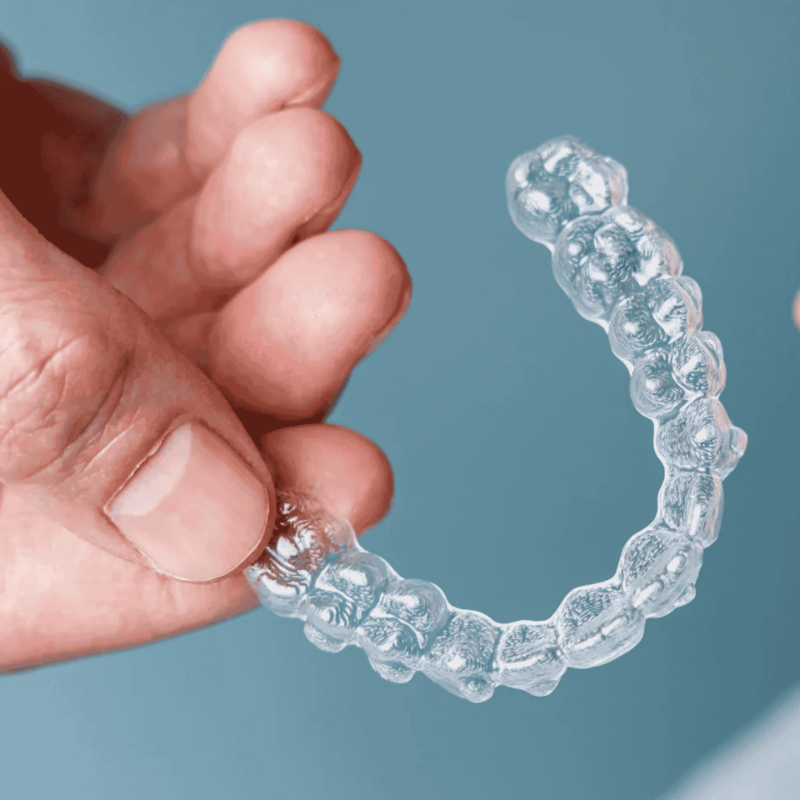
Your Invisalign aligner spends 22 hours a day in your mouth. During those 22 hours, it is in constant contact with your saliva, oral bacteria, and food residue.
An aligner treatment represents an investment of between €2,500 and €5,500 depending on the complexity and the practitioner. (Source: orthodontie-paris.org — aligner rates 2025-2026) This investment deserves rigorous daily care — not only to protect the appliance, but above all to protect your teeth during treatment.
Because here is what most first-time wearers do not realize: a poorly cleaned aligner is a bacterial reservoir that reintroduces into your mouth the microorganisms responsible for cavities and gum disease — precisely where they have the most time to act, trapped between the aligner and your teeth for 22 consecutive hours.
What happens on your aligner in 24 hours
Within a few hours in your mouth, your aligner develops a bacterial biofilm — a microscopic film that adheres to its surface. This biofilm is made up of the same bacteria responsible for cavities: Streptococcus mutans, Lactobacillus, Candida albicans.
This biofilm is invisible to the naked eye. It does not disappear with rinsing in water. It partially resists light brushing.
The consequences of insufficient cleaning:
| Timeframe | What happens |
|---|---|
| 24-48h | Established bacterial biofilm |
| 3-5 days | Start of visible yellowing |
| 1-2 weeks | Persistent odor despite rinsing |
| 1 month | Visible calcium deposits |
| Duration of treatment | Risk of "white spots" cavities under the aligner |
The "white spots" — white areas of enamel demineralization — are a documented complication of aligner treatment in patients with insufficient hygiene. These spots are permanent and unattractive.
Cleaning methods — What really works
Method 1 — Water rinsing (not enough on its own)
What it does: removes visible food residue and saliva from the surface.
What it does not do: remove bacterial biofilm, early tartar, or staining deposits.
Use: every time the aligner is removed — but never as the only cleaning method.
⚠️ Always use lukewarm water — never hot. Hot water warps the aligner's thermoplastic material, making it unusable.
Method 2 — Gentle brushing with a soft brush (partial)
What it does: mechanically dislodges part of the surface biofilm.
What it does not do: reach the micro-pores of the material where bacteria are lodged.
Absolute rule: never use toothpaste on an aligner. Toothpaste contains abrasives (calcium carbonate, silica) that scratch the aligner surface — creating micro-scratches that trap even more bacteria and speed up yellowing.
Use: dedicated soft brush + lukewarm water only.
Method 3 — Effervescent cleaning tablets (effective)
What they do: release oxidizing agents that disinfect the outer surfaces and partially the deeper areas.
What they do not do: reach the biofilm in deep micro-pores as completely as ultrasound does.
Protocol:
- Dissolve 1 tablet in a glass of lukewarm water
- Soak the aligner for 15 to 20 minutes
- Rinse thoroughly with lukewarm water
- Brush gently if deposits remain visible
Recommended frequency: at least once a day, ideally in the evening.
Method 4 — Ultrasonic cleaner (optimal method)
What it does: generates sound waves at 40,000 Hz that create millions of micro-bubbles (ultrasonic cavitation). These bubbles reach every surface of the aligner simultaneously — including micro-pores inaccessible to brushes and tablets.
A study published in the Journal of Prosthetic Dentistry (2021) showed that ultrasonic cleaning removes significantly more bacterial biofilm from removable dental appliances than manual brushing.
Ultrasound protocol:
- Fill the tank with room-temperature water
- Fully immerse the aligner
- Run the cycle (3 to 5 minutes)
- Rinse with clean water
- Optional: add 1 cleaning tablet for enhanced disinfection
Result: deep-cleaned aligner, clear, odor-free, and scratch-free.
Comparison table of methods
| Method | Surface biofilm | Deep biofilm | Staining deposits | Time | Scratch risk |
|---|---|---|---|---|---|
| Water rinse alone | 🟡 Partial | ❌ No | ❌ No | 30 sec | ✅ None |
| Soft brush cleaning | ✅ Yes | 🟡 Partial | 🟡 Partial | 1-2 min | 🟡 Low |
| Effervescent tablets | ✅ Yes | 🟡 Partial | ✅ Yes | 15-20 min | ✅ None |
| Ultrasonic cleaner | ✅ Yes | ✅ Yes | ✅ Yes | 3-5 min | ✅ None |
| Ultrasound + tablet | ✅ Yes | ✅ Yes | ✅ Yes | 5 min | ✅ None |
What you should never do with your aligner
❌ Hot or boiling water
Irreversibly warps the thermoplastic material. A warped aligner no longer fits your teeth properly and loses its orthodontic effect. Replacement required.
❌ Toothpaste
Abrasive — scratches the aligner surface and speeds up yellowing and bacterial buildup.
❌ Pure alcohol or bleach
Degrade the material and can leave dangerous chemical residues if the aligner is not rinsed properly before being put back in the mouth.
❌ Leaving the aligner in the open air
An aligner exposed to air dries out and attracts ambient bacteria. Always store it in its case — clean and dry.
❌ Leaving it to soak overnight in tablets
Prolonged soaking can weaken the material of some aligners. Follow the indicated time (15-20 minutes maximum for most tablets).
❌ Putting the aligner back on unbrushed teeth
You trap all food residue and bacteria from the meal under the aligner for 22 hours. Always brush your teeth before putting the aligner back in.
The optimal daily protocol — Copy and paste into your routine
🌅 Morning (before putting the aligner back in)
1. Remove the aligner
2. Rinse with lukewarm water
3. Ultrasound cycle 3-5 minutes (or tablets 15 min)
4. Brush your teeth as usual
5. Put the clean aligner back on clean teeth
🍽️ After each meal (before putting the aligner back in)
1. Remove the aligner before eating
2. Rinse the aligner with lukewarm water
3. Brush your teeth + interdental cleaning
4. Put the aligner back in
🌙 Evening (main cleaning)
1. Remove the aligner
2. Ultrasound cycle + 1 cleaning tablet (5 minutes)
3. Rinse thoroughly
4. Brush your teeth + water flosser
5. Put the aligner back in for the night
Don't forget the case — The detail 90% of wearers overlook
The storage case for your aligner accumulates the same bacteria as the aligner itself. A clean aligner stored in a dirty case is immediately recontaminated.
Case care:
- Wash with soapy water at least 2 times per week
- Air-dry before use
- Replace every 3 to 6 months
FAQ
How many times a day should I clean my aligner?
Ideally every time you remove it — that is, 3 to 4 times a day (morning, after each meal, evening). At minimum: one full clean in the morning and evening. The more regularly you clean it, the more transparent and odor-free it stays.
My aligner turned yellow despite cleaning — what should I do?
Rapid yellowing within a few days indicates either consumption of colored drinks with the aligner in place (coffee, tea, wine — absolutely avoid) or insufficient cleaning. An intensive ultrasonic cycle with a tablet can recover a slightly yellowed aligner. If the yellowing is significant, contact your orthodontist.
Can I drink coffee with my aligners?
No. Colored drinks (coffee, tea, red wine, colored sodas) stain the aligner within minutes. Only still water at room temperature is compatible with wearing the aligner.
Can the ultrasonic cleaner damage my Invisalign aligner?
No, provided you use room-temperature water and do not exceed a 5-minute cycle. Household ultrasonic cleaners operate at suitable power levels — they do not warp or scratch aligners.
Conclusion
Cleaning your Invisalign aligner properly is not an extra burden — it is the condition for your treatment to proceed without complications, without cavities under the aligner, and with an appliance that stays discreet throughout treatment.
The optimal protocol: daily ultrasonic cleaner in the morning + cleaning tablets in the evening + brushing your teeth before every reinsertion.
UltraClean Pro™ and UltraClean Pro+™ DentalPro Smile™ are specifically designed for the care of aligners, dentures, and dental appliances — 5-minute cycle, scratch-free, professional results.
👉 dentalpro-smile.com/fr-fr
RECOMMENDED RELATED ARTICLES:
→ Article 7: Dental prosthesis — complete care guide
→ Article 13: Brushing teeth with a fixed orthodontic appliance
→ Article 15: Bruxism and night guards
Informational article only. Does not replace the advice of a dentist or orthodontist. DentalPro Smile™ — 2026.



Leave a comment
This site is protected by hCaptcha and the hCaptcha Privacy Policy and Terms of Service apply.