
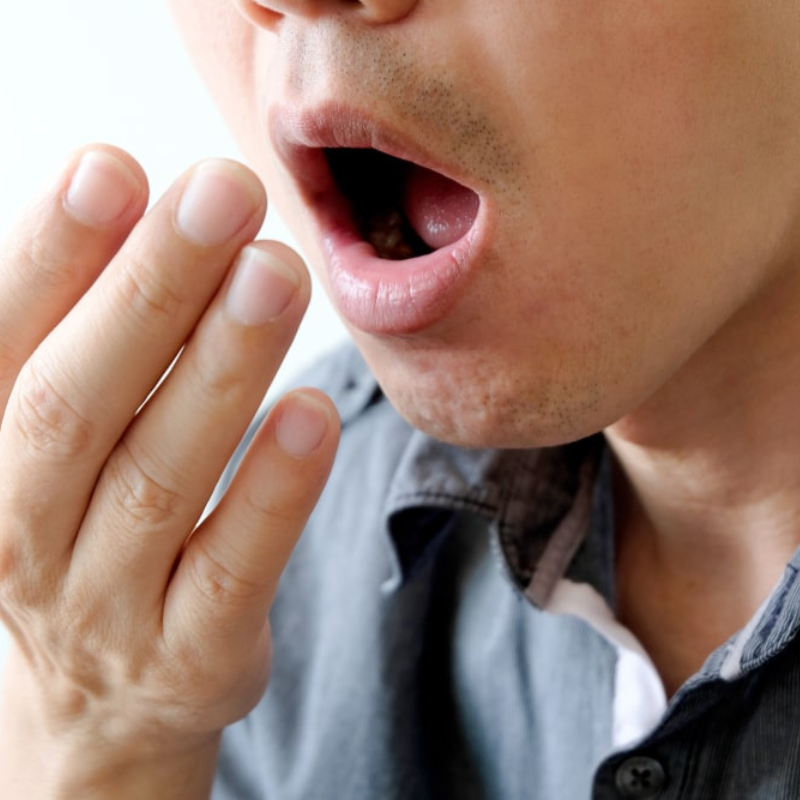
You brush your teeth twice a day. You use mouthwash. You chew mint gum. And yet — that discomfort keeps coming back. Mid-morning. After coffee. At the end of the day.
Chronic bad breath — or halitosis — is one of the most widespread and poorly treated oral health problems. Around 25% of the world's population suffers from it regularly. (Source: British Dental Journal — systematic review on halitosis, 2021)
Poorly treated because almost all commercially available solutions (mouthwashes, sprays, gum) act on the symptoms — the odor — without treating the cause.
This guide explains where the real cause of your bad breath lies, and how to eliminate it permanently by changing your routine.
Where does bad breath really come from?
In 85 to 90% of cases, bad breath originates in the mouth. The remaining 10 to 15% have systemic causes (kidney disease, uncontrolled diabetes, acid reflux, ENT infections). (Source: British Dental Journal, systematic review 2021)
The 3 main oral sources:
Source 1 — The tongue (responsible in 50 to 60% of cases)
The dorsal surface of the tongue — and more specifically its back part — harbors massive colonies of anaerobic bacteria. These bacteria produce volatile sulfur compounds (VSCs) — hydrogen sulfide, methyl mercaptan, dimethyl sulfide — directly responsible for the characteristic odor of halitosis.
The tongue has crypts and filiform papillae that create anaerobic micro-environments (without oxygen) perfect for these bacteria. They multiply there beyond the reach of your toothbrush.
Source 2 — Interdental spaces (20 to 30% of cases)
Food debris trapped between the teeth ferments quickly — releasing foul-smelling gases. Without daily interdental cleaning, this fermentation continues for hours.
Source 3 — Gum pockets (10 to 20% of cases)
Periodontal pockets — even shallow ones — create anaerobic environments where the same VSC-producing bacteria proliferate sheltered from oxygen. This is why gum disease is almost always associated with bad breath.
Why mouthwash does not solve the problem
Mint or chlorhexidine mouthwash creates an intense fresh feeling for 15 to 45 minutes. It temporarily reduces the superficial bacterial load.
But it does not penetrate the tongue's crypts. It does not clean between the teeth. It does not treat gum pockets.
Result: the VSC-producing bacteria resume their activity as soon as the effect of the mouthwash fades — often in less than an hour.
Long-term use of chlorhexidine (more than 2 to 4 weeks) can also cause brown staining on the teeth and disrupt the balanced oral flora. (Source: HAS — clinical use of chlorhexidine)
The complete protocol for long-lasting fresh breath
Step 1 — Clean the tongue every morning (top priority)
This is the most impactful and most neglected step. Fewer than 30% of French adults clean their tongue daily.
How to clean the tongue properly:
- Stick your tongue out as far as possible
- Place the tongue scraper as far back as possible without triggering the gag reflex
- Apply light pressure and pull forward in one continuous motion
- Rinse the scraper under running water
- Repeat 3 to 5 times
- Rinse your mouth with water
Frequency: every morning when you wake up, before brushing. This is when the concentration of VSCs is highest (saliva decreases during sleep, promoting overnight bacterial growth).
Recommended tool: a stainless steel tongue scraper is more effective than a toothbrush for cleaning tongue crypts. Its U-shaped design adapts to the shape of the tongue and scrapes the surface evenly.
Step 2 — Daily interdental cleaning
Water flosser or dental floss — the key is to remove fermentable debris between the teeth every evening.
Evening is the critical time : if debris remains between your teeth during 7 to 8 hours of sleep (during which saliva decreases), bacterial fermentation is at its peak.
Step 3 — Complete brushing with the correct technique
At least two minutes, twice a day. With special attention to the back molar area and the tooth-gum junction — areas where VSC-producing bacterial plaque preferentially builds up.
Step 4 — Adequate hydration
Saliva is your mouth's natural cleaning system. It dilutes VSCs, neutralizes acids, and partially inhibits bacterial growth. Even mild dehydration reduces salivary flow and significantly worsens bad breath.
Recommendation: 1.5 to 2 liters of water per day. Dry mouth (xerostomia) is one of the most common causes of morning halitosis.
Step 5 — Backup breath spray
For unexpected social situations (meeting, date), a breath spray based on zinc or essential oils temporarily neutralizes VSCs. Zinc reacts chemically with sulfur compounds and neutralizes them — making it a more effective backup solution than simple menthol flavorings.
Aggravating factors to identify
| Factor | Mechanism | Solution |
|---|---|---|
| Tobacco | Reduces salivary flow + its own chemical compounds | Cut back or quit |
| Alcohol | Dries out the oral mucosa | Compensatory hydration |
| Coffee | Lowers oral pH + aromatic compounds | Rinse with water afterward |
| Garlic and onion | Dietary VSCs absorbed then exhaled | Normal — temporary |
| Prolonged fasting | Ketosis breath (fruity-acetone) | Regular meals |
| Medications | Antihistamines, antidepressants reduce saliva | Medical consultation |
| Mouth breathing | Dries out the mucosa | ENT treatment if necessary |
When should you see a professional?
| Situation | Recommended action |
|---|---|
| Halitosis that persists after 4 weeks of the complete protocol | Dental consultation → check for periodontitis, abscess |
| Breath with a fruity odor (acetone) | Medical consultation → diabetes screening |
| Breath with a fishy odor | Medical consultation → kidney assessment |
| Breath with an ammonia odor | Medical consultation → possible kidney failure |
| Halitosis associated with difficulty swallowing | ENT consultation |
FAQ
Is morning bad breath normal?
Yes — morning breath is universal and physiological. During sleep, salivary flow drops drastically, and anaerobic bacteria proliferate without being diluted. Tongue cleaning + brushing on waking makes it disappear in 2 minutes. If it persists after morning brushing, it is a sign of chronic halitosis.
Can yogurt help against bad breath?
Preliminary studies suggest that the probiotics found in plain unsweetened yogurt may reduce VSC-producing bacteria. These data remain insufficient to make it a formal clinical recommendation. I cannot confirm this effect without a more robust source.
Is hydrogen peroxide mouthwash effective against halitosis?
Diluted hydrogen peroxide (3%) has antiseptic properties and can temporarily reduce the bacterial load. Regular use is not recommended — it can irritate the mucosa and disrupt the balanced oral flora. Use only occasionally and diluted.
Can you have bad breath without realizing it?
Yes. The nasal mucosa gradually adapts to constant odors — this is the phenomenon of olfactory adaptation. People suffering from chronic halitosis often do not detect it themselves. The wrist test (lick and smell after drying) gives a partial indication — it detects VSCs from the front of the mouth but not those from the back of the tongue.
Conclusion
Permanently eliminating bad breath comes down to one single strategy: treat the bacterial sources, not the odors. Tongue, interdental spaces, gums — these three areas must be cleaned daily and properly.
The 5-step protocol (tongue scraper + water flosser + brushing + hydration + backup spray) transforms breath in 7 to 14 days in the majority of cases of oral halitosis.
CleanTongue Pro+™ in stainless steel and PureSpray Pro™ DentalPro Smile™ — the two essential tools for long-lasting fresh breath every day.
👉 dentalpro-smile.com/fr-fr
RECOMMENDED RELATED ARTICLES:
→ Article 2: Water flosser vs dental floss
→ Article 3: Bleeding gums — often associated with halitosis
→ Article 7: Dentures — care and breath
Article for informational purposes only. Does not replace the advice of a dental surgeon. DentalPro Smile™ — 2026.

Leave a comment
This site is protected by hCaptcha and the hCaptcha Privacy Policy and Terms of Service apply.