
Sport is beneficial for your cardiovascular, muscular, and mental health. But its effects on your teeth are much more ambiguous.
Athletes — whether they practice contact sports, endurance sports, or power sports — face specific oral health challenges that standard hygiene guides do not address.
Dental trauma, enamel erosion from isotonic drinks, dry mouth from heavy breathing, exercise-induced bruxism during intense phases: the dental health of athletes deserves special attention.
A study from the 2012 London Olympic Games found that more than 55% of athletes had oral health problems that affected their quality of life and, in some cases, their performance. (Source: British Journal of Sports Medicine — oral health of Olympic athletes, compiled data)
The 5 specific dental risks for athletes
Risk 1 — Dental trauma in contact sports
Dental trauma (fractures, dislocations, tooth avulsions) is the main oral health concern in contact sports.
Risky sports:
| Sport | Risk of trauma | Recommended mouthguard |
|---|---|---|
| Rugby | 🔴 Very high | ✅ Mandatory (regulation) |
| Boxing | 🔴 Very high | ✅ Mandatory |
| Ice hockey | 🔴 Very high | ✅ Mandatory |
| Martial arts | 🔴 High | ✅ Strongly recommended |
| Soccer | 🟡 Moderate | 🟡 Recommended |
| Basketball | 🟡 Moderate | 🟡 Recommended |
| Cycling | 🟡 In case of a fall | 🟡 Optional |
| Swimming | 🟢 Low | 🟢 Not necessary |
| Running | 🟢 Low | 🟢 Not necessary |
In the event of dental trauma — what to do immediately:
If a tooth is completely knocked out (avulsion):
- Pick up the tooth by the crown (not the root)
- Rinse it gently with water without rubbing it
- Place it back in its socket if possible, or keep it in milk or between the cheek and gum
- See a dentist as an absolute emergency within 30 minutes — a tooth replaced within the hour has a good chance of being saved
Risk 2 — Enamel erosion from sports drinks
Isotonic, energy, and recovery drinks generally have an acidic pH (between 2.5 and 4 for energy drinks, 3 to 4 for most isotonic drinks). Consumed frequently and in small sips during exercise, they keep oral pH below the erosion threshold for long periods.
The data is concerning: studies on endurance athletes show a high prevalence of dental erosion correlated with regular consumption of sports drinks. (Source: compiled data — Scandinavian Journal of Dental Research and British Journal of Sports Medicine)
Practical solutions:
- Choose water for efforts under 90 minutes (the carbohydrates in isotonic drinks are only useful beyond 60-90 minutes of exertion)
- Drink sports drinks quickly rather than in continuous small sips
- Rinse with water between servings of sports drinks
- Do not brush your teeth within 30 minutes after consuming acidic drinks
Risk 3 — Dry mouth from heavy breathing
During intense exercise, breathing becomes mouth breathing — which quickly dries out the mucous membranes. Saliva, the body’s first natural defense system against bacteria and acids, is reduced.
Consequences: faster plaque buildup, lower oral pH, increased risk of cavities and erosion during and after exercise.
Solution: maintain optimal hydration before, during, and after exercise. Rehydration with water (not just sports drinks) is a priority for dental health.
Risk 4 — Exercise-induced bruxism
During intense exertion phases (lifting weights, sprints, contact phases), many athletes clench their teeth — involuntary exercise-induced bruxism. This repeated pressure can wear down enamel and strain the temporomandibular joints.
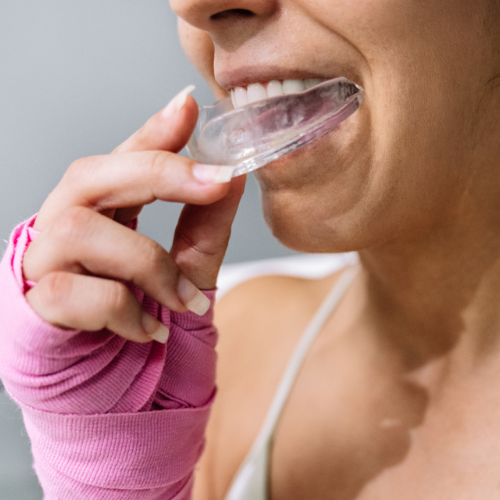
Solution: a lightweight mouthguard during high-intensity training (strength training, power sports) can protect enamel from this invisible wear.
Risk 5 — Competition cavities
Elite athletes frequently consume sugary products (energy gels, bars, drinks) during training and competition — often without the ability to brush their teeth immediately afterward. The combination of sugar + acidity + high frequency creates a significant cavity risk.
The mouthguard — custom-made or pharmacy?
This is the most common question among athletes starting a contact sport.
| Criterion | Pharmacy mouthguard (thermoformable) | Custom-made mouthguard (dentist) |
|---|---|---|
| Price | 5-20€ | 100-300€ |
| Fit | 🟡 Average | ✅ Perfect |
| Comfort | 🟡 Medium | ✅ Excellent |
| Protection | 🟡 Adequate | ✅ Optimal |
| Lifespan | 1 season | 2-3 seasons |
| Communication | ❌ Difficult with | ✅ Possible |
| Breathing | 🟡 Sometimes hindered | ✅ Not hindered |
Recommendation:
- Moderate-risk contact sports (soccer, basketball) → thermoformable acceptable
- High-risk contact sports (rugby, boxing, martial arts, hockey) → custom-made strongly recommended
- Wearers of orthodontic appliances → custom-made mandatory (thermoformable ones do not fit brackets)
The athlete’s dental routine — Practical adjustments
Before training
- Normal brushing if training is in the morning
- Hydrate with water — avoid acidic drinks before training
During exercise
- Water preferred for efforts < 90 minutes
- If using sports drinks: large quick sips, no continuous sipping
- Rinse with water between energy gels
After exercise — The critical moment
- Wait 30-60 minutes before brushing your teeth if acidic drinks were consumed
- Rinse with water or use a neutral mouthwash to remove sugary and acidic residue
- Full brushing + water flosser when you get home
- Rehydrate with water — not just sports drinks
The athlete dental checkup — Often neglected
Many sports federations recommend an annual oral health checkup for members, especially in contact sports. In France, the annual medical certificate for a sports license generally does not include a dental checkup — it is a voluntary step.
An annual dental checkup for a contact sport athlete allows you to:
- Detect enamel weaknesses before trauma occurs
- Have a custom mouthguard made if needed
- Identify erosion linked to sports drinks
- Treat cavities before they make wearing a mouthguard difficult
FAQ
Can you wear a mouthguard with orthodontic braces?
No for over-the-counter thermoformable mouthguards — they do not fit brackets. A custom-made mouthguard specifically designed for wearers of orthodontic appliances can be made by the dentist or orthodontist.
Are homemade isotonic drinks (water + salt + sugar) less harmful to teeth?
Yes, slightly. The pH of a homemade isotonic drink is generally less acidic than that of commercial drinks, which often contain citric or phosphoric acid. Their cavity risk remains high if consumed frequently.
Does running affect teeth?
Directly, not much — except through oral dehydration (heavy breathing) and sports drinks. Indirectly, some runners suffer from exercise-induced bruxism at high intensity. Direct trauma is rare except in falls.
Should you brush your teeth before or after sports?
Ideally both — before (to start with a clean mouth) and after (to remove exercise residue). If only one brushing is possible, brushing after exercise is the priority — waiting 30 to 60 minutes after acidic drinks.
Conclusion
Sport and dental health can go hand in hand with the right tools and habits. An appropriate mouthguard for contact sports, water-first hydration, delaying post-workout brushing by 30 minutes if acidic drinks were consumed, and an annual dental checkup: four actions that protect your enamel long-term, whatever your sport.
PureBrush Pro™ DentalPro Smile™ — for an effective 2-minute post-workout routine.
👉 dentalpro-smile.com/fr-fr
RELATED RECOMMENDED ARTICLES:
→ Article 15 : Bruxism — frequent exercise-induced bruxism in athletes
→ Article 18 : Nutrition and dental health — sports drinks
→ Article 5 : Sensitive teeth — sport-related erosion
Informational article only. It does not replace the advice of a dental surgeon. DentalPro Smile™ — 2026.

Leave a comment
This site is protected by hCaptcha and the hCaptcha Privacy Policy and Terms of Service apply.