
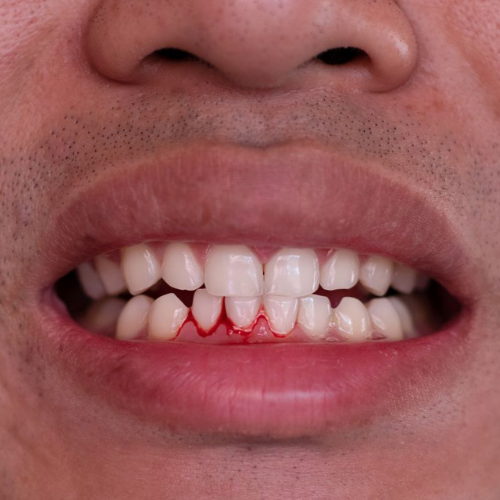
You spit blood after brushing. Maybe for a long time. Maybe so regularly that you ended up accepting it as normal.
It is not normal.
Healthy gums do not bleed. Ever. Not when brushing, not when chewing, and not spontaneously. Gum bleeding is always a sign of inflammation — and that inflammation has an identifiable cause and, in most cases, a solution that does not require an urgent dental appointment.
In France, nearly 50% of adults have some form of gum disease according to data from the Haute Autorité de Santé. It is the most common oral health condition — and one of the most undertreated. (Source: HAS — Periodontal diseases, epidemiological data)
Why do gums bleed? The real cause
Bacterial plaque — responsible in 95% of cases
The vast majority of gum bleeding cases have a common cause: the buildup of bacterial plaque at the junction between the tooth and the gum.
This plaque — an invisible bacterial biofilm — constantly accumulates on your teeth. If it is not removed within 24 to 48 hours, it triggers an inflammatory reaction in the gum tissue. The gum swells slightly, becomes engorged with blood, and bleeds at the slightest mechanical contact — brushing, in particular.
This process is called gingivitis — inflammation of the gums. It is the early, reversible stage of periodontal disease.
The pattern is as follows:
Plaque not removed (24-48h)
→ Gum inflammation (gingivitis)
→ Bleeding when brushing
→ If untreated: periodontitis
→ Bone destruction
→ Tooth loss
Aggravating factors
Plaque is the main cause, but several factors can worsen or speed up the process:
| Factor | Mechanism | Impact |
|---|---|---|
| Smoking | Masks inflammation and reduces gum blood flow | Worsens without visible symptoms |
| Pregnancy | Hormonal changes increase gum sensitivity | Common pregnancy gingivitis |
| Diabetes | High blood sugar promotes bacterial infections | Accelerated periodontitis |
| Medications | Certain antiepileptics, immunosuppressants, antihypertensives | Gum overgrowth |
| Vitamin C deficiency | Weakens the collagen in gum tissue | Easier bleeding |
| Chronic stress | Reduces local immunity | Easier gum infections |
The 3 stages of gum disease
Stage 1 — Gingivitis (reversible)
Signs: red, swollen gums that bleed when brushing. No pain in most cases. No bone destruction.
Good news: gingivitis is fully reversible by improving oral hygiene. In 2 to 4 weeks of a complete, consistent routine, bleeding decreases significantly.
Stage 2 — Mild to moderate periodontitis
Signs: bacteria have started destroying the tooth’s supporting tissues (periodontal ligament, alveolar bone). The gums slightly pull away from the teeth — forming "periodontal pockets". Slight tooth mobility is possible.
Treatment: requires professional treatment (deep cleaning below the gumline, root planing). Not reversible, but can be stabilized.
Stage 3 — Severe periodontitis
Signs: advanced bone destruction, marked tooth mobility, possible tooth loss. The leading cause of tooth loss in adults over 35 in France.
Treatment: periodontal surgery is necessary in advanced cases.
How to stop bleeding in 2 to 4 weeks — The protocol
Step 1 — Identify and remove plaque in critical areas
Gum bleeding happens precisely where plaque accumulates the most — between the teeth and in the gum sulcus. These areas cannot be reached with a toothbrush alone.
What you need to add to your routine immediately:
- Daily interdental cleaning (water flosser or dental floss)
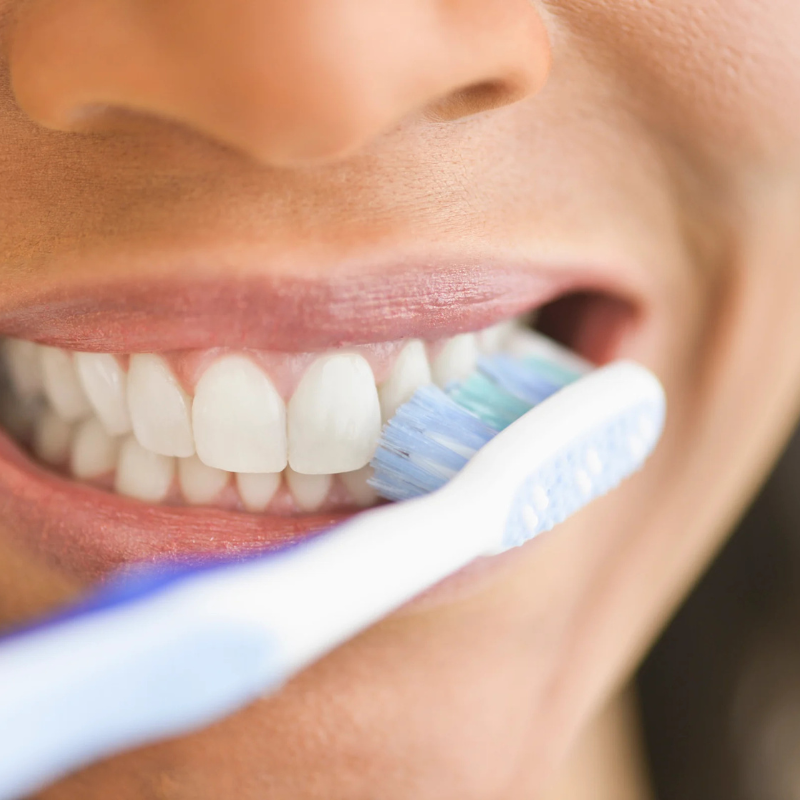
- Brushing correctly angled toward the tooth-gum junction at 45°
Step 2 — Do not stop brushing your teeth
This is the most common mistake: stopping or reducing brushing because the gums bleed. That is counterproductive. Bleeding disappears when plaque is removed — not when you stop disturbing it.
Keep brushing your teeth twice a day. If needed, use a "Sensitive" mode if you have an electric toothbrush.
Step 3 — Add the water flosser
The water flosser is particularly effective for bleeding gums because it removes subgingival plaque without traumatizing inflamed tissue. Start at the lowest pressure and gradually increase over 7 to 10 days.
Recommended daily routine:
| Time | Action | Duration |
|---|---|---|
| Morning | 2 min sonic brushing + 2 min water flosser | 4 min |
| Evening | 2 min sonic brushing + 2 min water flosser | 4 min |
Step 4 — Monitor progress
Day 7: normal reduction in bleeding of 30 to 50%
Day 14: significant reduction — less swollen gums
Day 28: bleeding nearly absent in cases of simple gingivitis
If bleeding persists after 4 weeks of a strict routine : see a dentist. It may be a periodontal stage that requires professional treatment.
Common myths about bleeding gums
"My brush is too hard — I need to brush less firmly"
False in most cases. The brush is not the cause of the bleeding — plaque is. Switching to a softer brush without improving interdental cleaning will not solve the problem.
"It’s hereditary, there’s nothing I can do"
A genetic predisposition to periodontal disease does exist, but it affects the speed of progression — not inevitability. Rigorous hygiene can control the disease even in genetically at-risk profiles.
"My gums bleed because I eat too many hard foods"
No. Healthy gums do not bleed when chewing, regardless of how hard the food is. If they bleed while chewing, they are already inflamed — and the cause is bacterial.
"Toothpaste for sensitive gums will fix the problem"
Partly. Some toothpastes based on amine fluoride or chlorhexidine have modest anti-inflammatory properties. But without mechanically removing plaque, no toothpaste can resolve gingivitis.
When should you see a dentist urgently?
| Sign | Urgency |
|---|---|
| Spontaneous bleeding (without brushing) | 🔴 Prompt appointment |
| Heavy bleeding that does not stop | 🔴 Emergency |
| Painful gums + fever | 🔴 Emergency — possible abscess |
| Loose tooth | 🟡 Appointment within the week |
| Persistent bleeding after 4 weeks of correct routine | 🟡 Recommended appointment |
| Light bleeding when brushing with no other signs | 🟢 Improve the routine — monitor |
FAQ
Can bleeding gums heal on their own?
Simple gingivitis can regress spontaneously if the cause (plaque) is removed. But without improving your hygiene routine, it will not go away on its own — and it may progress to a more advanced stage.
Can baking soda help bleeding gums?
Baking soda has mild antiseptic properties and can temporarily reduce oral acidity. It does not replace mechanical plaque removal. Used in excess, it can abrade enamel.
Is a chlorhexidine mouthwash effective against bleeding?
Chlorhexidine is the most well-documented oral antiseptic. It can reduce bacterial load and gum inflammation in the short term. Its use should not exceed 2 to 4 consecutive weeks because of the risk of tooth staining and disruption of the oral flora.
Can gum bleeding signal a general illness?
In rare cases, gum bleeding may be associated with clotting disorders, vitamin deficiencies (vitamin C, vitamin K), or certain systemic diseases. If the bleeding is heavy, spontaneous, and does not improve with better hygiene, a medical consultation is recommended.
Conclusion
Bleeding gums are a warning sign — not a fate. In 95% of cases, the cause is identifiable (bacterial plaque) and the solution is accessible (a complete hygiene routine including interdental cleaning).
The key: act now, not in 6 months at your next dental appointment. 2 to 4 weeks of a strict routine can transform the condition of your gums.
HydroJet Pro™ DentalPro Smile™ is specifically designed for profiles with sensitive or inflamed gums — 5 pressure levels, gentle pulsed spray, 300ml reservoir.
👉 dentalpro-smile.com/fr-fr
RECOMMENDED RELATED ARTICLES:
→ Article 2: Water flosser vs dental floss
→ Article 9: Dental tartar — how to prevent it
→ Article 16: Dental hygiene and diabetes — the little-known link
Informational article only. Does not replace the advice of a dentist. DentalPro Smile™ — 2026.


Leave a comment
This site is protected by hCaptcha and the hCaptcha Privacy Policy and Terms of Service apply.