
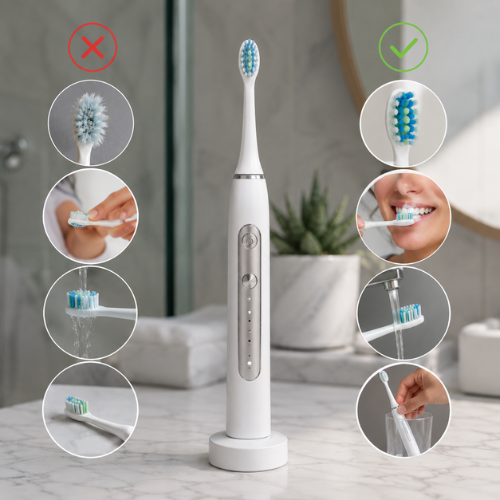
You invested in an electric toothbrush. You brush your teeth twice a day. And yet your dentist still keeps finding plaque, inflamed gums, and sometimes early tartar.
The problem is probably not your brush. It is how you use it.
An observational study of brushing habits among European adults found that more than 80% of electric toothbrush users make at least two to three technical errors that significantly reduce the effectiveness of their daily brushing. Some of these mistakes are counterintuitive — they seem logical, even recommended by common sense, but they contradict the available clinical data.
This guide reviews the 10 most common mistakes, explains why they are a problem, and gives you the exact correction to apply starting tonight.
Mistake 1 — Scrubbing instead of guiding
This is the number one mistake. And it is completely understandable: for decades, you have brushed your teeth using a scrubbing motion with a manual brush. Your muscle memory automatically repeats that motion with an electric toothbrush.
The problem: with a sonic or oscillating electric toothbrush, the working motion is generated by the motor — not by your wrist. The vibrations or oscillations do the cleaning. Your role is only to position and gently move the head from one tooth to the next.
Scrubbing as well does not improve cleaning. Worse: it can abrade enamel, irritate the gums, and reduce the hydrodynamic effect of the sonic brush by disrupting the vibratory flow in the oral fluid.
The correction: guide the brush head slowly from tooth to tooth — 2 to 3 seconds per tooth. Let the weight of the brush create the contact. Your arm only places the brush; it does not scrub.
Mistake 2 — Rinsing your mouth immediately after brushing
This one surprises most people — because rinsing after brushing seems like such a natural, unavoidable habit.
The problem: fluoride toothpaste releases fluoride ions that deposit on the enamel during and after brushing. These ions strengthen the crystal structure of enamel and inhibit cariogenic bacteria. This process takes time — about 30 minutes.
Immediate rinsing removes 90% of the active fluoride before it has time to do its protective work. You brush with a fluoride toothpaste but cancel out its benefits within 10 seconds.
The French National Authority for Health explicitly recommends spitting without rinsing after brushing. (Source: has-sante.fr — oral health prevention recommendations)
The correction: spit after brushing. Do not add water. Wait at least 30 minutes before drinking or rinsing. If you use mouthwash, use it before brushing — or wait 30 minutes after.
Mistake 3 — Pressing too hard on your teeth
The reflex is universal: the harder you press, the better you clean. That is true with a manual brush. It is false — and potentially dangerous — with an electric toothbrush.
The problem: excessive pressure with an electric toothbrush produces two negative effects at once. First, it mechanically abrades enamel with every brushing — enamel is hard but not indestructible, and this abrasion adds up over the years. Second, with a sonic brush, it disrupts the hydrodynamic effect by compressing the bristles against the surface and reducing the spread of vibrations through the oral fluid.
The correction: apply minimal pressure — the weight of the brush alone is enough. If your brush has a pressure sensor (red LED or sound signal), wait for it to stop before positioning properly. Try holding the brush between your thumb and index finger rather than in your fist — this grip naturally reduces the pressure applied.
Mistake 4 — Replacing the brush head too late
Most people replace their brush head when the bristles are visibly worn — flattened, splayed, discolored. By then, the head should have been replaced several weeks earlier.
The problem: the American Dental Association recommends replacement every 12 weeks — four times a year. Bristles that begin to spread sideways lose up to 30% of their cleaning effectiveness. They clean poorly while potentially irritating the gums more because of their lack of precise contact.
The bristles on a worn head no longer follow the correct contour of the teeth and gums. They "skip" over areas to be cleaned instead of conforming to them.
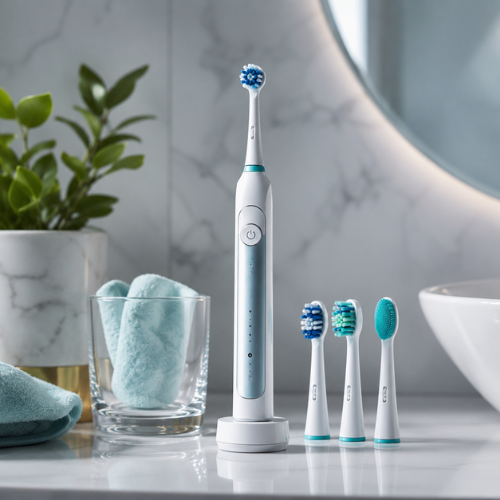
The correction: change the head every 12 weeks without waiting for visible wear. Mark the date on your calendar or use replacement heads in different colors to spot the change visually. Also replace it after any infectious illness (flu, sore throat) to avoid bacterial reinfection.
Mistake 5 — Not brushing for the full 2 minutes
Even with an electric toothbrush, brushing time remains a critical factor. And the reality is that most adults stop well before the recommended 2 minutes.
The problem: a 45- to 60-second brushing — the average time observed without a timer — consistently leaves areas uncleaned. The back molars, the inner surfaces of the teeth, and the tooth-gum line are the first to be neglected when time is short.
The correction: use the built-in timer on your brush. If it signals every 30 seconds (quadrant change), follow it strictly. The mouth is divided into 4 quadrants of 30 seconds each: upper right, upper left, lower right, lower left. If your brush does not have a timer, use your phone's stopwatch.
Mistake 6 — Always starting in the same place
An automatic and unconscious habit: you always start brushing in the same place — usually the upper front teeth or the molars on one side.
The problem: the areas brushed first always get the most attention and the most time. The areas brushed last — often the lower molars on the opposite side and the inner surfaces — consistently get less time and attention. Over months and years, tartar builds up and cavities appear in these neglected areas.
The correction: vary your starting point at each brushing. Sometimes start with the lower right molars, sometimes with the inner surfaces, sometimes with the lower left. This variation ensures that all areas receive equal attention over time.
Mistake 7 — Forgetting the inner surfaces of the teeth
This is the most neglected area of the mouth — and the one where tartar forms first. The lingual surfaces of the lower incisors (tongue side) are directly in front of the sublingual salivary glands, which speeds up plaque calcification.
The problem: instinctively, we brush the visible surfaces — the outer faces of the teeth, the ones we see in the mirror. The inner surfaces (tongue side and palate side) are less intuitive to reach and are often rushed through in a few seconds.
The correction: spend as much time on the inner surfaces as on the outer surfaces. For the lower incisors, tilt the brush head slightly downward and guide it slowly. Include the inner surfaces in your quadrant routine: for each quadrant, treat the outer surface, then the inner surface, then the chewing surfaces.
Mistake 8 — Not cleaning the brush head after use
The brush head is an ideal environment for bacterial growth: damp, warm, with food and toothpaste residue. A head that is not rinsed properly after each use develops bacterial colonies between brushings.
The problem: a contaminated brush head reintroduces bacteria into the mouth with every brushing. This is especially concerning if you recently had an oral infection (canker sore, sore throat, thrush).
The correction: rinse the head thoroughly under running water immediately after each use. Shake it to remove residual water. Store the brush head up in the open air — never in a closed case or covered glass that keeps moisture in and promotes growth. Never cover the head with a cap between brushings at home.
Mistake 9 — Using the same brushing mode for every situation
Your electric toothbrush offers several modes. And you always use the same one — usually the default or the most powerful mode.
The problem: different modes meet different needs. Sensitive mode is designed for inflamed or reactive gums — maximum-power Clean mode can worsen irritation in these cases. White mode is optimized for surface stains — using it all the time is unnecessary and can be more abrasive.
The correction: adapt the mode to your current situation. Sensitive mode when your gums are irritated or after dental treatment. Clean mode for standard daily brushing. White mode once or twice a week for stains. Gum Care if you have active gingivitis. Check your brush instructions to understand what each mode does.
Mistake 10 — Brushing immediately after an acidic meal
You come home from a restaurant, and you have had wine. Or you just finished your morning orange juice. Immediate reflex: brush your teeth.
The problem: acidic foods and drinks (fruit juice, soda, wine, vinegar) temporarily lower oral pH and soften enamel. In the 30 to 60 minutes after consuming an acidic food, enamel is in a state of temporary fragility — more vulnerable to mechanical abrasion.
Brushing during this window with an electric toothbrush — whose action is more intense than a manual brush — can abrade this temporarily softened enamel significantly more.
The intuitive solution many people choose — "I brush right after the meal to remove the acidity" — is exactly what can cause the most damage.
The correction: after an acidic meal or drink, rinse your mouth with plain water to dilute the acids. Wait 30 to 60 minutes before brushing your teeth. If you need to clean your mouth immediately, use a neutral mouthwash or simply water — not the brush.
Summary table of the 10 mistakes
| # | Mistake | Impact | Immediate correction |
|---|---|---|---|
| 1 | Scrubbing instead of guiding | Enamel abrasion, gum irritation | Guide slowly, 2-3 sec/tooth |
| 2 | Rinsing after brushing | Loss of active fluoride | Spit without rinsing — wait 30 min |
| 3 | Pressing too hard | Enamel abrasion, loss of hydrodynamic effect | Weight of the brush alone is enough |
| 4 | Head too old | -30% effectiveness | Change every 12 weeks |
| 5 | Less than 2 minutes | Uncleaned areas | Timer required |
| 6 | Always the same starting point | Chronically neglected areas | Vary the starting point |
| 7 | Forgetting inner surfaces | Preferential tartar buildup | Treat inside = outside |
| 8 | Head not rinsed | Bacterial cross-contamination | Rinse + air-dry after each use |
| 9 | Only one mode | Needs not matched | Adapt mode to the situation |
| 10 | Immediate post-acid meal brushing | Abrasion of softened enamel | Wait 30-60 min after acid |
Conclusion — Correcting these mistakes changes your results immediately
These 10 mistakes all have one thing in common: they can all be corrected immediately, without changing your brush, without spending an extra euro, and without fundamentally changing your routine.
Apply corrections 1, 2, and 3 starting tonight — they are the most impactful and the easiest to integrate. Then gradually add the others over the next two weeks until they become automatic.
Provided you have the right brush and use it correctly, results are visible in 7 to 14 days — smoother teeth, less sensitive gums, improved breath.
At DentalPro Smile™, our PureBrush Pro™ and NaturalBambou Pro™ brushes include a 2-minute timer with quadrant signal, pressure sensor, and 5 brushing modes adapted to every situation — to help you naturally avoid these mistakes every day.
Discover the DentalPro Smile™ range → Free delivery · 1-year warranty · Visible results in 7 days.
👉 dentalpro-smile.com/fr-fr
❓ FAQ
1. Do I really have to avoid rinsing after brushing — even with water?
Yes. Even rinsing with plain water removes a significant portion of the fluoride deposited by toothpaste. The official recommendation from the French National Authority for Health is to spit without rinsing. If the feeling of toothpaste in your mouth bothers you, choose a toothpaste with a more neutral taste — there are formulas made specifically for people who are worried about not rinsing.
2. How can I tell if I am pressing too hard with my electric toothbrush?
Several signs: your gums bleed regularly when brushing, you notice notches at the neck of the teeth (the tooth-gum junction), or the bristles of your brush head splay out quickly after a few weeks. If your brush has a pressure sensor, it activates when you exceed the recommended threshold — learn to respect that signal consistently.
3. Is it really necessary to change the head every 12 weeks if the bristles still seem fine?
Yes. The wear of the bristles on an electric toothbrush head is not always visible to the naked eye before a significant loss of efficiency has occurred. Standardized tests show that bristles that look visually fine at 16 weeks clean 20 to 30% less effectively than a new head. Twelve weeks is a preventive threshold — not a sign of visible wear.
4. Can I use my brush's White mode every day?
It is not recommended for long-term daily use. White mode generates vibrations or oscillations at a frequency or amplitude optimized to lift surface stains — which means an action that is slightly more abrasive than standard Clean mode. One to two uses per week is the frequency generally recommended for light to moderate staining.
5. If I ate something acidic in the morning, when can I brush my teeth?
Wait 30 to 60 minutes after consuming acidic foods or drinks (fruit juice, soda, coffee, yogurt, wine). During this window, you can rinse your mouth with plain water to dilute the acids and speed up the return of oral pH. If work constraints do not allow you to wait, rinse thoroughly and use the brush in a very gentle mode rather than doing nothing.
6. Should I brush my teeth before or after breakfast?
Both approaches have documented benefits. Brushing before breakfast removes overnight plaque before it comes into contact with the sugars in the meal — and avoids the problem of post-acid-meal brushing. Brushing after removes food debris. The main recommendation from French dentists is to brush after breakfast — but wait 30 minutes if the meal included acidic foods. The important thing is to brush twice a day without exception.
Sources:
— HAS — Oral health prevention recommendations: has-sante.fr
— American Dental Association — Brushing guidelines: ada.org
— Journal of Dental Hygiene — Toothbrushing technique and outcomes
— British Dental Journal — Fluoride retention after toothbrushing
— Journal of Clinical Dentistry — Pressure and toothbrush abrasion studies
Informational article only. Does not replace the advice of a dentist. DentalPro Smile™ — 2026.

Leave a comment
This site is protected by hCaptcha and the hCaptcha Privacy Policy and Terms of Service apply.