
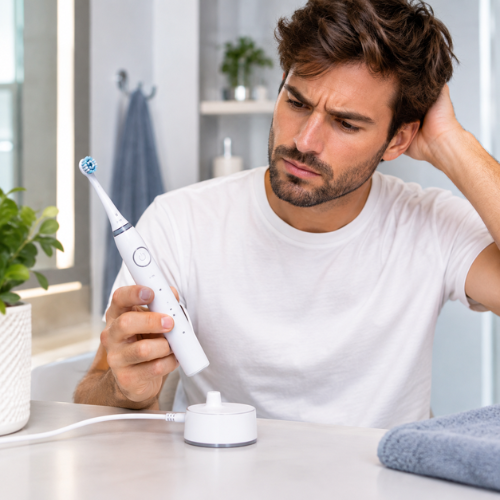
It's morning. You pick up your electric toothbrush. It's off. You place it on the charger. Nothing. No indicator light. No sound signal. Nothing.
First instinct: panic and order a new toothbrush.
Wrong reflex — in most cases.
Of the dozens of reports of electric toothbrushes "not charging" analyzed by major brands' after-sales service teams, more than 60% are simple issues that require no replacement. Dirty contacts, a faulty wall outlet, a poorly positioned charger, a triggered thermal protection.
This guide reviews the 8 most common causes of an electric toothbrush not charging — with the exact fixes to apply in order, from the simplest to the most complex.
Before anything else — The quick diagnosis in 5 questions
Before diving into the detailed causes, answer these 5 questions. They immediately point to the likely cause.
| Question | If YES | If NO |
|---|---|---|
| Does the toothbrush turn on when you press the button? | Battery not empty → charger problem | Battery completely drained or faulty |
| Does the charger's light turn on without the toothbrush? | Charger works → contact or toothbrush problem | Mains power or charger problem |
| Has the toothbrush been unused for more than 3 months? | Deep sleep mode likely → see cause 3 | Different cause |
| Has the toothbrush recently been dropped? | Possible internal damage → see cause 7 | Different cause |
| Has the charger recently changed (travel, new charger)? | Possible voltage incompatibility | Different cause |
Cause 1 — The wall outlet or power strip is faulty
This is the simplest cause — and the one most often ignored. Before diagnosing the toothbrush itself, check the power source.
Symptoms : no indicator light on the charger, no response from the toothbrush, problem appeared suddenly.
Check :
- Plug the charger into another wall outlet — not the same power strip
- Test another device on the same outlet (phone charger, lamp)
- If the power strip has a switch, make sure it is in the ON position
- Check that the bathroom circuit breaker has not tripped
Solution : if the outlet is faulty, switch outlets. If the breaker has tripped, reset it after unplugging the suspicious devices.
Likelihood this is the cause : 15 to 20% of reported cases.
Cause 2 — The contacts between the charger and the toothbrush are dirty
Inductive chargers (wireless, drop-on) and chargers with metal pins accumulate limescale, dried toothpaste, and corrosion on the electrical contacts. These deposits create electrical resistance that prevents power transfer.
Symptoms : the toothbrush was charging properly until recently, the charger's light works on its own but not with the toothbrush placed on it, visible white or brownish deposits on the contacts.
Check : look carefully at the charger's metal contacts and those at the bottom of the toothbrush handle. White traces (limescale) or brownish traces (light corrosion) are often visible.
Solution :
- Unplug the charger
- Soak a cotton swab in pure white vinegar
- Gently rub the charger's contacts
- Do the same on the toothbrush handle contacts
- Let it dry completely — at least 15 minutes
- Plug it back in and test
For more advanced corrosion, use a cotton swab lightly dampened with isopropyl alcohol (available at a pharmacy). Never pour liquid directly onto the contacts.
Likelihood this is the cause : 25 to 30% of reported cases.
Cause 3 — The battery is in deep sleep mode (deep discharge)
Lithium-ion batteries have a protection mechanism against complete discharge. When they drop below a certain critical threshold (usually 2.5V per cell), they enter deep sleep mode — a protective state that prevents standard charging to avoid irreversible damage.
This typically happens when the toothbrush has been stored unused for several weeks or months with a low battery, or when it fully discharged and stayed in that state.
Symptoms : the toothbrush does not turn on at all, it does not respond to the normal charger, it has not been used for a long time.
Solution — Slow recovery charging :
- Plug the toothbrush into its charger as normal
- Leave it plugged in for 24 to 48 hours without interruption
- Do not unplug it to test — recovery requires continuous charging
- After 24h, briefly test whether a light comes on
- If yes, continue until fully charged
- If not after 48h, the battery is definitely faulty
This slow recovery process works in about 40% of deep-discharge cases. If the toothbrush has been in this state for more than 6 months, the chances of recovery are lower.
Likelihood this is the cause : 15 to 20% of reported cases.
Cause 4 — The charger is faulty or damaged
The charger itself may be the cause of the problem — especially if it has been dropped, exposed to water, or simply failed internally after years of use.
Symptoms : the charger's light does not turn on at all even without the toothbrush on it, or the charger is visibly damaged (cut cable, cracked base, burned smell).
Check :
- Inspect the charger and its cable visually
- If the charger has its own LED light, check whether it turns on when plugged in alone
- If possible, test with a compatible charger from the same brand
Solution :
- If the charger is visibly damaged: stop using it — electrical hazard
- Order an official replacement charger (available on the manufacturer's website or from a specialist retailer)
- Never use an unofficial charger whose output voltage is not identical — risk of overheating or battery damage
Warning : inductive chargers (magnetic induction, without direct metal contact) may look identical to the naked eye but operate at different frequencies. A charger from another brand may seem compatible but be ineffective or damaging.
Likelihood this is the cause : 15 to 20% of reported cases.
Cause 5 — Thermal protection has triggered
Many modern electric toothbrushes include a thermal protection circuit that automatically cuts charging if the temperature exceeds a safe threshold. This system protects the battery from overheating — one of the main causes of premature lithium-ion failure.
Situations that trigger thermal protection :
- Charging in a very hot bathroom (after a hot shower, in summer)
- Charger placed against a radiator or heater
- Toothbrush left in the sun (car, windowsill)
- Partial short circuit in the charging circuit
Symptoms : the toothbrush was charging normally, then stopped abruptly or did not start after exposure to heat.
Solution :
- Unplug the charger
- Remove the toothbrush from the charger
- Let it cool to room temperature for 30 to 60 minutes in a cool, dry place
- Plug it back in and test
If thermal protection triggers regularly, check the charging environment — the bathroom should not exceed 35°C during charging for optimal lithium-ion battery use.
Likelihood this is the cause : 5 to 10% of reported cases.
Cause 6 — The toothbrush is in travel mode (travel lock)
Some premium electric toothbrushes have a travel mode (or transport lock) that disables the on/off button to prevent accidental activation in luggage. This mode can also affect charging on some models.
Symptoms : the toothbrush does not start and does not seem to charge, you have recently traveled or handled the toothbrush unusually.
Travel mode activation/deactivation by brand :
| Brand type | Deactivation procedure |
|---|---|
| Standard long press | Hold the button for 5 to 8 seconds |
| Double press | Press twice quickly then hold |
| Button combination | Refer to the specific user manual |
Check the user manual for your specific toothbrush — the procedure varies by model. If you no longer have the manual, search for the exact model name followed by "travel lock" or "travel mode" on the manufacturer's website.
Likelihood this is the cause : 5 to 10% of reported cases.
Cause 7 — Physical damage after a drop
A fall onto hard tile can misalign internal components, sever a soldered connection, or crack the battery housing — without any visible damage from the outside.
Symptoms : the charging problem appeared immediately after a drop, the toothbrush has visible cracks or deformities on the handle.
What you can do :
- If the toothbrush is under warranty (less than one year generally, 2 years under European law for hidden defects): contact the manufacturer's customer service and mention the defect — damage caused by a drop is generally not covered by the standard warranty, but some manufacturers offer exceptions.
- If out of warranty: the cost of repairing internal damage often exceeds the price of a new toothbrush. Replacement is usually the most economical solution.
Absolute safety rule : never try to open the handle of an electric toothbrush to inspect or repair internal components. The lithium-ion battery can be dangerous if damaged — risk of short circuit, overheating, or ignition.
Likelihood this is the cause : 5 to 10% of reported cases.
Cause 8 — The battery has definitively reached end of life
After 300 to 500 full charge cycles, a lithium-ion battery loses its ability to charge properly. This degradation is irreversible — it is the battery's natural end of life.
Symptoms : the toothbrush is more than 3 to 4 years old, battery life has gradually decreased over the last few months, the toothbrush now lasts only 1 to 2 days after a full charge, then not at all.
What you can do :
In the vast majority of consumer electric toothbrushes, the battery is not user-replaceable — it is soldered inside the sealed handle. A few manufacturers offer battery replacement through their customer service.
Cost of a battery replacement through customer service : generally 20 to 40€ labor + part. Compare that with the cost of a new toothbrush (40 to 80€) to decide whether replacement is economically justified.
Decision criterion :
- Toothbrush less than 2 years old: claim the warranty or contact customer service
- Toothbrush 2 to 4 years old: compare replacement cost vs. a new toothbrush
- Toothbrush more than 4 years old: full replacement is usually more sensible
The troubleshooting protocol — In the exact order
To maximize your chances of solving the problem without unnecessary expense, follow these steps in order.
Step 1 (2 minutes) : Test another wall outlet
Step 2 (5 minutes) : Clean the contacts with white vinegar + cotton swab
Step 3 (48 hours) : Attempt a long-duration recovery charge
Step 4 (1 minute) : Check and disable travel mode if applicable
Step 5 (30 minutes) : Let it cool if recently exposed to heat
Step 6 : Test with a replacement charger if available
Step 7 : Contact customer service if under warranty
Step 8 : Assess replacement vs repair based on the toothbrush's age
Prevention — How to avoid these problems in the future
Charging best practices
- Charge in an environment between 15°C and 25°C
- Do not leave the toothbrush plugged in all the time — recharge when the battery drops to 20-30%
- Use only the original official charger
- Store the charger away from excessive bathroom humidity
Storage best practices
- If you do not use the toothbrush for more than a month, store it with 40-50% battery
- Never store it with a completely empty battery
- Protect the handle from drops with a stable holder
Contact care best practices
- Wipe the charger and handle contacts monthly with a dry cloth
- Avoid direct contact of the charger with water or toothpaste
- Rinse the bottom of the handle (not the contacts) if toothpaste runs onto it
Conclusion — In 6 out of 10 cases, the problem can be fixed for free
Before replacing your electric toothbrush, spend 30 minutes following the troubleshooting protocol in this guide in order. In most cases, the problem is linked to dirty contacts, a faulty outlet, or a recoverable battery in deep sleep mode.
If after all these steps the toothbrush still does not work — and it is more than 3 years old — then it is indeed time to invest in a new model. A toothbrush whose battery has reached end of life no longer cleans properly, even when it seems to work.
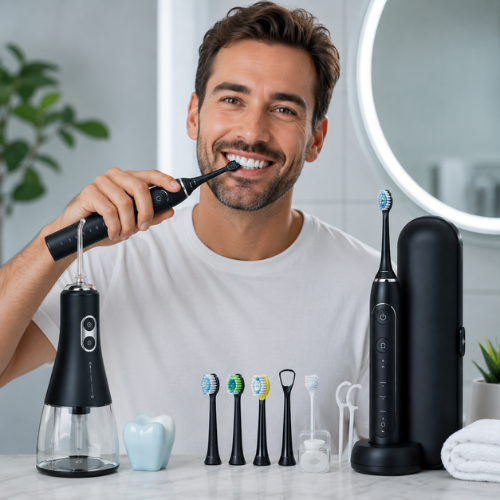
At DentalPro Smile™, our PureBrush Pro™ and NaturalBambou Pro™ toothbrushes come with a 1-year warranty and responsive customer support for any technical issue. Our replacement heads and accessories are always available.
Discover the DentalPro Smile™ range → Free delivery · 1-year warranty · Customer support available.
👉 dentalpro-smile.com/fr-fr
❓ FAQ
1. Can I use a universal wireless charger (Qi) to charge my electric toothbrush?
No — unless your toothbrush is explicitly compatible with the Qi standard, which is very rare. Electric toothbrush inductive chargers operate at a specific frequency and power, different from the Qi standard used by phones. A universal Qi charger will not deliver the correct charge and could damage the battery or simply do nothing. Use only the charger supplied with your toothbrush or an official replacement from the same brand.
2. The charging light flashes but the toothbrush does not charge — what should I do?
A flashing light has a specific meaning that varies by brand and model. It may indicate: a temperature error (thermal protection triggered), a battery at end of life that can no longer accept a charge, an intermittent contact problem, or simply that charging is taking place at very low intensity (recovery of a deeply discharged battery). Consult the user manual for your specific model to decode the flashing pattern.
3. My electric toothbrush heats up while charging — is that normal?
A slight warming of the handle during charging is normal — lithium-ion batteries generate heat during the charging process. However, if the handle becomes hot to the touch (hard to hold), or if you smell anything unusual, unplug it immediately and contact the manufacturer's customer service. Abnormal overheating may signal a fault in the battery or charging circuit.
4. Does the warranty cover battery problems?
The legal warranty in France (2 years for hidden defects, according to the European directive) covers conformity defects — including battery manufacturing defects. A natural decline in battery life after 2 to 3 years of normal use is generally not considered a covered defect. However, a battery that completely refuses to charge after less than one year of normal use may be covered — contact customer service and keep your proof of purchase.
5. How long should you charge an electric toothbrush for the first use?
Most manufacturers recommend a full initial charge before first use — generally 16 to 24 hours depending on the model. This long initial charge is not always essential with modern lithium-ion batteries (unlike older NiMH batteries), but it helps calibrate the battery level indicator and ensures the battery starts at maximum capacity.
6. My new toothbrush does not charge — what should I do?
If a new toothbrush does not charge on first use, it may be a deeply discharged battery after warehouse storage (solution: 24-48h recovery charge), a faulty charger supplied with the product, or a manufacturing defect. In all cases, a new non-working toothbrush is covered by the legal warranty. Contact the retailer or manufacturer immediately with your proof of purchase for a replacement.
Sources :
— Battery University — Lithium-ion battery care and maintenance : batteryuniversity.com
— DGCCRF — Legal consumer warranty in France : economie.gouv.fr
— IEC 62133 — Safety requirements for portable sealed secondary lithium cells
— Consumer Reports — Electric toothbrush troubleshooting
— ADEME — Lithium battery recycling guide : ademe.fr
Informational article only. Does not replace the advice of a specialized technician. DentalPro Smile™ — 2026.

Leave a comment
This site is protected by hCaptcha and the hCaptcha Privacy Policy and Terms of Service apply.