
Between the teeth. That is where most cavities and gum disease develop in adults.
And that is exactly where your toothbrush — even electric, even sonic — physically cannot reach. Interdental spaces account for around 40% of total tooth surfaces. Leaving them without daily cleaning means ignoring nearly half of your mouth.
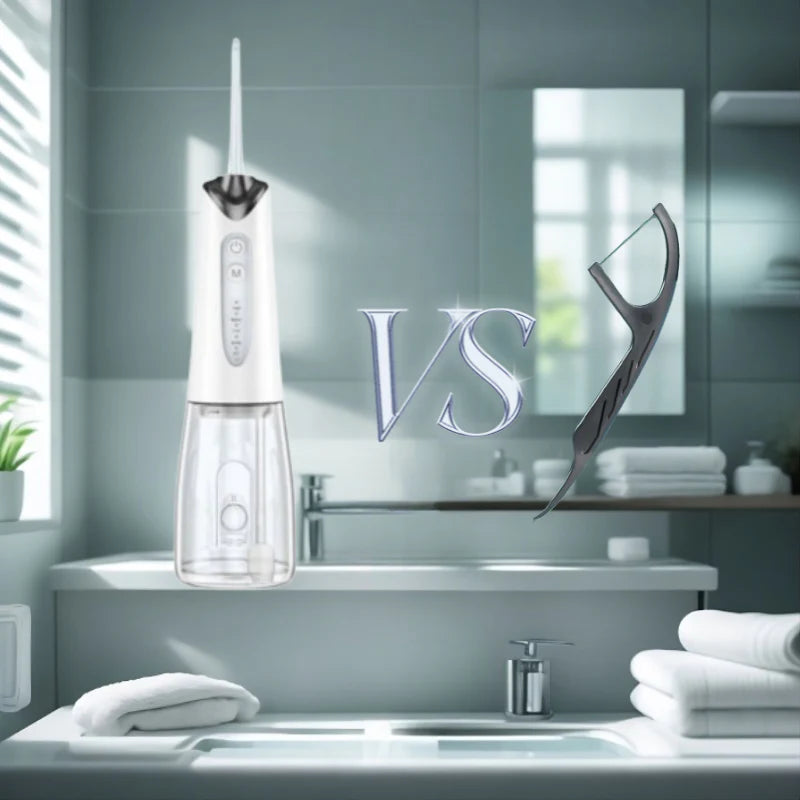
Two tools compete to cover these areas: dental floss, used for decades, and the water flosser (oral irrigator), a more recent technology that gains new followers in France every year.
Which one should you choose? The answer depends on your profile — and the available clinical studies provide clear answers.
How does dental floss work?
Dental floss works through direct mechanical contact. By sliding the floss between two teeth and curving it around each tooth to reach slightly under the gumline, you mechanically dislodge plaque through friction.
The correct technique in 6 steps:
- Cut about 40 cm of floss
- Wrap most of it around your middle fingers — keep only 2-3 cm active
- Guide the floss between two teeth with your thumbs and index fingers
- Form a "C" around the first tooth — go slightly below the gumline
- Move back up, scraping the tooth surface
- Form the "C" around the second tooth again — repeat
- Use a clean section of floss for each space
The reality: this technique, when done correctly, is effective. But studies show that fewer than 30% of people who use dental floss do so with proper technique. Most simply move it back and forth between the teeth — which is not enough to reach below the gumline.
How does a water flosser work?
A water flosser works by propelling a fine, targeted jet of water or irrigating solution at high pressure, directed between the teeth and along the gumline to remove food residue, dental plaque, and hard-to-reach debris.
The water pressure creates a simultaneous rinsing and mechanical lifting effect — without direct contact with the gum tissue, which makes it especially suitable for sensitive or inflamed gums.
The correct technique in 5 steps:
- Fill the reservoir with lukewarm water (never cold if gums are sensitive)
- Start at the lowest pressure — increase gradually
- Lean over the sink, mouth slightly open
- Aim the nozzle at 90° toward the tooth-gum junction
- Follow the gumline of each tooth — 2 to 3 seconds per space
The objective comparison — What the studies say
| Criterion | Dental floss | Water flosser |
|---|---|---|
| Plaque reduction | ✅ Effective if technique is correct | ✅ Effective |
| Gingivitis reduction | ✅ Documented | ✅ Superior according to several studies |
| Below-the-gumline area | 🟡 Difficult without perfect technique | ✅ Reaches it naturally |
| Braces wearers | ❌ Very difficult | ✅ Ideal |
| Bridge wearers | ❌ Bridge threader required | ✅ Simple |
| Dental implants | 🟡 Possible with caution | ✅ Recommended |
| Ease of use | ❌ Technique to learn | ✅ Intuitive |
| Consistency of use | 🔴 Often abandoned | ✅ Better adherence |
| Initial cost | ✅ Low (2-5€) | 🔴 Higher (40-100€) |
| Annual cost | 🔴 Recurring (floss) | ✅ Water only |
A review of studies published in the Journal of Clinical Periodontology showed that using a water flosser together with brushing reduces gingivitis in a statistically significant way compared with brushing alone — and compared with brushing + dental floss in some cases. (Source: Journal of Clinical Periodontology — systematic review on interdental cleaning)
Water flosser vs dental floss depending on your profile
Profile 1 — Bleeding gums
Recommendation: Water flosser
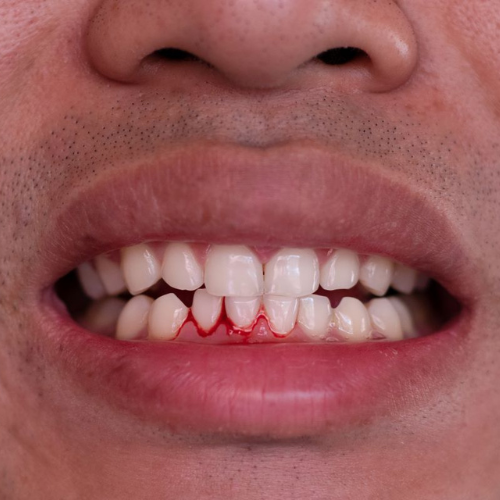
Bleeding signals inflammation. The water flosser removes plaque without traumatizing inflamed gum tissue. Dental floss, when used incorrectly on inflamed gums, can worsen bleeding and discourage the habit.
Expected results with a water flosser: significant reduction in bleeding within 2 to 4 weeks of daily use.
Profile 2 — Wearer of fixed orthodontic braces
Recommendation: Water flosser — essential
Flossing with braces is time-consuming (5 to 10 minutes), tedious, and often abandoned after a few weeks. The water flosser cleans around brackets and under wires in 2 to 3 minutes. For this profile, a water flosser is not an option — it is a necessity.
Profile 3 — Bridge or implant wearer
Recommendation: Water flosser
Under a bridge, access with dental floss requires a specific floss threader. The water flosser naturally reaches these difficult areas. Around implants, a gentle-pressure jet is recommended by many periodontists.
Profile 4 — Person without any particular dental issue
Recommendation: Water flosser OR dental floss — consistency comes first
For an adult without a specific issue who has used dental floss correctly for years and does not want to change habits: dental floss is perfectly effective. If they struggle to stay consistent or to master the technique: the water flosser will be more effective in practice.
Profile 5 — Very tight budget
Recommendation: Charcoal-infused dental floss
Dental floss remains the least expensive option. Charcoal floss provides an additional benefit for staining and freshness. If the budget allows for the investment in a water flosser, the return on investment in preventing dental treatment can be calculated over 2 to 3 years.
Can you combine both?
Yes — and it is the optimal strategy for complex cases.
| Profile | Dental floss | Water flosser |
|---|---|---|
| Healthy mouth, simple routine | ✅ Enough on its own | Optional |
| Sensitive gums | ❌ Replaced by | ✅ |
| Braces or bridges | ❌ Not enough on its own | ✅ Essential |
| Complex profile (implants + gums) | 🟡 As a supplement | ✅ Main tool |
Misconceptions to correct
"A water flosser damages the gums"
False, if used correctly. At the recommended pressure (low at first, increased gradually), a water flosser does not traumatize gum tissue. Excessive pressure can irritate — which is why it is important to start at the minimum setting.
"Dental floss is more effective because it really scrapes"
Partly true — floss mechanically scrapes the tooth surface. But this action depends entirely on technique, which 70% of users do not have. The water flosser depends less on technique to achieve a correct result.
"A water flosser replaces brushing"
No. A water flosser cleans interdental and below-the-gumline spaces. It does not replace brushing the tooth surfaces — these two actions are complementary, not interchangeable.
FAQ
How often should you use a water flosser?
Once a day, ideally in the evening after brushing, gives the best results. Some profiles (brace wearers, very inflamed gums) may benefit from using it morning and evening during the first few weeks.
Can you put mouthwash in the water flosser?
Yes, some water flossers can take a diluted solution (mouthwash + water). Check the manufacturer's recommendations. Water alone is effective for most profiles.
Is a water flosser suitable for children?
Generally not recommended before age 6. Between ages 6 and 12, use is possible under parental supervision at the minimum pressure. After age 12, standard adult use.
How long does a quality water flosser last?
A quality water flosser generally lasts 3 to 5 years with proper maintenance (emptying the reservoir after each use, monthly cleaning of the nozzle). Replacement nozzles should be changed every 3 to 6 months.
Conclusion
The water flosser vs dental floss debate does not have a universal answer — it has a personalized one.
For the majority of French adults who struggle to maintain regular flossing, or who wear orthodontic appliances, bridges, or implants: the water flosser is superior in real-life practice. Not because it is technologically better in absolute terms, but because an imperfect technique applied regularly beats a perfect technique applied irregularly.
Interdental cleaning remains the most impactful preventive step after brushing — whichever tool you choose.
Discover the HydroJet Pro™ DentalPro Smile™ — IPX7 water flosser usable in the shower, 5 pressure levels, 300ml reservoir.
👉 dentalpro-smile.com/fr-fr
RECOMMENDED RELATED ARTICLES:
→ Article 1: Choosing your adult electric toothbrush
→ Article 3: Bleeding gums — causes and solutions
→ Article 13: Brushing with fixed orthodontic braces
Article for informational purposes only. Does not replace the advice of a dental surgeon. DentalPro Smile™ — 2026.

Leave a comment
This site is protected by hCaptcha and the hCaptcha Privacy Policy and Terms of Service apply.