
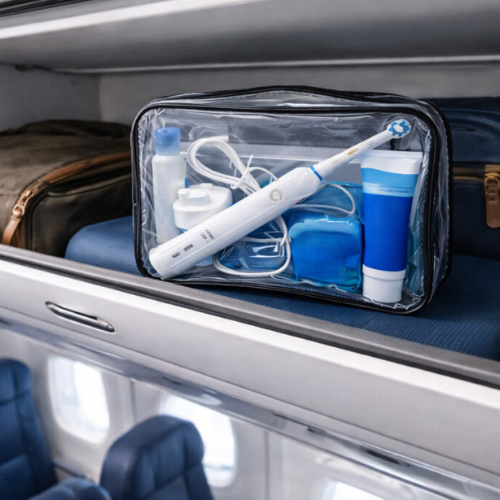
The bag is packed. The ticket is printed. And when you’re about to slip your electric toothbrush, water flosser, aligner, and mouthguard into your luggage, you realize you don’t know exactly what’s allowed, what can go in the cabin, and how to keep up your routine without your usual ultrasonic cleaner.
Travel is no excuse to give up oral hygiene — but it does require specific preparation. Especially when you wear an Invisalign aligner (22h/24 required), a night guard for bruxism, or a dental appliance that needs daily care.
This guide covers every situation — from a quick weekend away to long-haul travel, from a car trip to an intercontinental flight.
The electric toothbrush on a plane — The exact rules
In carry-on luggage
The electric toothbrush is allowed in carry-on luggage on almost all airlines. There is no international regulation banning it.
What to check:
- The built-in lithium-ion battery is generally allowed if the capacity is under 100 Wh (which is the case for all consumer electric toothbrushes)
- Replacement brush heads are allowed without restriction
Practical precaution: remove the brush heads and store them separately to prevent them from turning on accidentally in the bag. Or use the travel case included with most sonic toothbrushes.
Liquids in the cabin
The 100ml rule applies to your toothpaste. A 75ml travel toothpaste tube is fine. Above 100ml, it must go in checked baggage.
Travel alternative: solid toothpaste tablets or toothpaste tabs are exempt from the liquids rule — they can go in the cabin with no quantity restriction.
The plug adapter
Most modern sonic toothbrush chargers work on universal 100-240V. Check the marking on your charger. If so, you only need a plug adapter (type C, G, I, etc.) depending on your destination — not a voltage converter.
| Destination | Plug type | Voltage |
|---|---|---|
| Continental Europe | Type C or E | 230V ✅ |
| United Kingdom | Type G | 230V ✅ |
| USA / Canada | Type A/B | 120V — check charger |
| Australia | Type I | 230V ✅ |
| Japan | Type A | 100V — check charger |
The water flosser while traveling
Standard water flosser
Standard water flossers (with a 200-300ml tank) can go in checked baggage without any problem. In the cabin, an empty reservoir passes without restriction.
Travel solution: empty the reservoir completely before bringing it into the cabin. Security staff may ask to confirm that it is empty.
Travel water flosser
There are compact models specifically designed for travel, with:
- 150 to 200 ml reservoir
- Cabin-friendly dimensions
- USB power (charges via power bank)
- Reduced weight (150-250g)
These models are the best compromise for frequent travelers.
The Invisalign aligner while traveling — The right protocol
The main challenge of traveling with an aligner
Without your ultrasonic cleaner, how can you keep the aligner effectively clean?
Solution 1 — Travel cleaning tablets
Effervescent cleaning tablets (FreshTab Pro™ or equivalent) are the ideal travel solution. They take up no space, can go in the cabin with no restrictions, and provide effective disinfection in 15 to 20 minutes.
Travel aligner protocol:
Morning:
1. Remove the aligner
2. Tablet in a glass of lukewarm water — 15 min
3. Rinse thoroughly
4. Brush your teeth
5. Put the aligner back in

Evening:
1. Same protocol
2. Rinse the case with hot water
3. Keep the aligner in clean water overnight
Solution 2 — Gentle brushing with water only
If you don’t have tablets, gently brushing the aligner with a dedicated brush and lukewarm water removes surface biofilm. Not enough on its own for several days, but acceptable for 1 to 2 days.
What to do if you lose your aligner while traveling?
- Contact your orthodontist immediately
- While waiting for a solution, wear the previous aligner (if you kept it) to maintain the position
- As a last resort, wear the next one only if your orthodontist authorizes it
- Do not stop wearing it for several days without a solution — teeth move faster than you think
The night guard while traveling
Transport
The night guard in its hard case can go in the cabin with no restrictions.
Tip: never put the night guard in a bag without a hard case — it can be crushed, bent, or lost.
Care on the go
Same protocol as the aligner: effervescent cleaning tablets in the evening, rinse with lukewarm water in the morning.
Warning: never rinse the night guard with hot water in the hotel bathroom — tap temperatures can vary and exceed 45°C, which can warp the resin.
The dental appliance while traveling
Transport
The appliance in its storage glass or case can travel without restriction.
Tip: always have a dedicated hard case for the appliance when traveling — hotel glasses can be fragile or unsuitable.
Care on the go
Cleaning tablets are the ideal solution — light, effective, no cabin restrictions.
Simplified travel protocol:
- Tablet in a glass of lukewarm water at night (15-20 min)
- Thorough rinse
- Store in a glass of clean water overnight
The ideal travel dental kit — What to pack
Short trip kit (1 to 4 days)
| Product | Travel size |
|---|---|
| Sonic toothbrush | Standard model with case |
| Toothpaste | 75ml tube or solid tablets |
| Floss / portable water flosser | Travel floss or compact flosser |
| Cleaning tablets | 5 to 8 tablets in a sachet |
| Breath spray | Mini 15ml bottle |
| Appliance/aligner case | Rigid case |
| Universal plug adapter | If outside Europe |
Long trip kit (1 week and more)
Add to the short kit:
- Replacement brush heads (if > 3 months)
- Compact USB water flosser
- Interdental brushes (if braces)
- Toothpaste 100ml max or tablets in quantity
- Mini ultrasonic cleaner (ultra-compact models available)
Special situations
Long overnight flight (> 6 hours)
On an overnight flight, mouth drying is accelerated (very dry pressurized air) and saliva decreases. Recommendations:
- Remove the aligner if possible during the night (check with your orthodontist)
- Hydrate frequently (water, not alcohol)
- Brush your teeth before falling asleep and upon landing
Camping and areas without electricity
- Battery-powered toothbrush or long-battery-life sonic toothbrush
- Toothpaste tablets
- Cleaning tablets (no hot water needed — room-temperature water is enough)
- Emergency floss kit
Countries with non-potable water
- Never fill the water flosser or rinse the aligner with local tap water if it is not potable
- Use bottled water to rinse dental devices
- Cleaning tablets also work with bottled water
FAQ
Can an electric toothbrush go in the cabin in the United States (TSA)?
Yes. The TSA (Transportation Security Administration) explicitly allows electric toothbrushes in carry-on luggage. Always check the TSA rules updates on tsa.gov before you leave.
What should I do if my electric toothbrush stops working while traveling?
Having a backup manual toothbrush in the kit is always recommended. Most international pharmacies sell emergency manual toothbrushes. For frequent travelers, bringing a sonic toothbrush with good battery life (30 days) reduces this risk.
Can you travel with a full dental appliance in the cabin?
Yes, without restriction. The appliance in its case can go in the cabin and checked baggage without any problem.
How do you handle jet lag when wearing an aligner?
Keep your goal of 22 hours of wear per 24 hours — the reference time zone doesn’t matter. What matters is the total daily wear time.
Conclusion
Travel does not mean giving up oral hygiene. With a suitable kit and a few simple adjustments, you can keep up a full routine anywhere in the world — in the cabin or in checked baggage, in a five-star hotel or under a tent.
The key: plan ahead, bring alternative solutions (tablets, compact toothbrush, spray), and never improvise with an aligner or night guard that your teeth’s health depends on.
The DentalPro Smile™ travel kit — FreshTab Pro™ & PureSpray Pro™, cabin-compatible travel format — for perfect hygiene anywhere in the world.
👉 dentalpro-smile.com/fr-fr
RECOMMENDED RELATED ARTICLES:
→ Article 4: Cleaning your Invisalign aligner
→ Article 15: Bruxism and night guard
→ Article 7: Dental appliance care
Informational article only. It does not replace the advice of a dentist. DentalPro Smile™ — 2026.

Leave a comment
This site is protected by hCaptcha and the hCaptcha Privacy Policy and Terms of Service apply.