
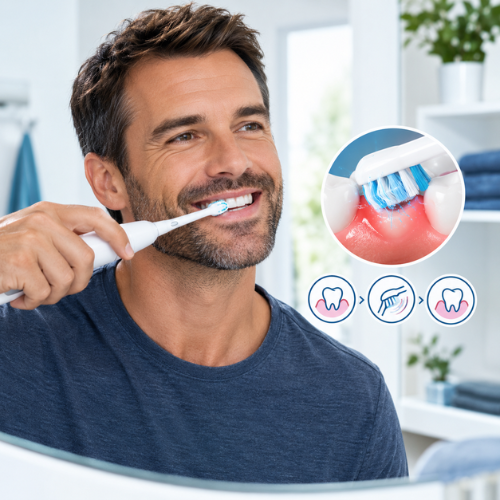
Your gums bleed when you brush your teeth. You cut back on brushing frequency to "let them heal." The bleeding continues.
That’s the most common gingivitis trap — and one of the most well-documented mistakes in oral hygiene.
Bleeding gums don’t need less brushing. They need more effective brushing, better targeted, in the right areas, with the right tool.
The sonic electric toothbrush — used with the right technique and the right mode — is the most effective over-the-counter tool available to reduce gingival bleeding linked to gingivitis. Clinical studies show a significant reduction in bleeding in 2 to 4 weeks.
This guide explains the exact mechanism, the protocol to follow, and what to expect week by week.
Why gums bleed — The full mechanism
To understand how the electric toothbrush reduces bleeding, you first need to understand why it happens.
The real cause of gingival bleeding
In 95% of cases, bleeding gums while brushing indicate gingivitis — inflammation of the gums caused by the buildup of bacterial plaque at the tooth-gum junction.
Here is the full mechanism:
Unremoved bacterial plaque
→ Build-up in the gum sulcus (0-3mm below the gumline)
→ Inflammatory reaction in the gum tissue
→ Local vasodilation (increased blood flow)
→ Swollen, red, highly vascularized gum tissue
→ Less mechanical contact → bleeding
→ You brush less
→ More plaque builds up
→ Inflammation increases
→ Bleeding worsens
It’s a classic vicious cycle. And the way out is counterintuitive: brush the inflamed areas more effectively — not avoid them.
Why plaque builds up in the gum sulcus
The gum sulcus is the 1 to 3 mm space between the tooth and the free edge of the gum. It’s an anatomically difficult area to clean — no manual toothbrush can physically reach it deeply.
Plaque that accumulates there is protected from superficial cleaning. Without regular disruption, it calcifies into subgingival tartar in 24 to 72 hours, sustaining chronic inflammation.
How the sonic electric toothbrush acts on bleeding — The 3 mechanisms
Mechanism 1 — Plaque removal through the hydrodynamic effect
The sonic toothbrush generates turbulence in the oral fluid that spreads into the gum sulcus — reaching plaque in the first 1 to 2 millimeters of the sulcus without direct physical contact. This partial subgingival action, documented clinically, is absent with manual toothbrushes and rotary brushes.
What this means for bleeding: by reaching plaque in the gum sulcus — the main source of inflammation — the sonic toothbrush directly targets the cause of bleeding, not just the symptoms.
Mechanism 2 — Sensitive mode protects tissues during the acute phase
Inflamed gums are fragile, highly vascularized tissues. Too much mechanical contact can traumatize these tissues and temporarily worsen inflammation.
Sensitive mode on a sonic toothbrush reduces vibration frequency and amplitude to 60-70% of standard power — delivering effective cleaning action on fresh plaque without traumatizing inflamed gum tissue.
This combination — partial subgingival hydrodynamic action + reduced intensity — makes it possible to clean inflamed areas without making them worse.
Mechanism 3 — The timer ensures complete coverage
A very common mistake among people with bleeding is brushing faster to minimize painful contact — further reducing cleaning effectiveness in critical areas.
The electric toothbrush timer enforces a full 2 minutes, with quadrant signals every 30 seconds. This forced structure ensures that each area receives equal attention — including the areas that bleed and that the user would tend to avoid.
What the clinical studies say
Several randomized clinical studies have evaluated the impact of the sonic toothbrush on gingivitis and gingival bleeding.
A meta-analysis published in the Cochrane Database of Systematic Reviews comparing sonic and manual toothbrushes across several studies documented a statistically significant reduction in gingival bleeding indices in favor of the sonic toothbrush at 3 months. (Source: Cochrane Database — powered toothbrushes for oral health)
A comparative study published in the Journal of Clinical Periodontology specifically evaluated the impact of Sensitive mode on patients with mild to moderate gingivitis. Results showed a 30 to 45% reduction in gingival index in 4 weeks of daily use with proper technique. (Source: Journal of Clinical Periodontology — sonic toothbrush gingival bleeding)
What these studies do not say: they evaluate the sonic toothbrush under optimal use conditions — proper technique, daily frequency, 2 minutes per session. Real-world results vary depending on individual adherence.
The exact protocol — Week by week
Phase 1 — Weeks 1 and 2: Sensitive mode only
What you do:
Morning:
→ Sonic toothbrush in SENSITIVE mode — 2 minutes
→ 45° angle toward the gumline — held strictly
→ Pressure: only the weight of the brush
→ Spit without rinsing

Evening:
→ Sonic toothbrush in SENSITIVE mode — 2 minutes
→ + Water flosser in GENTLE mode — 2 minutes
   (start at the lowest pressure)
→ Spit without rinsing
What happens during these 2 weeks:
| Day | Normal progression |
|---|---|
| D1 to D3 | Possible slight increase in bleeding — NORMAL |
| D4 to D7 | Bleeding starts to decrease — 20 to 30% reduction |
| D8 to D14 | Significant reduction — 40 to 60% reduction |
The critical point of D1-D3: a slight increase in bleeding in the first few days is normal and does not mean the brush is making the problem worse. Pre-existing plaque is dislodged, creating a more intense temporary inflammatory response before improvement sets in. Do not stop.
Phase 2 — Weeks 3 and 4: Transition to Clean
What you do:
Morning:
→ SENSITIVE mode or attempt CLEAN MODE depending on comfort
→ 2 minutes
→ Water flosser if available

Evening:
→ SENSITIVE or CLEAN mode depending on gum condition
→ 2 minutes
→ Water flosser in gentle to moderate mode — 2 minutes
What happens:
- Bleeding nearly absent in cases of simple gingivitis
- Gums visibly less swollen
- Gum color more healthy pink (vs inflamed red)
- Noticeably cleaner teeth throughout the day
Phase 3 — Starting month 2: Maintenance
What you do:
Morning:
→ CLEAN mode — 2 minutes
→ Water flosser or dental floss

Evening:
→ CLEAN or GUM CARE mode (alternating)
→ Daily water flosser
At this stage, your routine is maintenance — not active treatment. If bleeding returns occasionally (after a very heavy meal, a period of stress), temporarily switch back to Sensitive mode for a few days.
The 5 mistakes that prevent bleeding from resolving
Mistake 1 — Stopping brushing on the bleeding areas
This is the most common and most harmful mistake. Plaque builds up in the unbrushed areas, worsens inflammation, and makes bleeding worse over time.
The rule: brush all areas — especially the ones that bleed. In Sensitive mode, brushing does not traumatize inflamed tissues.
Mistake 2 — Switching to a "softer" manual toothbrush instead of using the electric in Sensitive mode
A manual toothbrush, even a very soft one, does not generate a subgingival hydrodynamic effect. It only cleans the surfaces it physically touches — without reaching the gum sulcus where inflammatory plaque accumulates.
Mistake 3 — Neglecting the water flosser
Interdental spaces are often the main source of gingival inflammation — because they are inaccessible to the brush. Without a daily water flosser or dental floss, the brush alone cannot resolve gingivitis linked to interdental plaque.
Mistake 4 — Rinsing after brushing
Immediate rinsing removes the protective fluoride before it can strengthen enamel and provide its mild antibacterial action. Spit — do not rinse.
Mistake 5 — Giving up after D1-D3 if bleeding increases slightly
This slight initial worsening is a sign that the brush is reaching areas that had not been cleaned for a long time. It rarely lasts more than 3 to 5 days — and is followed by clear improvement.
What you can expect — Realistic results by profile
| Profile | Estimated resolution time | Conditions |
|---|---|---|
| Mild gingivitis, poor hygiene | 7 to 14 days | Protocol followed + water flosser |
| Moderate gingivitis, frequent bleeding | 14 to 28 days | Strict protocol + daily water flosser |
| Chronic gingivitis > 1 year | 3 to 6 weeks + professional scaling | Hygiene + consultation needed |
| Periodontitis (bone loss) | Not solvable on its own | Professional periodontal treatment required |
| Pregnancy-related bleeding | Improvement with hygiene but possible persistence | Consultation recommended |
| Smoking-related bleeding | Slower (smoking masks inflammation) | Enhanced hygiene + consultation |
When bleeding requires urgent dental care
The electric toothbrush can resolve simple gingivitis. But some situations absolutely require a professional.
| Sign | Urgency | Action |
|---|---|---|
| Spontaneous bleeding (without contact) | 🔴 Urgent | Appointment within 48h |
| Heavy bleeding that does not stop | 🔴 Urgent | Emergency care if needed |
| Pain + fever + localized swelling | 🔴 Urgent | Possible abscess — emergency care |
| Loose tooth | 🟡 Quick | Appointment within the week |
| Persistent bleeding after 4 weeks of protocol | 🟡 Quick | Consultation + scaling |
| Frequent recurrence despite good hygiene | 🟡 Normal | Periodontal evaluation recommended |
The role of the water flosser as a supplement — Essential for gums
The sonic toothbrush alone, even in Sensitive mode with perfect technique, cannot clean interdental spaces — where inflammatory plaque tends to accumulate.
The water flosser is the essential add-on for people with gingival bleeding. It directly irrigates the interdental gum sulcus with a controlled stream of water — removing plaque from areas inaccessible to the brush.
The optimal combination for bleeding:
Sonic toothbrush in Sensitive mode (surfaces)
+
Water flosser in gentle mode (interdental spaces)
=
Complete coverage of all inflammatory plaque areas
→ Resolution of gingivitis in 2 to 4 weeks
Studies comparing brush alone vs brush + water flosser show an additional 25 to 35% reduction in gingival bleeding index in the group using both tools — vs brush alone. (Source: Journal of Clinical Periodontology — water flosser adjunct to toothbrushing)
Conclusion — 14 days to transform your gums
Gingival bleeding is one of the most common and most easily reversible dental problems — provided you use the right tool with the right technique.
The sonic electric toothbrush in Sensitive mode, paired with daily water flossing, is the most effective over-the-counter protocol available to resolve mild to moderate gingivitis. Results are visible in 7 days and consolidated in 14 to 28 days in the vast majority of cases.
At DentalPro Smile™, our PureBrush Pro™ with Sensitive mode and pressure sensor, paired with our HydroJet Pro™ in gentle mode, form the ideal combination for this protocol.
Discover the DentalPro Smile™ range → PureBrush Pro™ + HydroJet Pro™ · Visible results in 14 days · Free delivery.
👉 dentalpro-smile.com/fr-fr
❓ FAQ
1. Is it normal for my gums to bleed more in the first few days of using the electric toothbrush?
Yes — and it’s a sign that the brush is reaching areas that had not been cleaned effectively. Dislodged pre-existing plaque creates a more intense temporary inflammatory response before improvement sets in. This initial worsening usually lasts 3 to 5 days. If it continues beyond 7 days with proper technique, see your dentist.
2. Can I use Clean mode from the start if my gums bleed?
Technically possible, but not recommended for the first 2 weeks. Full-power Clean mode can be uncomfortable and slightly traumatic on very inflamed gums. Sensitive mode provides enough cleaning effectiveness for fresh plaque while being much gentler on tissues in the acute phase. Wait until the bleeding resolves before returning to Clean mode.
3. Is dental floss as effective as a water flosser for reducing gingival bleeding?
Both are effective, but the water flosser has a major practical advantage: it is much easier to use correctly. Studies show that fewer than 30% of adults use dental floss with sufficient technique to effectively clean the interdental gum sulcus. The water flosser, being more intuitive, produces better real-world results for most people.
4. My gums only bleed in one specific spot — what should I do?
Bleeding in one specific area often signals a buildup of plaque or tartar that is especially significant there — sometimes due to poor brushing technique in that spot, or the presence of a dental restoration (crown, bridge) creating a retention area. Focus your Sensitive-mode brushing especially on that area, and mention it to your dentist at the next checkup.
5. Can taking aspirin or anticoagulants cause gingival bleeding?
Yes — anticoagulant medications (warfarin, dabigatran, rivaroxaban, etc.) and aspirin reduce clotting ability and can increase pre-existing gingival bleeding. If you are taking an anticoagulant and your gums bleed, consult your dentist and your doctor before increasing brushing intensity. The gingival cause (plaque) and the medication cause can be present at the same time.
6. Once the bleeding has resolved, can the routine be relaxed?
Partially. Once gingivitis is resolved, a daily maintenance routine (sonic toothbrush + water flosser once a day) is enough to prevent recurrence. Completely removing the water flosser or reducing brushing frequency to once a day usually makes gingivitis come back within a few weeks in sensitive profiles. Maintenance is less demanding than treatment — but it remains daily.
Sources :
— Cochrane Database of Systematic Reviews — Powered toothbrushes for oral health
— Journal of Clinical Periodontology — Sonic toothbrush and gingival bleeding
— Journal of Clinical Periodontology — Water flosser adjunct to toothbrushing
— HAS — Gingival disease recommendations: has-sante.fr
— American Academy of Periodontology — Gingivitis prevention guidelines
Informational article only. Not a substitute for advice from a dental surgeon. DentalPro Smile™ — 2026.


Leave a comment
This site is protected by hCaptcha and the hCaptcha Privacy Policy and Terms of Service apply.