
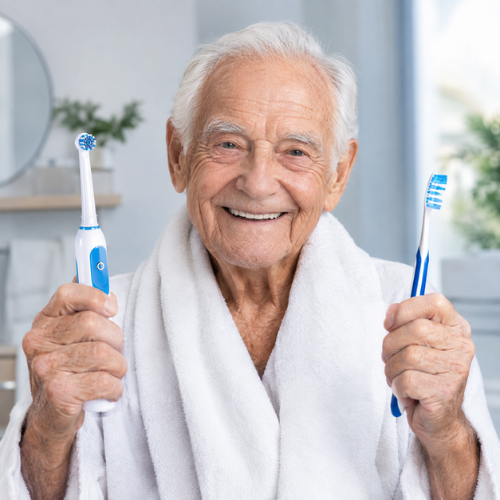
"My manual toothbrush is perfectly enough for me."
That’s what 60% of French adults who still use a manual toothbrush say. And objectively, they are partly right — a manual toothbrush used with perfect technique for exactly 2 minutes twice a day produces acceptable results.
The problem? Less than 10% of adults brush with perfect technique for exactly 2 minutes. Observational studies show that the average brushing time with a manual toothbrush is 45 to 60 seconds — and that the technique consistently leaves some areas uncleaned.
The electric toothbrush does not replace the manual toothbrush through technology alone. It does so because it compensates for universal human weaknesses — insufficient time, imprecise technique, excessive pressure, and missed areas.
This comparison gives you the full clinical verdict — criterion by criterion, study by study, with no bias.
Methodology — How to compare objectively
To be valid, this comparison must be based on clinical studies — not testimonials or marketing claims. The sources used in this article are :
- The 2023 Cochrane meta-analysis on electric vs manual toothbrushes — the most comprehensive reference available
- The Journal of Clinical Periodontology — randomized comparative studies
- The American Dental Association — official recommendations
- Studies published in the British Dental Journal and the Journal of Dentistry
Important condition : all of these studies compare toothbrushes used correctly by participants following instructions. Results in real-world conditions, without supervision, are generally less favorable to the manual toothbrush — because users' free-form technique is less rigorous than under study conditions.
Criterion 1 — Plaque reduction
Plaque is the main cause of cavities and gum disease. Reducing it is the most fundamental clinical criterion.
What the studies say
The 2023 Cochrane meta-analysis, which analyzed data from 56 studies involving 5,068 participants, concluded that :
- Electric toothbrushes reduce plaque by 21% more than manual toothbrushes at 3 months
- This superiority reaches 11% more at 3 months on the standardized plaque index
(Source : Cochrane Database of Systematic Reviews — Powered versus manual toothbrushes for oral health, 2023)
Important nuances
This 21% superiority is measured under conditions where both types of toothbrush are used according to the optimal protocol. In real-world conditions, the difference is often greater in favor of the electric toothbrush — because the timer and automatic guidance compensate for technique and timing errors.
Criterion 1 verdict : ✅ Clear, documented advantage for the electric toothbrush.
Criterion 2 — Reduction of gingivitis (gum inflammation)
Gingivitis is the most common oral disease in adults. Reducing it is a directly measurable marker of periodontal health.
What the studies say
The same 2023 Cochrane meta-analysis documents :
- Reduction in gingival index of 6% greater with the electric toothbrush at 3 months
- Reduction of 11% greater at 3 months on the gingival bleeding index
These figures may seem modest in percentage terms — but they represent a clinically measurable and significant difference in long-term periodontal health.
An important nuance : studies show that sonic toothbrushes have a more pronounced advantage on gingivitis than oscillating vs manual toothbrushes — due to the hydrodynamic effect that partially reaches the gingival sulcus.
Criterion 2 verdict : ✅ Documented advantage for the electric toothbrush — more pronounced for sonic toothbrushes.
Criterion 3 — Effective brushing time
Time is one of the most important factors in brushing effectiveness — and one of the hardest to maintain without help.
What observational studies show
| Type of toothbrush | Observed average brushing time |
|---|---|
| Manual toothbrush without a timer | 45 to 60 seconds |
| Manual toothbrush with an external timer | 90 to 110 seconds |
| Electric toothbrush with built-in timer | 110 to 130 seconds |
| Electric toothbrush with app coaching | 120 to 135 seconds |
The built-in timer on the electric toothbrush is the single factor that best explains the electric toothbrush's clinical superiority in real-world conditions. It enforces the full 2 minutes where the user would stop at 45 seconds.
(Source : Journal of Dental Research — toothbrushing duration observational studies)
Criterion 3 verdict : ✅ Major advantage for the electric toothbrush — thanks to the built-in timer.
Criterion 4 — Coverage of hard-to-reach areas
Hard-to-reach areas — the inner surfaces of the molars, the gingival sulcus, the spaces near adjacent teeth — are where plaque accumulates most easily and is least disturbed.
The reality of manual brushing
Studies using plaque disclosure before and after brushing show that the areas most often left with residual plaque after manual brushing are :
- The lingual surfaces of the lower molars
- The gingival sulcus (0-3mm below the gumline)
- The distal (back) areas of the last molars
- The spaces near adjacent teeth
These areas are consistently better cleaned by the sonic electric toothbrush — thanks to the hydrodynamic effect and the structured timer with quadrant signal.
Criterion 4 verdict : ✅ Significant advantage for the sonic electric toothbrush.
Criterion 5 — Whitening and stain reduction
Extrinsic stains (coffee, tea, red wine, tobacco) are the main aesthetic concern in dental hygiene.
What the studies show
High-frequency sonic toothbrushes (40,000-45,000 vibrations/min) show a significantly greater reduction in extrinsic stains than manual toothbrushes at 4 and 8 weeks — thanks to the polishing effect of hydrodynamic turbulence.
The manual toothbrush, even with whitening toothpaste, provides clearly less polishing action than a sonic toothbrush with White or Polish mode.
Nuance : neither the manual toothbrush nor the electric toothbrush can treat intrinsic stains (within the tooth structure). For those stains, professional whitening is still necessary.
Criterion 5 verdict : ✅ Clear advantage for the sonic electric toothbrush on extrinsic stains.
Criterion 6 — Applied pressure and enamel protection
Brushing too hard abrades enamel and causes gum recession — progressive and partly irreversible damage.
The reality of brushing pressure
Observational studies show that :
- 80% of adults apply excessive pressure (> 200g) with a manual toothbrush
- With an electric toothbrush without a pressure sensor : 60% apply excessive pressure
- With an electric toothbrush with an active pressure sensor : 25% apply excessive pressure
The pressure sensor on the electric toothbrush — absent from any manual toothbrush — is the feature that most effectively reduces this risk.
Criterion 6 verdict : ✅ Advantage for the electric toothbrush with pressure sensor — neutral between manual and electric without sensor.
Criterion 7 — Ease of use and compliance
The best tool is the one you use regularly and correctly.
Compliance in real-world conditions
Long-term follow-up studies show that :
- Electric toothbrush users maintain their brushing routine more consistently at 6 and 12 months
- The built-in timer is the main factor in this better compliance
- App-based coaching further improves short-term compliance (8-12 weeks), with an effect that fades afterward
The manual toothbrush requires discipline that few people maintain over the long term. The electric toothbrush automates the most critical parameters — time, zone-change signal — reducing the cognitive load of the routine.
Criterion 7 verdict : ✅ Advantage for the electric toothbrush in long-term compliance.
Criterion 8 — Total cost over 3 years
Cost is a real factor that influences purchasing decisions.
| Item | Manual toothbrush | Electric toothbrush (mid-range) |
|---|---|---|
| Initial purchase | 2 to 5€ | 40 to 60€ |
| Replacement (every 12 weeks) | 3€ × 12 = 36€ | Heads 8€ × 12 = 96€ |
| Electricity | 0€ | < 1€ |
| Total over 3 years | 38 to 41€ | 137 to 157€ |
| Monthly cost | ~1.10€ | ~4.30€ |
The difference: about 3.20€ per month.
The economic counter-question : what is the cost of professional scaling every 6 months (34 to 50€ out of pocket depending on insurance) vs every 12 months if your hygiene improves? Of a filling avoided (30 to 80€)? Of a gum graft avoided (500 to 1,500€)?
Over 10 years, the electric toothbrush can represent a net saving of several hundred euros in avoided preventive care — despite its higher purchase cost.
Criterion 8 verdict : 🟡 Lower upfront cost for the manual toothbrush — total cost advantage over 10 years potentially in favor of the electric toothbrush.
Criterion 9 — Accessibility and availability
The manual toothbrush is available everywhere — pharmacies, supermarkets, gas stations, hotels. The electric toothbrush requires a charger and replacement heads.
Criterion 9 verdict : ✅ Clear advantage for the manual toothbrush in availability and travel convenience.
Criterion 10 — Environmental impact
Both types of toothbrush generate plastic waste.
| Aspect | Manual toothbrush | Electric toothbrush |
|---|---|---|
| Toothbrush body | Entire plastic × 4/year | Durable handle × 1/5 years |
| Plastic waste/year | 4 complete toothbrushes | 4 heads (< total plastic) |
| Electronic waste | None | 1 handle/5 years (WEEE) |
| Bamboo toothbrush available | ✅ Yes | ✅ Yes (some brands) |
Criterion 10 verdict : 🟡 Slight nuance depending on toothbrush type — overall comparable with bamboo options available in both categories.
Final summary table
| Criterion | Manual toothbrush | Electric toothbrush | Winner |
|---|---|---|---|
| Plaque reduction | Reference | +21% at 3 months | ✅ Electric |
| Gingivitis reduction | Reference | +6 to 11% | ✅ Electric |
| Effective brushing time | 45-60 sec on average | 110-130 sec | ✅ Electric |
| Hard-to-reach areas | Variable | Superior | ✅ Electric |
| Whitening (extrinsic stains) | Moderate | Superior | ✅ Electric |
| Enamel protection (pressure) | Variable | Superior (with sensor) | ✅ Electric |
| Long-term compliance | Variable | Better | ✅ Electric |
| Initial cost | ✅ Cheaper | More expensive | ✅ Manual |
| Availability / travel | ✅ Everywhere | Constraints | ✅ Manual |
| Environmental impact | 🟡 Comparable | 🟡 Comparable | Tie |
Score : Electric 7 — Manual 2 — Tie 1
Can the manual toothbrush be as effective as the electric one?
The honest answer : yes, theoretically. No, practically.
A manual toothbrush used with :
- Perfect Bass technique
- Exactly 2 minutes per session
- An external quadrant signal (phone timer)
- Twice a day without exception
- A precisely maintained pressure of 150g
- A replacement every 12 weeks
...produces clinical results close to those of the electric toothbrush.
The problem is that fewer than 5% of adults maintain this combination of conditions over the long term. The electric toothbrush automates the most critical parameters — and it is this automation, not the technology itself, that explains the documented clinical superiority.
For whom is the manual toothbrush still a valid choice?
The manual toothbrush is not obsolete. It remains a valid choice in these specific situations.
Situations where the manual toothbrush is appropriate :
- Travel without access to electricity (backup toothbrush)
- Extremely tight purchase budget (< 5€ available)
- Very young children (< 3 years) whose gums require fine parental control of pressure
- People with exceptional brushing technique and impeccable discipline (< 5% of the population)
Situations where switching to electric is clearly recommended :
- Persistent gum bleeding
- Recurring tartar detected at every visit
- Reduced dexterity (arthritis, tremors)
- Brushing time under 90 seconds
- Troubling tooth staining
- Wearing fixed braces
Conclusion — The electric toothbrush wins on almost every clinical criterion
The clinical data available in 2026 are clear: the sonic electric toothbrush is superior to the manual toothbrush on the most important clinical criteria — plaque reduction, gingivitis, compliance, and effective brushing time.
This superiority is not huge in absolute terms in controlled studies. It is much greater in real-world conditions — because the electric toothbrush compensates for universal human errors that the manual toothbrush cannot correct.
The question is no longer really "electric or manual?" — the clinical answer is clear. The question is: "which electric toothbrush suits my profile and budget?"
At DentalPro Smile™, our PureBrush Pro™ at 45,000 vibrations per minute — with 5 modes, quadrant-signal timer, and pressure sensor — offers documented clinical performance accessible to everyone.
Discover the PureBrush Pro™ DentalPro Smile™ → Superior to the manual toothbrush on 7 out of 10 criteria · Free delivery · 1-year warranty.
👉 dentalpro-smile.com/fr-fr
❓ FAQ
1. Can a manual toothbrush really be enough if you use it perfectly?
Technically, a manual toothbrush used with perfect technique for exactly 2 minutes can produce results close to those of an electric toothbrush. In practice, fewer than 5% of adults maintain that level of rigor over the long term. The electric toothbrush is superior in real life not because its technology is revolutionary, but because it automates the parameters the user does not maintain on their own — time, technique, pressure.
2. Are studies comparing electric and manual toothbrushes reliable?
High-quality studies on this topic exist and are numerous — notably the 2023 Cochrane meta-analysis aggregating data from 56 studies and 5,068 participants. It is one of the most robust literature reviews in dental medicine. The recognized limitations of these studies: they are often short-term (3 months), conducted under supervised conditions, and sometimes funded by toothbrush manufacturers. The conclusions remain consistent across independent studies.
3. Is my manual toothbrush enough if I add a water flosser?
Adding a water flosser significantly improves the results of a manual toothbrush — by covering inaccessible interdental spaces. The combination of a perfectly used manual toothbrush + daily water flosser produces clinical results close to the electric toothbrush alone. However, electric toothbrush + water flosser remains the optimal combination — the two tools complement each other, and the electric toothbrush compensates for human technique weaknesses on surfaces.
4. Is the difference visible quickly after switching to an electric toothbrush?
Yes — and it is one of the first observations new users make. Within the first few weeks, users report smoother teeth after brushing, less bleeding if gingivitis is present, and sometimes the start of improvement in mild staining. These noticeable results appear in 2 to 4 weeks for most profiles.
5. Is it true that an electric toothbrush can damage teeth if used incorrectly?
Yes — an electric toothbrush used incorrectly (excessive pressure, wrong head, incorrect technique) can abrade enamel and irritate the gums more effectively than a manual toothbrush, precisely because it applies these forces at a higher frequency. That is why the correct technique — guided, without pressure, correct angle, suitable mode — is just as important with an electric toothbrush as without one. The pressure sensor is especially useful for users who have trouble controlling their pressure intuitively.
6. Should you tell your dentist that you are switching from a manual toothbrush to an electric one?
It is not mandatory, but it is useful. Your dentist can give you personalized recommendations based on your profile — which brush head to choose, which mode to favor, what pressure to aim for — depending on the condition of your teeth and gums. At your next checkup, mention the change and ask for feedback on your technique during the exam.
Sources :
— Cochrane Database of Systematic Reviews — Powered versus manual toothbrushes for oral health 2023
— Journal of Dental Research — Toothbrushing duration observational studies
— American Dental Association — Electric vs manual toothbrush position statement : ada.org
— Journal of Clinical Periodontology — Sonic toothbrush comparative efficacy
— HAS — Oral hygiene recommendations : has-sante.fr
Informational article only. Does not replace the advice of a dental surgeon. DentalPro Smile™ — 2026.


Leave a comment
This site is protected by hCaptcha and the hCaptcha Privacy Policy and Terms of Service apply.