
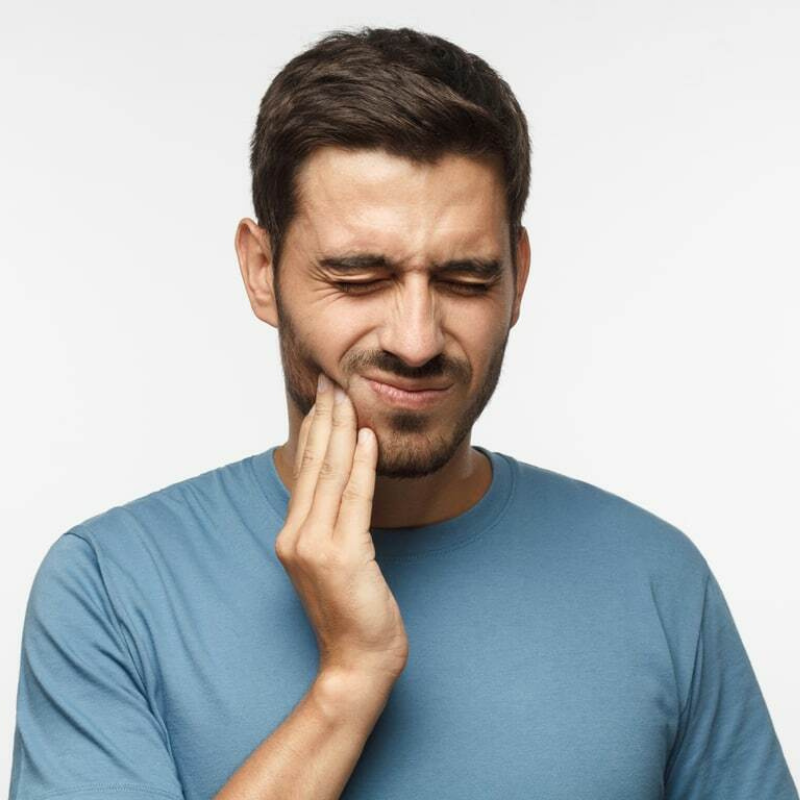
You wake up with a sore jaw. Your teeth seem more sensitive in the morning. Your partner tells you that you grind your teeth at night. Or your dentist notices abnormal enamel wear.
These signs point to the same phenomenon: bruxism.
Bruxism — from the Greek brychein (to grind the teeth) — is a parafunctional behavior: clenching or grinding the teeth outside the normal functions of chewing and swallowing. It occurs mainly during sleep, without the person being aware of it.
In France, sleep bruxism is thought to affect around 8 to 10% of adults according to available data. (Source: compiled data — French Society of Sleep Medicine and dental publications)
The two forms of bruxism
Centric bruxism (clenching)
The person clenches their teeth without moving the jaw. The temporalis and masseter muscles remain in prolonged static contraction. No characteristic noise. Often not detected by a partner. Causes muscle pain (jaw, temples) and morning jaw fatigue.
Eccentric bruxism (grinding)
The jaw makes side-to-side movements with the teeth in contact. Produces the characteristic noise that a partner may hear. Causes visible enamel wear on the chewing edges.
How can you tell if you suffer from bruxism?
Signs you can observe yourself
| Sign | Description |
|---|---|
| Morning pain | Jaw, temples, neck upon waking |
| Flattened teeth | Abnormally flat and even chewing edges |
| Tooth sensitivity | Especially in the morning, easing during the day |
| Morning headaches | Starting from the temples and neck |
| Cheeks bitten on the inside | Horizontal bite line on the cheek mucosa |
| Marks on the tongue | Tooth marks on the side edges of the tongue |
What your dentist can observe
Abnormal enamel wear is the most reliable clinical sign. On healthy teeth used normally, enamel does not wear visibly for many decades. Premature wear of the chewing edges or cusps signals excessive parafunctional contact.
Identified causes of bruxism
Bruxism is a multifactorial phenomenon — several causes may coexist.
| Factor | Mechanism | Frequency |
|---|---|---|
| Stress and anxiety | Nighttime muscle tension linked to chronic stress | 🔴 Main cause |
| Sleep disorders | OSA (sleep apnea), fragmented sleep | 🟡 Common |
| Certain medications | SSRIs (antidepressants), amphetamines | 🟡 Documented |
| Genetic factors | Family predisposition | 🟡 Moderate |
| Dental malocclusion | Abnormal tooth contacts | 🟡 Debated |
| Tobacco and alcohol | Worsen nighttime bruxism | 🟡 Aggravating |
| Caffeine | Nervous system stimulant — worsens it if consumed in the evening | 🟡 Aggravating |
Untreated consequences of bruxism
On the teeth
- Progressive enamel wear — irreversible
- Tooth fractures and fractures of existing fillings
- Dentin hypersensitivity (the enamel thins, the dentin becomes exposed)
- Loss of vertical dimension (the teeth "shorten")
On the joints and muscles
- Temporomandibular disorder (TMD) — pain in the jaw joint
- Myofascial pain (jaw muscles, temples, neck)
- Limited mouth opening in advanced cases
Long-term dental costs
A molar with enamel worn down by bruxism may require a crown (500€ to 1,100€). Multiplied across several teeth over 10 to 20 years of untreated bruxism, the bill can be considerable.
Available solutions — From the simplest to the most advanced
Solution 1 — Occlusal splint (standard treatment)
A bruxism splint — also called an occlusal splint, bite plate, or relaxation splint — is the first-line treatment for bruxism. It is custom-made by the dentist from an impression of your teeth.
What it does:
- Protects enamel from friction wear
- Distributes clenching forces across the whole surface (reducing pressure at each point)
- Slightly repositions the jaw into a muscle-relaxing position
What it does not do:
- Cure bruxism (it returns if the splint is not worn)
- Treat the underlying causes (stress, sleep disorders)
Cost: variable depending on the dentist and the type of splint — from a few hundred to several hundred euros. Partially covered by some supplementary health insurance plans. (Check your insurance policy)
Solution 2 — Stress management
Since bruxism is mostly linked to stress, stress-management techniques can significantly reduce its intensity.
- Progressive muscle relaxation (Jacobson technique)
- Meditation and mindfulness
- Regular physical activity
- Cognitive behavioral therapy (CBT) — positive clinical data for bruxism
Solution 3 — Behavioral adjustments
- Reduce or eliminate caffeine after 2 p.m.
- Avoid alcohol in the evening
- Keep the mouth slightly open during stressful daytime activities (daytime clenching)
- Wear a sports mouthguard during intense physical activity
Solution 4 — Botulinum toxin injections
In cases of severe, treatment-resistant bruxism, botulinum toxin injections into the masseter muscles can reduce contraction force. This procedure is reserved for qualified professionals and is not reimbursed. (Source: clinical data — literature reviews on botulinum toxin and bruxism)
Solution 5 — Treatment of associated sleep apnea
If bruxism is associated with sleep apnea (OSA), treating the apnea (CPAP, mandibular advancement device) can simultaneously reduce bruxism. (Source: Journal of Clinical Sleep Medicine — data on the association between OSA and bruxism)
Daily care of a bruxism splint
A poorly maintained bruxism splint accumulates the same bacterial biofilm as a dental aligner. It reintroduces these bacteria into your mouth during the 8 hours it is worn at night.
Recommended care protocol:
| Frequency | Action |
|---|---|
| Every morning | Rinse with lukewarm water + gentle brushing without toothpaste |
| Every evening (before wearing) | 5-minute ultrasonic cleaner cycle |
| 1x/week | Ultrasonic cleaning + cleaning tablet |
| Storage | In a glass of clean water or air-dried in its dry case |
FAQ
Can bruxism go away on its own?
Some episodes of bruxism are temporary and disappear when the triggering factor is resolved (for example, the end of a period of intense stress). Chronic bruxism generally does not go away on its own without intervention.
Are splints sold in pharmacies effective?
Over-the-counter thermoformable splints partly protect enamel. They are less precise than a custom-made dentist's splint and may be less comfortable. For mild bruxism, they can be a temporary solution. For moderate to severe bruxism, a custom-made splint remains preferable.
Is bruxism hereditary?
Studies suggest a genetic component in susceptibility to bruxism. If your parents or close relatives suffer from bruxism, your risk may be slightly increased. But environmental factors (especially stress) remain predominant.
How often should you replace your bruxism splint?
The lifespan of a custom-made splint varies depending on the intensity of the bruxism and the quality of maintenance. A heavy grinder may wear out their splint in 6 to 12 months. Rigorous maintenance (daily ultrasonic cleaning) extends its lifespan and preserves the clarity of the material.
Conclusion
Bruxism is a largely underdiagnosed condition that can have severe long-term dental and muscular consequences. The custom-made occlusal splint remains the standard treatment to protect enamel. Rigorous daily maintenance — especially ultrasonic cleaning — is just as important as wearing it.
UltraClean Pro™ DentalPro Smile™ — the ideal ultrasonic cleaner for the daily care of your bruxism splint.
👉 dentalpro-smile.com/fr-fr
RECOMMENDED RELATED ARTICLES:
→ Article 4: Cleaning an aligner — identical protocol for splints
→ Article 5: Sensitive teeth — often worsened by bruxism
→ Article 7: Denture care — the same maintenance logic
Article for informational purposes only. Does not replace the advice of a dentist or sleep doctor. DentalPro Smile™ — 2026.

Leave a comment
This site is protected by hCaptcha and the hCaptcha Privacy Policy and Terms of Service apply.