
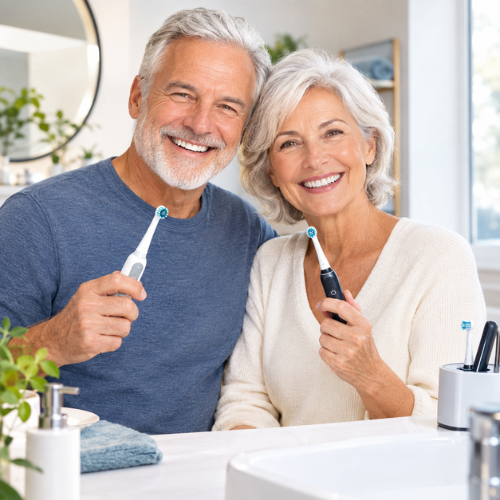
After 60, your mouth is not quite the same as it was at 30.
This is not inevitable — it is a physiological reality that calls for adapting your oral care tools. The electric toothbrush you've used for 15 years, or the manual toothbrush you've never replaced, may no longer be the best fit for your current needs.
In France, people over 65 account for around 21% of the population — more than 14 million adults whose oral hygiene needs are specific and often poorly covered by general-public guides. (Source: INSEE — 2025 Demographic Report)
Senior dental challenges are not simply "more sensitivity" or "receding gums." They are multiple, interconnected problems: medication-related xerostomia, root caries on exposed roots, chronic periodontitis, partial or full dentures, implants, and reduced manual dexterity due to arthritis or tremors.
This guide helps you identify your exact senior profile and choose the toothbrush — and routine — that matches it.
The 6 specific oral hygiene challenges after 60
Challenge 1 — Xerostomia (dry mouth)
This is the most common and most underestimated problem among seniors. Xerostomia — the feeling of chronic dry mouth — affects a significant proportion of people over 65, mainly because of medications.
More than 400 common medications reduce saliva flow: antihypertensives, antidepressants, antihistamines, diuretics, Parkinson's disease medications, and many others.
Why this is serious for teeth: saliva is your mouth's natural protection system. It neutralizes acids, inhibits bacteria, and remineralizes enamel. Without enough saliva, cavities develop much more quickly — even in adults who have never had them in their life.
What this changes when choosing a toothbrush: a dry mouth reduces the hydrodynamic effect of the sonic toothbrush (the fluid propagation effect is less abundant). Wetting the brush head before use and rinsing with water beforehand become especially important.
Challenge 2 — Root caries
With the gum recession that comes with aging, tooth roots gradually become exposed. These roots are covered with cementum — a material much more permeable to acids than enamel. Root caries progress silently and quickly.
What this changes when choosing a toothbrush: a toothbrush with Sensitive mode and an extra-soft head is especially important to avoid abrasion of exposed roots. High-fluoride toothpaste (on dental recommendation) strengthens the exposed cementum.
Challenge 3 — Reduced manual dexterity
Hand arthritis, essential tremors, progressive muscle weakness — all of these phenomena affect the ability to hold and maneuver a toothbrush properly. A manual toothbrush becomes less and less effective as dexterity declines.
What this changes when choosing a toothbrush: this is precisely the profile for which the electric toothbrush is most valuable. It does not require precise scrubbing motions — the user simply guides the head from tooth to tooth, while the motor does the cleaning. A wide, non-slip ergonomic handle makes gripping easier despite reduced dexterity.
Challenge 4 — Receding gums and sensitivity
Progressive gum recession is almost universal after 65. Exposed root areas create sensitivity to cold and to brushing. The gums themselves may be fragile and react to the slightest mechanical pressure.
What this changes when choosing a toothbrush: Sensitive mode, pressure sensor, extra-soft bristles — these three features become essential rather than optional for this profile.
Challenge 5 — The presence of dentures, bridges, or implants
The vast majority of people over 65 wear at least a partial denture, a bridge, or an implant. These devices create hard-to-clean areas and require specific complementary tools.
What this changes when choosing a toothbrush: the electric toothbrush should be accompanied by a water flosser and an ultrasonic cleaner for removable dentures — these tools are no longer optional but necessary.
Challenge 6 — Difficulty maintaining a regular routine
Some seniors — especially those living alone, those with a gradual loss of independence, or those in care facilities — have difficulty maintaining a complete, regular brushing routine.
What this changes when choosing a toothbrush: a simple toothbrush, with a single easy-to-use button, a clear timer, and replacement heads that are easy to find, is preferable to a toothbrush with multiple buttons and a complex interface.
Selection criteria — What matters for a senior
| Criterion | Importance for the senior | Why |
|---|---|---|
| Wide, ergonomic handle | 🔴 Critical | Reduced dexterity, arthritis |
| Sensitive mode | 🔴 Critical | Receding gums, sensitivity |
| Extra-soft bristles | 🔴 Critical | Exposed roots, fragile gums |
| Simple, clear timer | 🔴 Critical | Ease of use |
| Pressure sensor | 🟡 Important | Avoid abrasion on roots |
| Battery life ≥ 14 days | 🟡 Important | Less charging hassle |
| Lightweight handle | 🟡 Important | Reduced muscle fatigue |
| Gum Care mode | 🟡 Important | Gum health maintenance |
| Bluetooth / App | 🟢 Optional | Rarely used by this profile |
| 5 modes | 🟢 Optional | 2 to 3 are enough |
| Travel case | 🟢 Optional | Depending on travel habits |
Sonic toothbrush vs rotary toothbrush — Which technology for seniors?
The sonic toothbrush — The reference choice for seniors
The sonic toothbrush is especially well suited to seniors for three specific reasons.
Reason 1 — The hydrodynamic effect compensates for reduced dexterity
With reduced dexterity, accurate brush placement may be compromised. The hydrodynamic effect of the sonic toothbrush cleans beyond direct bristle contact — partially compensating for less precise placement.
Reason 2 — Sensitive mode is gentler on receding gums
The sonic toothbrush in Sensitive mode generates distributed, progressive vibrations — much less traumatic on exposed root areas than the direct mechanical oscillation of a rotary toothbrush.
Reason 3 — One simple motion is enough
The sonic toothbrush is guided gently — no wrist rotation, no scrubbing motion. This minimal movement is especially suited to people with tremors or hand muscle fatigue.
The rotary toothbrush — For certain specific profiles
The small round head of the rotary toothbrush can be an advantage for seniors with bridges or hard-to-reach areas — its small size allows it to position better in tight spaces.
For seniors with significant tartar and resilient gums (without cervical sensitivity or significant recession), the direct mechanical action of the rotary toothbrush may be slightly more effective on stubborn plaque.
The senior-adapted dental routine — The complete protocol
Morning — 6 to 7 minutes
| Step | Tool | Duration | Senior-friendly |
|---|---|---|---|
| 1 | Tongue scraper | 30 sec | ✅ Simple action |
| 2 | Rinse with lukewarm water | 30 sec | ✅ Stimulates saliva |
| 3 | Sonic brushing, Sensitive mode | 2 min | ✅ Gentle on roots |
| 4 | Spit without rinsing | — | ✅ Preserves fluoride |
| 5 | Water flosser, gentle mode | 2-3 min | ✅ Interdental spaces |
Evening — 7 to 8 minutes
| Step | Tool | Duration | Senior-friendly |
|---|---|---|---|
| 1 | Remove dentures (if worn) | — | ✅ Access to remaining teeth |
| 2 | Clean dentures | Ultrasound 5 min | ✅ Simple and effective |
| 3 | Brush natural teeth, Sensitive mode | 2 min | ✅ |
| 4 | Water flosser | 2 min | ✅ |
| 5 | Clean mucous membranes | Soft brush + water | ✅ Mucosal health |
| 6 | Keep denture in clean water overnight | — | ✅ Recommended |
Adaptations according to independence level
Independent senior at home
Complete routine as described above. Dental checkups recommended every 6 months (vs once a year for adults without specific issues) to monitor recession areas, scaling, and root caries.
Senior with reduced mobility
Practical adaptations:
- Toothbrush holder with wall mount at the proper height
- Toothbrush handle with non-slip sleeve (available at pharmacies)
- Water flosser on a stand or with a flexible arm
- Cleaning tablets for dentures for maximum independence
Senior in a nursing home or losing independence
Oral hygiene for nursing home residents is a documented public health issue — often inadequately provided due to a lack of suitable tools and caregiver time.
For professional and family caregivers:
The sonic electric toothbrush greatly simplifies assisted brushing. The caregiver simply guides the head from tooth to tooth — the toothbrush does the work. This action is much less demanding for both parties than manual brushing.
The ultrasonic cleaner is the ideal tool for dentures in assisted-care settings — simply place the denture in the tray for 5 minutes for a complete clean, with no complex handling.
Points of attention for caregivers:
- Always check whether the resident wears dentures before brushing
- Check the condition of the gums monthly (redness, swelling, bleeding)
- Report any expressed oral pain or suggestive behavior (refusing to eat, agitation during meals)
- Alert the coordinating doctor if there are signs suggestive of thrush (white patches on the tongue or cheeks) or a dental abscess
Essential complementary products for seniors
The water flosser
Essential for interdental spaces — especially important for seniors whose spaces often widen with gum recession. The gentlest mode is recommended to start.
The ultrasonic cleaner
Essential for users of partial or full dentures, aligners, or mouthguards. A 5-minute cycle is enough for a deep clean — with no complex handling and no risk of abrasion.
The adapted fluoride toothpaste
On your dentist's recommendation, a higher-fluoride toothpaste may be prescribed for people at high cavity risk — especially seniors with significant xerostomia or recent root caries.
The saliva spray or stimulating lozenges
For seniors suffering from marked xerostomia, saliva substitutes (sprays or gels based on mucin or carboxymethylcellulose) or saliva stimulants (xylitol lozenges) help compensate for insufficient saliva flow between brushings.
What you should never recommend to a senior — Common mistakes
Mistake 1 — Recommending a toothbrush with too many buttons and options
A senior with cognitive decline or visual difficulties should not have to manage a toothbrush with 5 buttons, a multicolor LED, and a Bluetooth app. Simplicity and efficiency should come before premium features.
Mistake 2 — Minimizing oral pain
Dental pain in seniors is often brushed off — by the senior themselves ("it's age") or by those around them. Any persistent oral pain deserves a dental consultation — abscesses and oral cancers are medical emergencies whose diagnosis can be delayed if symptoms are normalized.
Mistake 3 — Failing to adapt the routine after a change in medical treatment
Each new medication can potentially affect oral health — by causing xerostomia, changing the oral flora, or interfering with healing. A dental checkup is recommended after any significant change in medical treatment.
Mistake 4 — Thinking dental care "isn't worth it" after a certain age
Senior oral health has a direct and documented impact on quality of life, nutrition, social life, and overall health. The links between periodontitis and cardiovascular disease, and between oral health and the risk of aspiration pneumonia in frail older adults, are documented in the medical literature. (Source: HAS — Oral health in older adults)
Conclusion — The electric toothbrush is the most valuable tool in the senior's bathroom
Paradoxically, the people who need a quality electric toothbrush most are also those who have the most difficulty using it correctly without adaptation — seniors.
The sonic electric toothbrush in Sensitive mode, with an ergonomic handle, pressure sensor and timer, paired with a gentle-mode water flosser and an ultrasonic cleaner for dentures, is the optimal routine for maintaining quality oral health well beyond 65.
At DentalPro Smile™ , our PureBrush Pro™ with Sensitive mode, our HydroJet Pro™ in gentle mode, and our UltraClean Pro™ make the ideal combination for independent or assisted seniors.
Discover the DentalPro Smile™ range adapted for seniors → Free delivery · 1-year warranty · French-speaking customer service.
👉 dentalpro-smile.com/fr-fr
❓ FAQ
1. At what age should you switch to an electric toothbrush if you used a manual one?
There is no universal age — manual dexterity should guide the decision. As soon as you notice your brushing becomes less regular, less precise, or more tiring (tremors, stiff fingers, difficulty gripping), switching to a sonic electric toothbrush is recommended. For people without particular difficulties, the electric toothbrush is beneficial at any adult age — not just after 60.
2. Is electric brushing safe after new crowns are placed?
Yes — ceramic or zirconia crowns are fully compatible with the sonic electric toothbrush. In Sensitive mode, the toothbrush is even recommended in the first weeks after placement because of its gentle action on gum areas that are often slightly irritated after the procedure. Avoid White or Polish mode on crowns so as not to abrade the glaze.
3. How can brushing be made easier if arthritis makes gripping difficult?
Several simple adaptations: a non-slip foam sleeve to slide onto the toothbrush handle (available at pharmacies or from occupational therapists), a suction-cup toothbrush holder fixed at the proper height, an electric toothbrush handle with a large diameter (some models reach 3 to 4 cm in diameter). An occupational therapist can also recommend personalized adaptations for severe arthritis cases.
4. Should you keep brushing if you no longer have any natural teeth?
Yes — even without natural teeth, brushing remains important for the health of the oral mucosa (gums, palate, cheeks, tongue). A soft brush passed over these surfaces twice a day maintains tissue health, reduces the risk of thrush, and supports local blood flow. Full dentures should be cleaned separately with an ultrasonic cleaner and effervescent tablets.
5. Can medication-related dry mouth be treated without changing treatment?
Yes — several compensatory approaches exist without changing medical treatment: frequent water intake (small regular sips rather than large glasses), xylitol saliva stimulants (sugar-free chewing gum or lozenges), artificial saliva sprays available at pharmacies, and increased brushing frequency (3 times a day if xerostomia is severe). A medication review by the doctor remains ideal if clinically possible.
6. How often should a senior see the dentist?
The standard recommendation is two visits per year for seniors — even without obvious symptoms. This frequency may be increased to three or four times a year for high-risk profiles: people with diabetes, full-denture wearers with recurrent gingivitis, patients taking bisphosphonates (risk of osteonecrosis), or patients who have recently had root caries. (Source: HAS — Follow-up recommendations for oral health in older adults)
Sources:
— HAS — Oral health in older adults: has-sante.fr
— INSEE — France Demographics 2025: insee.fr
— Journal of Gerontology — Oral health and aging
— American Geriatrics Society — Dental care guidelines for older adults
— Journal of Dental Research — Xerostomia and medication in elderly patients
Informational article only. Does not replace the advice of a dental surgeon or geriatrician. DentalPro Smile™ — 2026.


Leave a comment
This site is protected by hCaptcha and the hCaptcha Privacy Policy and Terms of Service apply.