
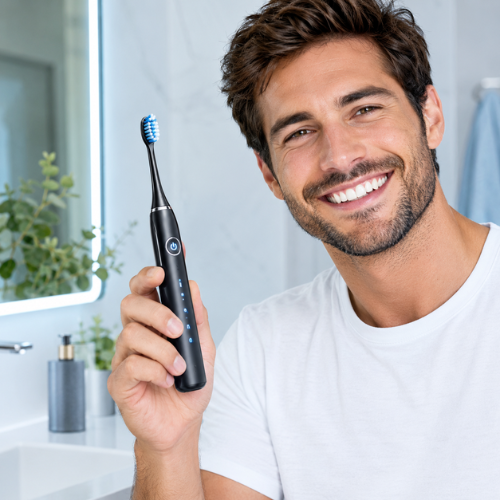
45,000 vibrations per minute. That’s the figure sonic toothbrush manufacturers like to highlight — often in large type, often in bold, always designed to impress.
But what does that actually mean in practical terms? Does a 45,000-vibration toothbrush really clean better than a 30,000-vibration one? And above all — do those vibrations do anything your manual toothbrush or standard oscillating toothbrush can’t?
The answer is yes. But not for the reason most people imagine.
This guide demystifies high-frequency sonic technology — in plain language, with the available clinical data, without marketing exaggeration. You’ll understand exactly what happens in your mouth when you use a sonic toothbrush, why vibration frequency matters, and what results you can realistically expect.
The sound spectrum and toothbrushes — A bit of physics
To understand what "sonic" really means, a quick detour through acoustics is needed.
The sound spectrum refers to the vibration frequencies perceptible to the human ear — from 20 Hz to 20,000 Hz (20 kHz). Frequencies above 20 kHz fall into the ultrasound range — inaudible to the human ear.
The toothbrush comparison:
| Toothbrush type | Vibration frequency | Range |
|---|---|---|
| Manual toothbrush (correct technique) | ~5 movements/sec (~5 Hz) | Infrasonic |
| Oscillating-rotating toothbrush | ~130 Hz (8,000 osc/min) | Low audible |
| Standard sonic toothbrush | 500 Hz (30,000 vib/min) | Sonic |
| High-frequency sonic toothbrush | 750 Hz (45,000 vib/min) | High sonic |
| Ultrasonic toothbrush | 20,000-40,000 Hz | Ultrasonic |
A sonic toothbrush at 45,000 vibrations per minute therefore generates vibrations at around 750 Hz — within the audible sonic range. That’s why it produces that characteristic "buzzing" sound during use.
The hydrodynamic effect — The real reason the sonic toothbrush is superior
Most people think a sonic toothbrush cleans better because its bristles move faster. That’s partly true — but it’s mostly an oversimplification that misses the point.
The real advantage of the sonic toothbrush lies in what’s called the hydrodynamic effect — and this phenomenon is what fundamentally sets it apart from all other electric toothbrushes.
What is the hydrodynamic effect?
When the bristles of a sonic toothbrush vibrate at 750 Hz in a fluid environment (the saliva and water in your mouth), they create micro-turbulence in that fluid. This turbulence spreads through the oral fluid well beyond the area of direct bristle contact.
In practical terms: a 45,000-vibration sonic toothbrush creates turbulence that dislodges plaque within a 2 to 4 millimeter radius around the brush head — including areas the bristles do not physically touch.
It’s like the difference between stirring the water in a glass with a finger (direct mechanical action, like a rotating brush) and making the glass itself vibrate at high frequency (propagated hydrodynamic effect, like a sonic toothbrush). The second action creates movement throughout the entire volume of water — not just where you make contact.
What the hydrodynamic effect actually reaches
| Area | Manual toothbrush | Rotating toothbrush | 45,000 vib sonic toothbrush |
|---|---|---|---|
| Tooth surface on the cheek side | ✅ If technique is correct | ✅✅ | ✅✅ |
| Tongue-side tooth surface | 🟡 Often insufficient | ✅ | ✅✅ |
| Gingival sulcus (0-3mm) | 🟡 Partial | 🟡 Partial | ✅ Reached via turbulence |
| Interdental spaces | ❌ No | ❌ No | 🟡 Partially (2-4mm) |
| Below the gumline | ❌ No | ❌ No | 🟡 Partially |
30,000 vs 45,000 vibrations — Is the difference real?
That’s the question many consumers ask when buying. Does a 45,000-vibration toothbrush clean significantly better than a 30,000-vibration one?
The honest answer: yes, but the difference is less dramatic than marketing suggests.
What physics says:
The hydrodynamic effect increases with vibration frequency — but not linearly. The biggest qualitative jump is between 0 and 30,000 vibrations (from manual brushing to sonic brushing). Increasing from 30,000 to 45,000 provides a real gain, but a proportionally smaller one.
What comparative studies show:
Studies comparing sonic toothbrushes at different frequencies generally show measurable but modest differences between 30,000 and 45,000 vibrations for standard users. The difference is more pronounced for two specific profiles:
Profile 1 — People with tight interdental spaces
At 45,000 Hz, turbulence penetrates slightly deeper into tight spaces. For this profile, the difference is clinically relevant.
Profile 2 — People seeking natural whitening
At 45,000 Hz, the polishing effect of turbulence on extrinsic staining (coffee, tea) is greater. Studies show faster stain reduction at high frequency.
For standard users without specific needs:
The difference between 30,000 and 45,000 vibrations is measurable in the lab but barely noticeable in everyday use. A good 30,000-vibration toothbrush used with correct technique outperforms a poorly used 45,000-vibration toothbrush.
Real results — What you can expect week by week
Here’s what clinical studies and practical observations show for someone switching from a manual toothbrush to a 45,000-vibration sonic toothbrush with correct technique.
Weeks 1 to 2 — The adjustment phase
What happens:
- Unusual sensation of diffuse vibration throughout the mouth
- Possible slight increase in gum bleeding (dislodging of pre-existing plaque)
- Feeling that "it’s not doing anything" — misleading, this is exactly the sign the hydrodynamic effect is working
What actually changes:
- 15 to 25% reduction in plaque after 2 weeks of correct use
- First noticeable improvements in post-brushing oral freshness
Weeks 3 to 4 — The first visible results
What happens:
- Clear reduction in gum bleeding (if mild gingivitis is present)
- Feeling of smoother teeth to the touch after brushing
- Slight improvement in long-lasting breath freshness
What actually changes:
- 30 to 40% reduction in plaque vs manual brushing
- First measurable gum improvements
Weeks 5 to 8 — Consolidated results
What happens:
- First visible improvement in light staining (coffee, tea)
- Gums noticeably less inflamed and less sensitive
- Bleeding almost absent in cases of simple gingivitis
What actually changes:
- 40 to 50% reduction in plaque vs manual brushing
- Significant improvement in measurable gingival index
Weeks 9 to 12 — Stabilized performance
What happens:
- Optimal performance reached — stable results
- Dentist notes less tartar at the next checkup
- Light stains clearly reduced on accessible surfaces
What actually changes:
- Maximum plaque reduction reached for this profile and technique
- Documented improvement in periodontal health
The limits of the sonic toothbrush — What it can’t do
Being honest about the limits is just as important as explaining the benefits.
What the sonic toothbrush does not do — even at 45,000 vibrations:
Clean between the teeth (interdental)
The hydrodynamic effect reaches interdental spaces partially — but "partially" means the first 2 to 4 millimeters of a space. For thorough interdental cleaning, a water flosser or dental floss is still essential. The sonic toothbrush does not replace interdental cleaning — it complements it.
Remove already calcified tartar
Mineralized tartar adheres to enamel with a strength that hydrodynamic turbulence cannot overcome. The sonic toothbrush prevents new tartar from forming — it does not remove existing tartar. Only professional scaling can remove it.
Whiten teeth intrinsically
The sonic toothbrush removes extrinsic stains (surface stains). Intrinsic stains (within the tooth structure) cannot be treated mechanically.
Replace all dental visits
The sonic toothbrush reduces the frequency and intensity of care needed — it does not eliminate it. Regular professional follow-up remains essential.
Why technique matters as much as frequency
A counterintuitive but proven phenomenon: a 45,000-vibration sonic toothbrush used incorrectly can produce worse results than a manual toothbrush used properly.
The hydrodynamic effect requires two conditions to work optimally:
Condition 1 — Light pressure
Pressing hard with a sonic toothbrush compresses the bristles against the tooth and inhibits vibration. Hydrodynamic turbulence only spreads when the bristles vibrate freely in the oral fluid. Light pressure — the brush’s own weight alone — is the optimal condition.
Condition 2 — Slow, guided movement
Moving the brush quickly from one tooth to another reduces the action time of the hydrodynamic effect on each area. Guide it slowly — 2 to 3 seconds per tooth — so the turbulence has time to act on each surface.
These two conditions explain why clinical studies show wide variation in results between users with the same brush — individual technique is the most important variable.
Is a sonic toothbrush suitable for everyone?
A high-frequency sonic toothbrush is suitable for most adults. A few situations call for special attention.
Particularly beneficial profiles:
- Adults with mild to moderate gingivitis
- People looking to reduce staining naturally
- Implant wearers (gentle action around peri-implant tissues)
- Seniors with reduced dexterity
- People after treated periodontitis in the maintenance phase
Profiles requiring adaptation:
- Very sensitive or very receded gums: start in Sensitive mode, increase gradually
- People with a strong vibration reflex: a 1 to 2 week adjustment period is normal
- Hearing aid users: sonic vibrations may interfere in rare cases — consult your audiologist
Profiles for which an oscillating toothbrush may be preferred:
- People with heavy tartar and resistant gums: the direct mechanical action of a rotating brush may be more effective on stubborn plaque
- Small mouths with difficult access to back areas: the small round head of a rotating brush is often more practical
Conclusion — 45,000 vibrations: a real advantage, not an empty marketing claim
High-frequency sonic technology is one of the few mainstream oral hygiene innovations whose benefits are clinically documented — not just promised in an ad.
The hydrodynamic effect at 45,000 vibrations per minute cleans beyond direct bristle contact, partially reaches interdental spaces, reduces plaque by 40 to 50% vs a manual toothbrush, and improves gum health in 2 to 4 weeks.
These results are real. They depend on correct technique (light pressure, slow guidance) and regular use (twice a day, 2 minutes). They do not replace interdental cleaning or professional follow-up.
PureBrush Pro™ from DentalPro Smile™ generates exactly 45,000 vibrations per minute — with 5 modes including Sensitive and White, built-in pressure sensor, 2-minute timer and quadrant signal.
Discover PureBrush Pro™ DentalPro Smile™ → Free delivery · 1-year warranty · Visible results in 7 days.
👉 dentalpro-smile.com/fr-fr
❓ FAQ
1. Is the difference between 30,000 and 45,000 vibrations really noticeable in everyday use?
For most standard users, the difference is measurable in the lab but not particularly dramatic in everyday experience. Both frequencies generate an effective hydrodynamic effect. The difference is more pronounced for people with tight interdental spaces or whitening goals — for whom 45,000 vibrations offer a clinically relevant advantage. For general use, a well-used 30,000-vibration brush is more than sufficient.
2. Is the sound emitted by the sonic toothbrush harmful to teeth or ears?
No. The vibrations at 750 Hz (45,000 vib/min) are within the standard audible spectrum and pose no risk to hearing or dental structures at the power used by consumer toothbrushes. If you wear hearing aids, consult your audiologist before use — vibrations may in rare cases interfere with certain device models.
3. Can a sonic toothbrush loosen or damage dental veneers or crowns?
No — consumer sonic vibrations are low amplitude and cannot dislodge properly placed restorations. Restorations that come loose after using a sonic toothbrush usually indicate a pre-existing adhesion problem or a defective restoration — regardless of the brush used. See your dentist if a restoration becomes loose after use.
4. How long does it take for the hydrodynamic effect to start acting on plaque?
The hydrodynamic effect is immediate as soon as the brush is activated — there is no "activation delay." What takes time is the accumulation of results over successive brushing cycles. Measurable plaque reduction becomes significant after 2 weeks of regular correct use, and reaches its optimal level around 8 to 12 weeks.
5. Can a sonic toothbrush be used with activated charcoal toothpaste?
Technically yes, but it’s not recommended. Activated charcoal is abrasive — its RDA value can exceed 70, which is already near the upper reasonable limit for toothpaste. Used with a 45,000-vibration sonic toothbrush, the polishing action of charcoal adds to the brush’s mechanical effect — potentially increasing long-term enamel abrasion. Choose a standard fluoride toothpaste with a reasonable RDA (< 100) for daily use with a high-frequency sonic toothbrush.
6. Is the sonic toothbrush effective against gingivitis without a water flosser as a complement?
Partially. The sonic toothbrush alone significantly reduces plaque on accessible surfaces and partially reaches the gingival sulcus via the hydrodynamic effect. It can reduce symptoms of mild to moderate gingivitis in 2 to 4 weeks of correct use. However, interdental spaces — often the main source of gum inflammation — are not cleaned sufficiently by the brush alone. For complete resolution of gingivitis, the combination of sonic toothbrush + daily water flosser is clearly superior to the brush alone.
Sources:
— Journal of Clinical Periodontology — Sonic toothbrush and hydrodynamic effect
— Journal of Dentistry — High-frequency sonic toothbrush efficacy comparison
— American Dental Association — Electric toothbrush technology review : ada.org
— Cochrane Review — Powered toothbrushes for oral health 2023
— HAS — Oral hygiene recommendations : has-sante.fr
Informational article only. Does not replace the advice of a dentist. DentalPro Smile™ — 2026.


Leave a comment
This site is protected by hCaptcha and the hCaptcha Privacy Policy and Terms of Service apply.