
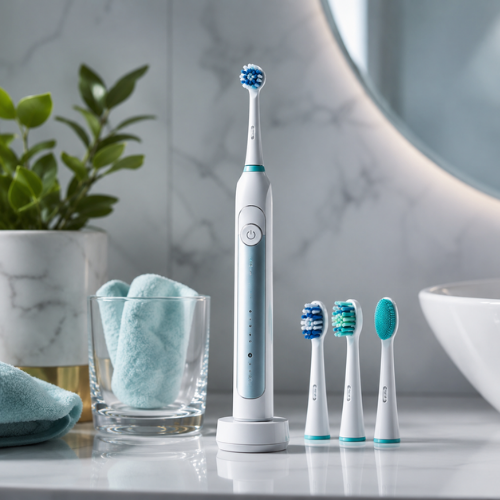
You bought an electric toothbrush 2 years ago. It still works. But does it still work well?
That’s the question nobody asks — until the day the dentist notices that plaque is building up in the same areas despite daily brushing. Or until the day the battery lasts only a week instead of a month.
An electric toothbrush is made up of several parts, each with its own lifespan: the brush head, the battery, the motor, and the electrical contacts. Confusing the lifespan of the whole brush with that of each component is the mistake that leads many people to use an ineffective brush for months without realizing it.
This guide explains exactly how long each part of your electric toothbrush lasts, how to spot signs of wear, and how to get the most from your investment over time.
The 4 components of an electric toothbrush and their lifespan
An electric toothbrush is not a single monolithic block. It is made up of four separate parts that age at very different rates.
Component 1 — The brush head
Recommended lifespan: 12 weeks (3 months)
This is the part that wears out the fastest — and the one most often neglected. The American Dental Association recommends replacing it every 12 weeks without exception. (Source: ada.org — Electric toothbrush guidelines)
The bristles on a brush head go through thousands of vibration or oscillation cycles per minute, for 4 minutes a day. Over 12 weeks, that adds up to about 840 minutes of high-frequency vibration — or several million mechanical cycles.
At that pace, the bristles gradually lose their ability to conform to the shape of the teeth and gums. They splay out, flatten, lose elasticity — and their cleaning effectiveness drops by 20 to 30%.
Visual signs of wear:
| Sign | What it means |
|---|---|
| Bristles splaying outward | Loss of elasticity — immediate replacement |
| Bristles flattened forward | Wear from excessive pressure |
| Bristle discoloration | Residue buildup — poor hygiene |
| Loose bristles | Defective head — replace immediately |
| Faded color indicator | Built-in replacement signal from the manufacturer |
Component 2 — The lithium-ion battery
Estimated lifespan: 2 to 4 years depending on use
Most modern electric toothbrushes use a built-in rechargeable lithium-ion battery — not user-replaceable. These batteries have a lifespan measured in charge cycles, generally between 300 and 500 full cycles.
For a brush charged every 2 weeks (14-day battery life), that works out to 26 charges per year. At 300 cycles, the battery should theoretically last more than 11 years. At 500 cycles and weekly charging, about 9 years.
But reality is different. Lithium-ion batteries also degrade over time independently of cycles, especially under the effects of heat and humidity — typical bathroom conditions. In practice, a noticeable drop in battery life is usually seen after 2 to 3 years.
Signs of battery wear:
- Battery life drops significantly (from 30 days to 10 days or less)
- The brush turns off during brushing despite a recent charge
- Charging time becomes unusually long
- The brush gets hotter while charging
Component 3 — The electric motor
Estimated lifespan: 3 to 5 years
The motor is the most robust part of the brush. It is designed to withstand millions of oscillation or vibration cycles. Under normal use and maintenance, a quality motor lasts 3 to 5 years — often longer.
The main causes of premature motor failure are water ingress (if the brush is not IPX7 and is used in the shower) and drops onto hard floors, which can misalign internal parts.
Signs of motor failure:
- Irregular vibrations or unusual noise
- Gradual loss of power (the vibrations feel less intense)
- Unexpected shutoffs unrelated to the battery
- Overheating of the handle during use
Component 4 — Electrical contacts and sealing gaskets
Estimated lifespan: 2 to 4 years
The contacts between the handle and the brush head, the IPX7 sealing gaskets, and the charging connectors gradually wear down due to humidity, limescale in tap water, and repeated micro-shocks.
Signs of wear:
- The brush head fits less securely on the handle
- Extra vibration or a rattling noise while brushing
- Water ingress despite the stated IPX7 rating (visible corrosion on the contacts)
Overall lifespan — What you can expect by price range
| Range | Indicative price | Handle lifespan | Battery lifespan | Head availability |
|---|---|---|---|---|
| Entry-level | 20-40€ | 1-2 years | 1-2 years | Variable |
| Mid-range | 40-80€ | 2-4 years | 2-3 years | Good |
| Premium | 80-150€ | 3-5 years | 3-4 years | Excellent |
| Professional | 150€+ | 5 years+ | 4-5 years | Excellent |
Critical point to check before buying: the availability of replacement heads. A brush whose heads are no longer available 2 years after purchase becomes unusable — even if the handle works perfectly. Choose brands that guarantee accessory availability for at least 5 years.
The 7 signs your electric toothbrush needs replacing
Sign 1 — Battery life has dropped by more than 50%
If your brush used to last from 30 days to less than 10-12 days between charges, the battery has lost a significant part of its capacity. It’s not dangerous, but it’s the first sign the brush is nearing the end of its useful life.
Sign 2 — The vibrations feel less intense
If it feels like your brush "vibrates less strongly" than when you bought it, that is often a sign of a weak battery no longer supplying enough current to the motor, or the motor itself beginning to fail.
Sign 3 — The brush turns off during brushing
Unexpected shutoffs during use — even after a full charge — indicate a faulty battery that can no longer maintain current under load.
Sign 4 — The brush head fits poorly
If the brush head moves, clicks, or no longer holds firmly on the handle, the attachment mechanism is worn. Depending on the model, this part may or may not be replaceable.
Sign 5 — An unusual noise has appeared
A rattling sound, a dull grinding noise, or irregular vibrations that were not present when you bought it usually indicate an internal mechanical issue.
Sign 6 — The brushing modes no longer work properly
If certain modes have become nonfunctional, if transitions between modes are erratic, or if the timer no longer works, the internal electronics are failing.
Sign 7 — You have had a serious oral infection
After certain oral infections (cold sores, thrush, strep throat), it is recommended to replace the brush head and, in some cases, consider replacing the entire brush if the head is no longer available for sale.
How to maximize the lifespan of your electric toothbrush
Daily care
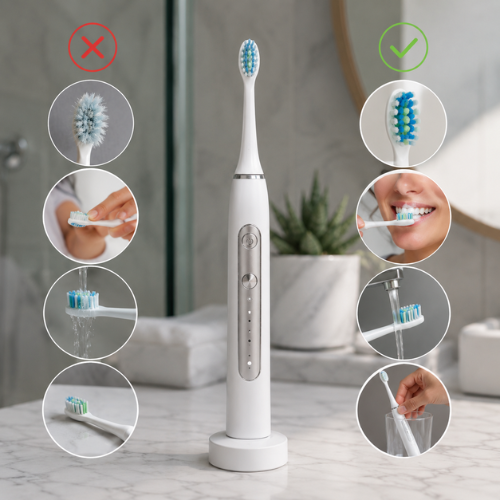
After each brushing:
- Rinse the head thoroughly under running water
- Shake off any remaining water
- Wipe the bottom of the handle with a dry cloth
- Store the head upright in open air
What you should never do:
- Submerge the handle in water (even if IPX7 — the certification has usage limits)
- Leave the brush in a closed, damp drawer
- Place the head facing down (water runs into the handle)
- Use harsh cleaners on the handle
Battery care
The lithium-ion battery degrades more if it is kept at 100% charge all the time or if it is regularly fully drained.
Best practices for the battery:
- Let the battery drop to 20-30% before recharging
- Avoid leaving the brush constantly plugged into the charger
- Do not charge it in a very hot or humid bathroom
- If you are going on a long trip, store the brush at 40-50% charge
Shock protection
Drops onto hard tile are the leading cause of premature mechanical failure. Keep your brush in a stable holder, away from the edge of the shelf. When traveling, store it in its travel case.
The cost calculation — When is it better to replace than to maintain?
This question comes up when the handle starts showing signs of failure but still works partially.
The replacement threshold:
| Situation | Decision |
|---|---|
| Faulty handle + heads available for less than 10€ | Buy the handle separately if possible |
| Faulty handle + heads at 15-20€ each | Complete replacement is often more economical |
| Working handle + weak battery after 4 years | Keep using until complete failure |
| Working handle + discontinued heads | Immediate replacement — the brush is unusable |
| Handle < 2 years + failure | Use the manufacturer warranty |
Recycling and environmental impact — What you need to know
An electric toothbrush contains electronic components and a lithium-ion battery that cannot be thrown in the regular trash. In France, they fall under the WEEE stream (Waste Electrical and Electronic Equipment).
How to recycle your old brush:
- Drop it off at a WEEE collection point (supermarkets, appliance stores, recycling centers)
- Some manufacturers offer take-back programs
- Standard plastic brush heads go in household waste (currently not recyclable in France)
- Bamboo brush heads: remove the bristles (nylon) before composting the handle
Conclusion — Investing wisely over time
A quality electric toothbrush is an investment of 40 to 80€ for the handle, and 30 to 40€ per year for replacement heads. Over 3 years, the total cost is around 130 to 200€ — or 43 to 66€ per year.
Compared with the 200 to 600€ spent annually at the dentist for mostly preventable care, it is the most cost-effective preventive investment in your bathroom.
Provided you replace the heads every 12 weeks, properly maintain the battery and handle, and watch for the 7 signs of wear described in this guide.
At DentalPro Smile™, our PureBrush Pro™ and NaturalBambou Pro™ brushes are covered by a 1-year warranty and designed to last 3 to 5 years with proper care. Our replacement heads are always available in our store.
Discover the DentalPro Smile™ range → Free delivery · 1-year warranty · Visible results in 7 days.
👉 dentalpro-smile.com/fr-fr
❓ FREQUENTLY ASKED QUESTIONS
1. Can you replace the battery of an electric toothbrush yourself?
In the vast majority of consumer electric toothbrushes, the lithium-ion battery is soldered inside the handle and cannot be replaced by the user without opening the casing — which voids the warranty and can damage the seal. Some high-end models offer battery replacement service through the manufacturer’s after-sales support. Check the warranty terms for your specific model before attempting any repair.
2. Does leaving the brush plugged in all the time damage the battery?
Yes, over time. Lithium-ion batteries degrade slightly faster when they are kept at 100% charge all the time. The recommended practice is to recharge when the battery drops to 20-30% and unplug once fully charged. It may seem inconvenient — but it significantly extends battery life over 2 to 3 years.
3. Are generic (non-original) brush heads just as effective?
Generic heads compatible with major brands are available at much lower prices. Their quality varies: some perform close to the originals, while others have bristles that are too sparse or a poor fit on the handle. For DentalPro Smile brushes, we recommend official heads to ensure compatibility and documented performance.
4. My electric toothbrush fell on the tile floor — do I need to replace it?
Not necessarily right away. First check that the brush head still attaches properly, that the vibrations are normal and consistent, and that there is no unusual noise. If everything works normally after the fall, keep using it while watching for the 7 signs of failure described in this article. A single drop on tile usually is not enough to damage a properly assembled quality handle.
5. How much does annual maintenance of an electric toothbrush cost on average?
For one person using the brush twice a day: 4 brush heads per year (replacement every 12 weeks). Depending on the model, heads cost between 6€ and 20€ each. Annual head budget: 24€ to 80€. For a premium brush with heads at 15€ each, annual cost is 60€ — or 5€ per month. Avoiding one scaling treatment (minimum 17€ out-of-pocket) more than covers this cost.
6. Should I replace my electric toothbrush after a herpes virus infection (cold sore)?
It is recommended to replace the brush head immediately after a cold sore appears and after it has fully healed. The Herpes simplex virus can survive on the bristles and cause recurrence or contamination. The handle itself does not come into direct contact with the lesions and does not need to be replaced — but wipe it with a gentle disinfectant. The same recommendation applies after strep throat.
Sources:
— American Dental Association — Toothbrush replacement guidelines : ada.org
— HAS — Oral health prevention recommendations : has-sante.fr
— Journal of Clinical Dentistry — Electric toothbrush longevity studies
— Consumer Reports — Electric toothbrush durability testing
— ADEME France — WEEE recycling guide : ademe.fr
Informational article only. Does not replace the advice of a dentist. DentalPro Smile™ — 2026.

Leave a comment
This site is protected by hCaptcha and the hCaptcha Privacy Policy and Terms of Service apply.