
You have been brushing your teeth twice a day for years. And yet, at every dentist visit, the verdict is the same: tartar to remove, slightly inflamed gums, and sometimes an emerging cavity.
It’s not your fault. It’s your toothbrush.
A manual toothbrush, even used with perfect technique, only effectively cleans 60 to 70% of tooth surfaces. The remaining 30 to 40% — interdental spaces, the gumline, and the inner tooth surfaces — collect bacterial plaque every day without being disturbed. Within 24 to 72 hours, this plaque hardens into tartar, impossible to remove without a professional.
The electric toothbrush fundamentally changes the game. Not because it’s a trendy gadget, but because its 30 000 to 45 000 vibrations per minute create a hydrodynamic effect that lifts plaque even in areas the bristles do not physically reach. It is scientifically proven, clinically validated, and visible in less than a week for most users.
In France, the electric toothbrush market has been growing by double digits annually since 2023. In 2026, with new sonic technologies and zero-waste bamboo alternatives, choosing the right toothbrush has become both a health issue and an environmental choice. This guide gives you all the answers.
The different electric toothbrush technologies — What really happens in your mouth
Before comparing models, it is crucial to understand what sets the available technologies apart — because marketing will tell you everything is "revolutionary," when the actual mechanisms are very specific.
The sonic toothbrush: the hydrodynamic effect explained
An electric toothbrush with a dental jet is an innovative device that combines the benefits of electric brushing with the power of a water jet to clean teeth and gums, making it possible to achieve superior oral cleanliness compared with traditional methods. emmi-dent
The sonic toothbrush generates between 30 000 and 45 000 vibrations per minute. At this frequency, the bristles do more than just scrub the tooth surface — they create micro-turbulence in the oral fluid (saliva + water) that extends the cleaning action beyond direct bristle contact. This is known as the hydrodynamic effect.
In practice, this means the brush cleans effectively up to 3 millimeters beyond the direct contact area — partially reaching the interdental spaces and gumline that bristles alone cannot reach.
The oscillating-rotating toothbrush: intensive mechanical cleaning
The rotating toothbrush uses a small round head that alternates between rotating and oscillating. It is the classic technology, very well documented clinically. It is particularly effective at dislodging early tartar through direct mechanical action.
Its weakness: it can be harsher on sensitive gums. Its small head is, however, an advantage for reaching hard-to-access posterior areas.
The ultrasonic toothbrush: cutting-edge technology
Ultrasonic toothbrushes operate with up to 1.6 million vibrations per second. The ultrasonic waves penetrate the tiniest gaps, even between braces and implants. Rakuten
Ultrasonic toothbrushes remain the most advanced technology — but also the least common in mainstream retail. They are particularly recommended for people with very sensitive gums, braces, or implants.
The bamboo electric toothbrush: performance and environmental responsibility
The sonic toothbrush with a bamboo handle delivers the same performance as the best plastic toothbrushes — with a drastically reduced environmental impact. The bamboo handle is biodegradable, and the electronic components can be recycled through WEEE channels. It is the ideal solution for combining clinical effectiveness and environmental responsibility.
The 7 essential criteria for choosing your electric toothbrush
Ignoring these criteria means risking buying an unsuitable toothbrush — and slipping back into your bad habits within 3 weeks.
Criterion 1 — Vibration frequency
The minimum threshold for a real hydrodynamic effect is 30 000 vibrations per minute. Below that, you only get improved mechanical brushing — better than manual, but without the fluid propagation effect.
| Frequency | Effect | For whom |
|---|---|---|
| < 20 000 vib/min | Improved mechanical | Beginners |
| 30 000 vib/min | Standard sonic | General use |
| 40 000-45 000 vib/min | High-performance sonic | Tartar, whitening |
| > 1 000 000 vib/sec | Ultrasonic | Specific profiles |
Criterion 2 — Brushing modes
A quality toothbrush offers at least 3 modes. Clean mode for daily use, Sensitive mode for reactive gums, and White mode for discoloration. Premium brushes add Gum Care (gum massage) and Polish (surface polishing) modes.
Criterion 3 — Real battery life
The battery life claimed is often overstated by manufacturers. A minimum of 14 days of battery life is necessary for comfortable home use. DentalPro Smile toothbrushes last 30 days on one charge — meaning monthly charging and eliminating the daily burden.
Criterion 4 — Timer and quadrant signal
The timer is non-negotiable. Without it, 80% of adults stop before 60 seconds. The timer should indicate the end of the 2 minutes and ideally beep every 30 seconds to signal quadrant changes (4 quadrants × 30 seconds = 2 minutes of optimal brushing).
Criterion 5 — Pressure sensor
If you tend to press hard on your brush — a very common habit — the pressure sensor is essential. Excessive pressure wears down enamel by 2 to 3% per year and irritates the gums. The sensor alerts you when you exceed the safe threshold.
Criterion 6 — Water resistance (IP Rating)
IPX7 water resistance allows full immersion up to 1 meter. This is the recommended standard for a toothbrush usable in the shower or bath — with no electrical risk.
Criterion 7 — Total cost of ownership
A toothbrush at 40€ with replacement heads at 20€ each, changed every 12 weeks (4 times a year), costs 40€ + 80€/year = 120€ in the first year. A toothbrush at 70€ with heads at 8€ costs 70€ + 32€/year = 102€. Always calculate the total cost over 3 years.
The correct technique — What no one really teaches you
Buying the best electric toothbrush in the world is useless if you use it with the wrong technique. And the technique for an electric toothbrush is fundamentally different from that of a manual toothbrush.
The golden rule: you guide, you do not scrub.
With a manual toothbrush, friction is the engine of cleaning. With a sonic or rotating electric toothbrush, vibration does the work — your role is simply to position the brush correctly.
The 7-step protocol:
- Apply the toothpaste to the dry head before putting it in your mouth (prevents splashing)
- Lightly moisten the head under water
- Hold at a 45° angle to the tooth-gum junction
- Turn it on in your mouth — never before
- Move slowly from tooth to tooth — 2 to 3 seconds per tooth
- Do not press — let the weight of the brush create contact
- Spit after brushing — do not rinse — let the fluoride act for at least 30 minutes
This last point surprises many people. Immediate rinsing removes the protective fluoride from toothpaste before it has time to act on the enamel. The French National Authority for Health recommends spitting without rinsing.
Electric toothbrushes and specific profiles — The right brush for your situation
Profile 1 — Sensitive or bleeding gums
Bleeding during brushing signals gum inflammation caused by plaque in the interdental spaces. The sonic toothbrush in Sensitive mode cleans without traumatizing inflamed tissues. Combined with a daily dental jet, it reduces bleeding within 14 days in most cases.
Profile 2 — People with fixed braces
The sonic toothbrush is superior to the rotating one for fixed orthodontics: its hydrodynamic effect partially cleans around brackets without traumatizing them. An orthodontic head (V-shaped bristles that wrap around the bracket) maximizes effectiveness. The dental jet remains essential as a supplement.
Profile 3 — People looking to whiten their teeth naturally
Extrinsic stains (coffee, tea, red wine) build up on plaque. A sonic toothbrush at 40 000+ vib/min in White mode effectively removes these staining deposits. Visible results in 4 to 8 weeks of regular morning and evening use.
Profile 4 — Seniors with reduced dexterity
The sonic electric toothbrush is particularly suitable for people suffering from arthritis or tremors. The vibration does the cleaning work — the user only needs to position the brush correctly, without precise friction movements.
Profile 5 — Eco-conscious profile
Ultrasonic toothbrushes are fundamentally suitable for anyone who wants to clean their teeth gently, especially those with sensitive gums, gingivitis and periodontitis, and people with braces, implants, and bridges. Rakuten
The bamboo-handled sonic toothbrush offers the same performance as a premium plastic brush with a drastically reduced environmental impact. It is the ideal choice for committed consumers.
Maintenance and lifespan — How to extend your investment
When should you replace the brush head?
The American Dental Association recommends replacing it every 12 weeks. Frayed or flattened bristles reduce cleaning effectiveness by up to 30% and can traumatize the gums. The simple rule: if the bristles start to splay sideways, it’s time to change it.
How to clean the brush between uses
- Rinse the head thoroughly under running water after each use
- Shake off the remaining water
- Let it air dry — never in a closed case (bacteria buildup)
- Never share your brush head, even within the family
- Replace the head after any illness (flu, sore throat)
How to maintain the electric handle
Wipe the handle weekly with a slightly damp cloth. Never submerge the handle in water (unless IPX7 is confirmed for the entire device, not just the head). Fully charge before first use and avoid repeated full discharges to preserve the lithium-ion battery.
Conclusion — Investing in the right brush is investing in your health
A quality electric toothbrush is an investment of 40 to 80€. Compared with the 200 to 600€ spent annually at the dentist for partly preventable care, it is one of the best returns on investment in your bathroom.
The key: choose according to your real profile, not according to advertising. Use it with the right technique. And stay consistent — twice a day, two minutes, all year long.
At DentalPro Smile™, each brush in our range has been designed to meet a specific profile: PureBrush Pro™ for adults seeking maximum performance, NaturalBambou Pro™ for eco-conscious profiles, and KidSmile Pro™ for children aged 3 to 15.
Discover the full DentalPro Smile™ range → Free delivery · 1-year warranty · Visible results in 7 days.
👉 dentalpro-smile.com/fr-fr
❓ FREQUENTLY ASKED QUESTIONS
1. What is the difference between a sonic toothbrush and an oscillating toothbrush?
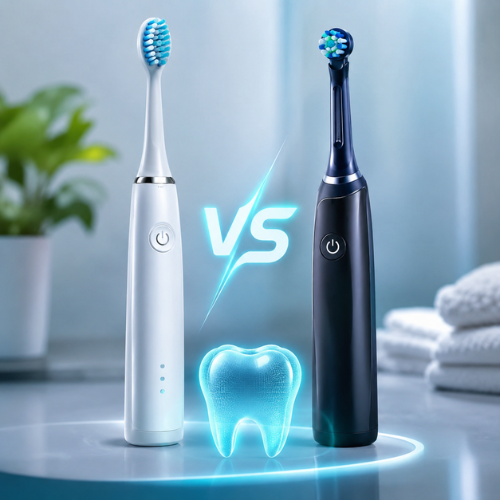
The sonic toothbrush generates high-frequency vibrations (30 000 to 45 000 vib/min), creating a hydrodynamic effect that cleans beyond direct bristle contact. The oscillating toothbrush uses a round head that rotates and oscillates mechanically. The sonic toothbrush is generally gentler on the gums, while the rotating one is more effective on early tartar through direct mechanical action. Both are clinically superior to a manual toothbrush.
2. Should you rinse your mouth after electric brushing?
No — and it’s one of the most common mistakes. Immediate rinsing removes the fluoride from toothpaste before it has time to act on the enamel. The French National Authority for Health recommends spitting without rinsing, or waiting at least 30 minutes. If you use mouthwash, wait 30 minutes after brushing as well.
3. How often should you replace the electric brush head?
Every 12 weeks according to the American Dental Association — that is, 4 times a year. Frayed bristles reduce cleaning effectiveness by up to 30% and can traumatize the gums. Also replace it after any infectious illness (flu, sore throat) to avoid reinfection.
4. Can an electric toothbrush damage enamel?
No, if it is used correctly. The sonic toothbrush with guiding technique (no scrubbing) and an active pressure sensor poses no risk to enamel. It is excessive rubbing with a hard manual toothbrush or incorrect use of an electric toothbrush (pressing too hard) that gradually wears enamel away.
5. Can an electric toothbrush be used with dental implants?
Yes — sonic toothbrushes are generally recommended by implant specialists for implant wearers. It cleans effectively around the crown and along the emergence profile without traumatizing the peri-implant tissues. Use Sensitive mode and avoid pressing directly on the implant-gum junction area.
6. Is a bamboo electric toothbrush as effective as a plastic one?
Yes — with equivalent sonic technology, the cleaning performance is identical. The handle is bamboo (biodegradable) but the motor technology is the same as in premium plastic brushes. The only difference is environmental: the bamboo handle significantly reduces the plastic impact of your oral care routine over 3 to 5 years of use.
Sources :
— HAS — Oral health prevention recommendations : has-sante.fr
— American Dental Association — Toothbrush guidelines : ada.org
— Futura-Sciences — Dental jet comparison 2026 : futura-sciences.com
— meilleurs.fr — Electric toothbrush comparison 2026
— emmi-dent.fr — Ultrasonic dental technology
Informational article only. Does not replace the advice of a dental surgeon. DentalPro Smile™ — 2026.

Leave a comment
This site is protected by hCaptcha and the hCaptcha Privacy Policy and Terms of Service apply.