
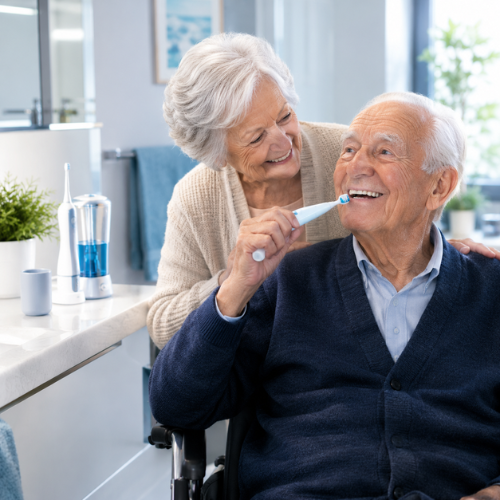
Brushing your teeth. A gesture that 95% of adults do without thinking twice.
But for people suffering from hand arthritis, essential tremor, stroke aftereffects, Parkinson's disease, multiple sclerosis, or any other condition affecting fine motor control in the hands — this everyday gesture can be a real challenge. Painful, imprecise, frustrating. Sometimes simply impossible to do properly on your own.
In France, around 10 million people suffer from arthritis according to Inserm data. Essential tremor affects around 400,000 people, Parkinson's disease around 200,000. (Source: Inserm — epidemiological data on neurological and rheumatological diseases)
This guide is for those people — and their caregivers — with practical solutions that have been tested and adapted to different levels of mobility.
Why the sonic electric toothbrush is particularly suitable for people with reduced mobility
The sonic electric toothbrush offers structural advantages that make it especially valuable for people with reduced mobility — regardless of any specific adaptation.
Advantage 1 — No scrubbing motion required
With a manual toothbrush, cleaning effectiveness depends directly on the quality of the wrist scrubbing motion. A person with severe arthritis, significant tremors, or hemiplegia often cannot reproduce this motion in a controlled way.
With a sonic electric toothbrush, the user only needs to position and guide it slowly — the motor does the cleaning. A slow, imprecise motion gives far better results than a fast, precise motion with a manual toothbrush.
Advantage 2 — The built-in timer replaces time awareness
People with reduced mobility — especially those with associated cognitive impairment (Parkinson's, stroke) — may have difficulty subjectively judging how long they have brushed. The timer ensures the full 2 minutes without extra cognitive effort.
Advantage 3 — The bulky handle makes it easier to hold
Most electric toothbrushes have thicker handles than manual toothbrushes. This larger diameter reduces the pressure needed from the fingers to keep hold of the brush — a direct benefit for people with arthritis or weak grip.
Advantage 4 — The pressure sensor compensates for imprecision
A person with tremors may apply too much pressure on certain teeth because of hand instability. The pressure sensor signals this excess and automatically corrects it — protecting enamel and gums from damage caused by unintentional overpressure.
The different profiles and their specific needs
Profile 1 — Hand arthritis
Specific challenges:
- Pain when gripping — holding a toothbrush can be painful
- Morning stiffness — joints are less mobile on waking
- Reduced grip strength — risk of dropping the brush
Suitable solutions:
Solution 1 — Non-slip ergonomic sleeve
A foam or silicone sleeve slipped over the handle increases the gripping diameter and reduces the pressure needed on the finger joints. Available at pharmacies or from occupational therapists (about 3 to 8€). Compatible with most standard electric toothbrushes.
Solution 2 — Large-diameter handle
Some manufacturers offer handles specifically designed with a large diameter (4 to 5 cm) for people with reduced grip. This diameter allows a full-palm grip rather than a pinch grip — much less painful for arthritic joints.
Solution 3 — One careful brushing a day if pain is severe
In case of intense pain during inflammatory flare-ups, one thorough daily brushing (in the evening) is preferable to two rushed or interrupted brushings. This temporary adjustment should be discussed with the dentist and rheumatologist.
Optimal timing: for rheumatoid arthritis, morning stiffness is at its worst on waking and decreases later in the morning. If possible, delay morning brushing until 30 to 60 minutes after getting up.
Profile 2 — Essential tremor
Specific challenges:
- Action tremor in the hands (kinetic tremor) — worsens during movement
- Unpredictable tremor amplitude — variable, uncontrolled pressure
- Fatigue — tremors can increase with tiredness
Suitable solutions:
Solution 1 — Weigh down the toothbrush handle
Adding weight to the handle reduces tremor amplitude through inertia. Special weighted sleeves for utensils (forks, pencils, etc.) can be adapted to an electric toothbrush handle. Occupational therapists can create custom adaptations.
Solution 2 — Two-handed support
Using both hands to hold the toothbrush reduces tremor amplitude — the non-dominant hand stabilizes the dominant hand. This technique feels intuitive to many people affected.
Solution 3 — Resting on a fixed object
Resting the forearm on the edge of the sink while brushing reduces tremor amplitude by creating a proximal point of support. The sonic electric toothbrush is particularly well suited to this technique — the cleaning motion is generated by the motor, not the wrist.
Solution 4 — Brush with greater mass
A heavier toothbrush (some models reach 180 to 200g with built-in charger) may reduce tremor amplitude through inertia — the same principle as weighted cutlery.
Profile 3 — Hemiplegia (paralysis on one side after stroke)
Specific challenges:
- Must use the non-dominant side — unusual grip
- Difficulty keeping the brush stable with one hand
- Possible apraxia or spatial neglect (right hemisphere affected) — difficulty initiating or organizing the movement
Suitable solutions:
Solution 1 — Suction-cup toothbrush holder
A suction-cup holder fixed to the sink edge or bathroom wall lets the brush be set down between brushing phases without risk of dropping it. Available at pharmacies or medical supply stores.
Solution 2 — Wall-mounted fixed brush
Some systems allow the brush to be fixed to a wall mount and the head to be moved instead of the brush — especially suited to severe hemiplegia where coordination is very limited.
Solution 3 — Caregiver-assisted brushing
For severe hemiplegia, brushing with the help of a caregiver using a sonic electric toothbrush is much less demanding than manual brushing — the caregiver simply guides the head, the motor does the work. This approach is also less invasive and less uncomfortable for the person being brushed.
Solution 4 — U-shaped brush
The U-shaped toothbrush — which fits into the mouth and cleans the outer, inner, and chewing surfaces at the same time — can be a solution for cases where coordination is very limited. The clinical effectiveness of U-shaped brushes remains lower than that of standard sonic brushes for adults, but they can be an acceptable compromise for some people with very limited coordination.
Profile 4 — Parkinson's disease
Specific challenges:
- Resting and action tremors
- Muscle rigidity
- Bradykinesia (slow movement)
- Possible dysarthria and swallowing difficulties — risk of swallowing toothpaste or water
- Variable effects depending on treatment phases (on/off)
Suitable solutions:
Critical timing: for people on dopaminergic treatment, motor performance varies depending on treatment effect phases. Plan brushing during the "ON" phases (usually 30 to 60 minutes after taking the medication) for better coordination.
Gel toothpaste rather than paste: the gel adheres better to the brush head and spreads less randomly during brushing — a practical advantage for people with reduced coordination.
Reduced amount of toothpaste: reducing the toothpaste amount to the equivalent of half a grain of rice lowers the risk of accidental swallowing.
Assisted rinsing: using a measuring cup with a spout makes rinsing easier and reduces the risk of aspiration.
Profile 5 — Multiple sclerosis and other neurological diseases
Specific challenges:
- Extreme fatigue — brushing can be exhausting
- Spasticity — sudden involuntary movements
- Symptom variability during flare-ups
Suitable solutions:
Optimizing position: brushing while seated (on a stool or in a wheelchair) rather than standing reduces fatigue. An adjustable mirror allows visual control while seated.
Breaking brushing into sections: during periods of major fatigue, dividing brushing into two 1-minute phases separated by a few minutes can be more manageable than one continuous 2-minute session.
The essential role of the occupational therapist
This is the professional to consult first for any oral hygiene adaptation related to reduced mobility.
The occupational therapist can:
- Precisely assess remaining functional abilities
- Suggest custom adaptations (sleeves, weights, supports)
- Teach specific compensation techniques
- Coordinate with the dentist for consistent recommendations
- Prescribe reimbursable assistive devices depending on the situation
In France, occupational therapy is reimbursed within a care network or with a specific medical prescription. Some mutual insurance plans cover outpatient occupational therapy sessions.
Summary table — Adaptations by profile
| Profile | Main adaptation | Complementary tool | Professional help |
|---|---|---|---|
| Mild to moderate arthritis | Ergonomic sleeve | Large-diameter electric toothbrush | Rheumatologist |
| Severe arthritis | Assisted brushing + sleeve | Prosthesis ultrasonic cleaner | Occupational therapist |
| Essential tremor | Two-handed support + weighting | Heavier toothbrush | Occupational therapist |
| Moderate hemiplegia | Brush with non-dominant hand | Suction-cup holder | Occupational therapist |
| Severe hemiplegia | Assisted brushing | U-shaped brush as a supplement | Physical therapist |
| Parkinson's | Brushing in ON phase | Dental gel + reduced amount | Neurologist + occupational therapist |
| Multiple sclerosis | Seated + split brushing | Adjustable mirror | Occupational therapist |
Assisted brushing — Guide for caregivers
For professional or family caregivers assisting the brushing of a person with reduced mobility, the sonic electric toothbrush greatly simplifies care.
The optimal position for assisted brushing:
| Position of the person receiving help | Advantages | Disadvantages |
|---|---|---|
| Seated facing the mirror | Visibility for both | Limited access to the back |
| Seated, caregiver behind | Better access to all areas | Less visual control |
| Lying down (hospital bed) | Maximum rest | Aspiration risk — safety |
Safety rules for brushing while lying down:
- Always tilt the head to one side — never backward
- Use the minimum amount of toothpaste
- Remove liquids with a gauze pad or gentle suction
- Never brush an unconscious person or someone with severe swallowing disorders without specific training
Technique for the caregiver:
- Always ask for consent before starting
- Explain each step out loud — even if the person does not respond verbally
- Gently guide the sonic brush from tooth to tooth — the motor does the cleaning
- Watch facial reactions to detect pain or discomfort
- Do not exceed 2 minutes — fatigue can be significant
The most useful complementary products for people with reduced mobility
Ultrasonic cleaner
For denture or aligner wearers, the ultrasonic cleaner is the most suitable tool for reduced mobility. The operation is limited to placing the device in the tray and pressing a button — no complex handling, no risk of dropping it, no physical effort.
Water flosser
Recommended — but it may require an adapted grip depending on the profile. Models with a non-slip ergonomic handle and flexible hose are preferable for people with reduced mobility. Starting at the lowest pressure reduces the risk of spraying if movements are imprecise.
Ergonomic tongue scraper
The anatomically shaped U-shaped stainless-steel tongue scraper is generally easier to handle than a tongue brush for people with reduced grip — its shorter handle and single-motion action make it accessible.
Conclusion — The electric toothbrush as a tool for independence
For people with reduced mobility, the sonic electric toothbrush is not a luxury — it is a tool for independence. It turns a gesture that had become difficult, painful, or imprecise into an accessible and effective routine — with or without outside help.
Investing in the right toothbrush, combined with the simple adaptations described in this guide, can make the difference between maintained dental hygiene and gradual decline caused by the inability to brush properly.
At DentalPro Smile™, our PureBrush Pro™ with ergonomic handle, Sensitive mode, pressure sensor, and built-in timer is the reference tool for people with reduced mobility.
Discover the PureBrush Pro™ DentalPro Smile™ → Suitable for people with reduced mobility · Free delivery · 1-year warranty.
👉 dentalpro-smile.com/fr-fr
❓ FAQ
1. Does health insurance reimburse assistive devices for brushing teeth?
Sleeves and utensil adaptations prescribed by an occupational therapist may be partly covered through the MDPH (Departmental House for Disabled People) depending on the recognized level of disability. The electric toothbrush itself is not reimbursed by Health Insurance. Some mutual insurance plans offer "well-being" or "independence support" packages that may partly cover these purchases. Check your mutual insurance policy and consult your local MDPH to find out what benefits are available in your situation.
2. Is the U-shaped brush really suitable for adults with reduced mobility?
The U-shaped brush — which fits into the mouth to clean all three tooth surfaces at the same time — can be a compromise solution for people with very limited coordination, since it only requires a simple jaw movement. Its clinical effectiveness remains lower than that of a standard sonic brush for adults — available studies show less complete cleaning, especially on gingival areas. It may be considered as the main solution if all other alternatives are impossible, or as an occasional supplement.
3. How can the bathroom be adapted to make brushing easier for a person with reduced mobility?
Several simple adaptations significantly improve accessibility: wall-mounted holder at adjustable height for the brush and glass, adjustable or magnifying mirror at the right height, shower stool in front of the sink for seated brushing, lever toothpaste dispenser (avoids unscrewing the cap), pump soap dispenser to make hand rinsing easier. An occupational therapist can carry out a home assessment and propose a personalized adaptation plan.
4. Can a person with Parkinson's use a water flosser?
Yes — with precautions. A water flosser at minimum pressure is generally accessible to people with Parkinson's in the ON phase of their treatment. Leaning forward over the sink reduces the risk of swallowing water. Models with a non-slip handle and an easy-to-operate trigger are preferable. In the OFF phase or during significant tremors, postpone use until a better time of day.
5. How do you teach assisted brushing to an untrained professional caregiver?
Start with a demonstration on yourself of the sonic brushing guidance technique (no scrubbing — slow tooth-to-tooth guidance). Explain the areas to cover systematically (outer surfaces, inner surfaces, chewing surfaces) and the 2-minute duration. Stress communication with the person receiving care before, during, and after the procedure. In nursing homes, some facilities offer specific oral care training — report this need to the care management team. The UFSBD (French Union for Oral Health) offers training resources for home care professionals.
6. Should you see the dentist more often when you have reduced mobility?
Yes — strongly recommended. People with reduced mobility are statistically more exposed to oral health problems (more difficult hygiene, medications that can cause dry mouth, modified diet). A dental check-up every 4 to 6 months is recommended for this group, with particular attention to detecting cavities in hard-to-brush areas. Always mention your mobility limitations to your dentist — they will adjust their recommendations and may refer you to home care if travel is difficult.
Sources:
— Inserm — Epidemiological data on arthritis and neurological diseases in France: inserm.fr
— HAS — Oral hygiene recommendations for dependent people: has-sante.fr
— UFSBD — Oral hygiene guide for people with disabilities: ufsbd.fr
— Journal of Disability and Rehabilitation — Oral hygiene adaptations for motor impairment
— American Dental Association — Dental care for patients with disabilities: ada.org
Informational article only. It does not replace the advice of a dentist, occupational therapist, or specialist physician. DentalPro Smile™ — 2026.



Leave a comment
This site is protected by hCaptcha and the hCaptcha Privacy Policy and Terms of Service apply.