
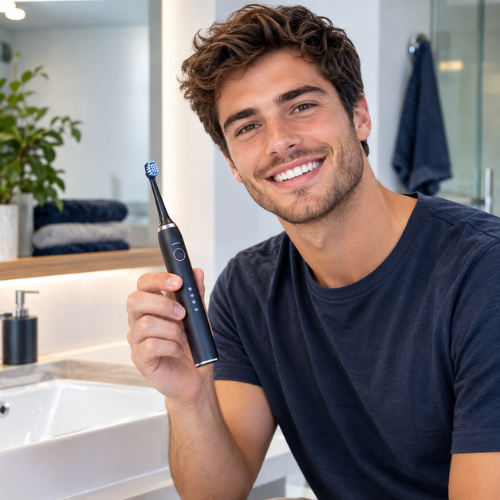
150€. 200€. Sometimes 250€ for the top-of-the-line models.
Do these premium electric toothbrushes really clean your teeth better? Is their price justified by real clinical benefits — or is it mainly marketing engineering built on top of solid technology already available for 50€?
That is the question many adults ask themselves when it’s time to replace their toothbrush. And it’s a legitimate question that deserves an honest answer — not the answer premium toothbrush makers or sponsored comparison sites want to give you.
This guide objectively analyzes each premium toothbrush feature, assesses its real clinical impact on your dental health, and clearly tells you what is worth the extra cost — and what is not.
The key question — What is a "premium" toothbrush in 2026?
The term "premium" is used freely by manufacturers without a standardized definition. For this comparison, we define a premium electric toothbrush as any model sold for more than 80€ — the range where you find the high-end models from major brands and specialist brands.
What usually sets a premium toothbrush apart:
| Feature | Presence in premium models |
|---|---|
| Vibration frequency ≥ 40,000 vibrations/min | ✅ Standard |
| 5 brushing modes or more | ✅ Standard |
| Advanced pressure sensor | ✅ Standard |
| Timer with quadrant signal | ✅ Standard |
| Bluetooth + app connection | ✅ Very common |
| Real-time brushing coaching | ✅ Common |
| Automatic brushing zone detection | 🟡 Very high-end models |
| 30 days or more battery life | ✅ Common |
| Travel case included | ✅ Common |
| Multiple replacement heads included | ✅ Common |
| Premium materials (handle) | ✅ Common |
Feature-by-feature analysis — What is worth the price and what is not
Feature 1 — Vibration frequency ≥ 40,000 vibrations/min
Clinical impact: REAL — but marginal beyond 30,000
As we saw in the article on 45,000 vibrations per minute, the clinically significant hydrodynamic effect starts at 30,000 vibrations. The difference between 30,000 and 45,000 is real but modest for standard users — more noticeable for those with tight interdental spaces or whitening goals.
Verdict : ✅ Justified if your profile matches (tight spaces, whitening). 🟡 Marginal for standard users.
Feature 2 — The 5 brushing modes
Clinical impact: REAL for some modes — none for others
The Clean and Sensitive modes are clinically relevant for all users. The Gum Care mode has documented benefits for gum health. The White mode is useful for stains.
The 5th mode (Deep Clean, Tongue, or a variant) is rarely used and its clinical impact is limited.
Verdict : ✅ 3 to 4 modes have real clinical value. 🟢 The 5th mode is a comfort bonus.
Feature 3 — The advanced pressure sensor
Clinical impact: REAL and documented
This is one of the premium features with the biggest real clinical impact. As we covered in the dedicated article, 80% of adults brush too hard — causing enamel wear and gum recession over the long term.
The advanced pressure sensor in premium models differs from basic versions by:
- More precise pressure measurement (fine gradation vs a simple threshold)
- More nuanced feedback (multiple alert levels vs a single alert)
- Integration with the app for historical pressure tracking
Verdict : ✅ Strongly justified for at-risk users (vigorous brushers, recurring gum issues, cervical sensitivity). 🟡 Useful but not essential for users already aware of their pressure.
Feature 4 — Bluetooth connection and the smartphone app
Clinical impact: CONDITIONAL — entirely depends on how you use it
This is the most debated feature — and the most honestly divisive.
What the app can do:
- Guide brushing zone by zone in real time
- Record the duration and pressure of each brushing session
- Detect areas that are chronically neglected over several weeks
- Offer personalized brushing programs
- Send head replacement reminders
What the studies say about the app:
Studies published in the Journal of Clinical Periodontology have assessed the impact of app-based coaching on brushing quality. The results show improved brushing coverage and duration in the first weeks of use. However, this effect tends to fade after 8 to 12 weeks — when the novelty wears off and app use becomes less regular. (Source: Journal of Clinical Periodontology — app-guided toothbrushing studies)
The reality of use:
According to usage data reported by some manufacturers, fewer than 30% of connected toothbrush buyers use the app regularly after 3 months. Which means that for 70% of buyers, the most expensive feature of their premium toothbrush is not used.
Verdict : ✅ Very useful for people who actually use the app long term. 🔴 Wasteful for the 70% who stop using the app after a few weeks.
Feature 5 — Automatic brushing zone detection
Clinical impact: POTENTIALLY HIGH — still emerging technology
Very high-end models (generally > 150€) integrate sensors that automatically detect which area of the mouth is being brushed — via accelerometer, gyroscope, or artificial intelligence linked to the app.
This feature lets the app visualize the treated areas in real time and identify each user’s chronic blind spots.
Current limitation : this detection remains imperfect on mainstream models. Distinguishing between the outer and inner surfaces of the same area, or between two adjacent teeth, is beyond the current capabilities of systems available for less than 200€.
Verdict : 🟡 Promising feature, but still needs improvement. Justified if accuracy improves in future versions.
Feature 6 — 30-day battery life
Clinical impact: NONE — real practical impact
A 30-day battery life vs 14 days has no impact on cleaning quality. It is purely a practical advantage — especially for frequent travelers who can leave for a month without bringing their charger.
Verdict : 🟢 Comfort only. Justified for frequent travelers, unnecessary for home users.
Feature 7 — Material quality and durability
Clinical impact: INDIRECT — real economic impact
Premium toothbrushes use higher-quality materials: reinforced ABS plastics, more durable seals, corrosion-resistant metal electrical contacts, more robust precision motors.
Result: an average lifespan of 4 to 6 years for premium toothbrushes vs 2 to 4 years for entry-level models.
The 6-year cost calculation:
| Scenario | Total cost over 6 years |
|---|---|
| 2 entry-level toothbrushes (2 × 40€) + heads (6 years × 40€) | 320€ |
| 1 premium toothbrush (150€) + heads (6 years × 60€) | 510€ |
| 1 premium toothbrush (100€) + heads (6 years × 40€) | 340€ |
Verdict : 🟡 Better durability does not fully offset the higher upfront cost over 6 years for standard users. It becomes worthwhile if the toothbrush really lasts 6 years vs 2 years for the entry-level model.
Summary table — Feature by feature
| Premium feature | Clinical impact | Price justification | For whom |
|---|---|---|---|
| Frequency ≥ 40,000 vibrations/min | 🟡 Marginal | 🟡 Partial | Tight spaces, whitening |
| 5 brushing modes | ✅ Real (3-4 modes) | ✅ Yes | Varied users |
| Advanced pressure sensor | ✅ Real and documented | ✅ Yes | Vigorous brushers |
| Bluetooth + app | 🟡 Conditional | 🟡 If actually used | Regular app users |
| Automatic zone detection | 🟡 Emerging | 🟡 Partial | Early adopters |
| 30-day battery life | ❌ No clinical impact | 🟢 Travelers | Frequent travelers |
| Durable materials | 🟡 Indirect | 🟡 Long-term | Long-term intensive use |
For which users is a premium toothbrush really justified?
Profile A — A premium toothbrush is clearly justified
You have sensitive gums with a history of gum recession
The advanced pressure sensor and Gum Care mode on a premium toothbrush can prevent gum damage whose corrective cost (gum grafts: 500 to 1,500€) far exceeds the extra cost of the toothbrush.
You have dental implants
The precision of the Sensitive mode and pressure sensor on premium toothbrushes is especially valuable around implants — where excessive pressure can speed up peri-implantitis.
You are in active periodontal treatment
During periodontal maintenance, brushing precision is critical. App coaching and detection of neglected areas can make a measurable clinical difference.
You have trouble maintaining a regular routine
App reminders, performance tracking, and brushing gamification help some users maintain a routine they previously abandoned. For this profile, the extra cost may be justified by better compliance.
Profile B — A premium toothbrush is not justified
You have healthy teeth and gums with no specific issue
A decent sonic toothbrush for 45-55€ with a timer and 2 modes will give you clinical results identical to a 150€ toothbrush on healthy teeth and gums. The extra cost is not clinically justified.
You won’t use the app
If you already know you won’t use the app regularly (you’re not very familiar with health apps, you find them burdensome), you are paying 50 to 80€ more for a feature whose potential you won’t use 80% of.
You are consistent and have good technique
If you already have good brushing technique (correct pressure, proper duration, full coverage), coaching features are unnecessary — you don’t need a tool to fix mistakes you’re not making.
Your dental budget is tight
If the choice is between a premium toothbrush and giving up on electric brushing, or between a premium toothbrush and needed dental care — the decent 50€ toothbrush is clearly the better overall economic decision.
What the studies say about the real performance difference
Clinical studies comparing entry-level and premium sonic toothbrushes show nuanced results.
On plaque reduction:
Measured differences between sonic toothbrushes in controlled clinical studies are generally small across price ranges — under 10% in most studies. These differences are statistically significant under controlled lab conditions, but hardly noticeable in everyday real-world use.
On gingivitis reduction:
Studies have shown that the premium toothbrush with app coaching produced slightly better gum improvement than the standard toothbrush over 12 weeks — mainly thanks to improved brushing duration and area coverage, not the technology itself.
Study conclusion : the superiority of premium toothbrushes in clinical outcomes is real but modest — and mainly due to behavioral features (coaching, pressure sensor) rather than the vibration technology itself.
The real value of a premium toothbrush — What nobody says
There is one aspect of premium value that comparison charts do not measure: the engagement effect.
People who invest 150€ in a toothbrush tend to use it more regularly, with more attention, and for longer. The higher investment creates stronger psychological commitment to the dental routine.
This effect is hard to quantify but real — and it may be the most important clinical benefit factor for some users.
If you know you are that kind of person (you take better care of things you’ve invested in), a premium toothbrush may produce better results for you — not because of its technology, but because of the commitment it creates.
Conclusion — The truth about premium toothbrush pricing in 2026
A 150€ premium toothbrush does not clean 3 times better than a 50€ toothbrush.
But it can fit certain specific users much better: sensitive gums with a history of recession, implant wearers, periodontal maintenance patients, or people who struggle to keep a routine without coaching.
For standard users with healthy teeth and gums, a good sonic toothbrush for 45-55€ with a timer, Sensitive mode, and available replacement heads is the most economically rational choice — with clinical results close to premium models.
At DentalPro Smile™, our PureBrush Pro™ offers the clinically relevant features of a premium toothbrush — 45,000-vibration sonic technology, 5 modes, pressure sensor, timer with quadrant signal — at a price that delivers the best real clinical value for money on the market.
Discover the PureBrush Pro™ DentalPro Smile™ → Premium clinical performance · Rational price · Free delivery · 1-year warranty.
👉 dentalpro-smile.com/fr-fr
❓ FREQUENTLY ASKED QUESTIONS
1. Does a 200€ toothbrush really last longer than a 50€ toothbrush?
In general, yes — but not necessarily 4 times longer. Premium toothbrushes use higher-quality materials and more robust motors, which translates into an average lifespan of 4 to 6 years vs 2 to 4 years for entry-level models. However, real lifespan also depends on maintenance (contacts cleaned regularly, proper storage, no drops) — a well-maintained 50€ toothbrush can last 4 years, while a neglected 200€ toothbrush can fail after 18 months.
2. Is a premium toothbrush’s coaching app really useful for improving brushing?
Yes — during the first weeks. Studies show improved brushing coverage and duration in the first 4 to 8 weeks of use with coaching. The effect then declines as app use becomes less regular. For people who keep using the app long term, the benefit is cumulative. For those who abandon the app after a few weeks — the majority — the benefit is temporary.
3. Is a premium toothbrush pressure sensor really more accurate than entry-level models?
Yes, generally. Sensors in premium models offer graded measurement with multiple alert levels (light pressure, excessive pressure, very excessive) vs a binary alert (normal/too hard) on entry-level models. This fine gradation is clinically more useful for gradually learning the correct technique, and the pressure history available in the app allows progress tracking over weeks.
4. Should you buy a premium toothbrush for a child?
No — and it’s often counterproductive. Children tend to lose or damage their toothbrushes. Spending 150€ on a child’s toothbrush risks a significant financial loss. For children, an age-appropriate electric toothbrush with a built-in timer and a suitable head for 25-40€ is the optimal choice — clinically effective and financially acceptable if lost or broken.
5. Are big premium brands really better than lesser-known brands with the same feature set?
Big brands have the advantage of replacement heads being widely available in retail stores (pharmacies, supermarkets), an established after-sales network, and many clinical studies on their products. Lesser-known brands with equivalent features may offer better value for money — provided you check long-term availability of replacement heads and that customer support is reachable. That is the most important differentiating factor between an established brand and a lesser-known brand.
6. Can you get the same results from a premium toothbrush with a more affordable toothbrush by changing your technique?
Mostly, yes. The main clinical benefits of a premium toothbrush (better plaque reduction, improved gum health) are largely due to the behavioral features it encourages — proper brushing duration, correct pressure, full coverage. These behaviors can be adopted deliberately with any decent sonic toothbrush, using your phone’s timer and consciously learning the right pressure. The pure clinical difference of the technology itself, with equal behavior, remains modest.
Sources :
— Journal of Clinical Periodontology — App-guided toothbrushing clinical impact
— Cochrane Review — Powered toothbrush efficacy comparison
— Journal of Dentistry — Premium vs standard electric toothbrush clinical outcomes
— American Dental Association — Electric toothbrush technology review : ada.org
— 60 Millions de Consommateurs — Premium electric toothbrush comparison 2026
Informational article only. Does not replace the advice of a dentist. DentalPro Smile™ — 2026.


Leave a comment
This site is protected by hCaptcha and the hCaptcha Privacy Policy and Terms of Service apply.