
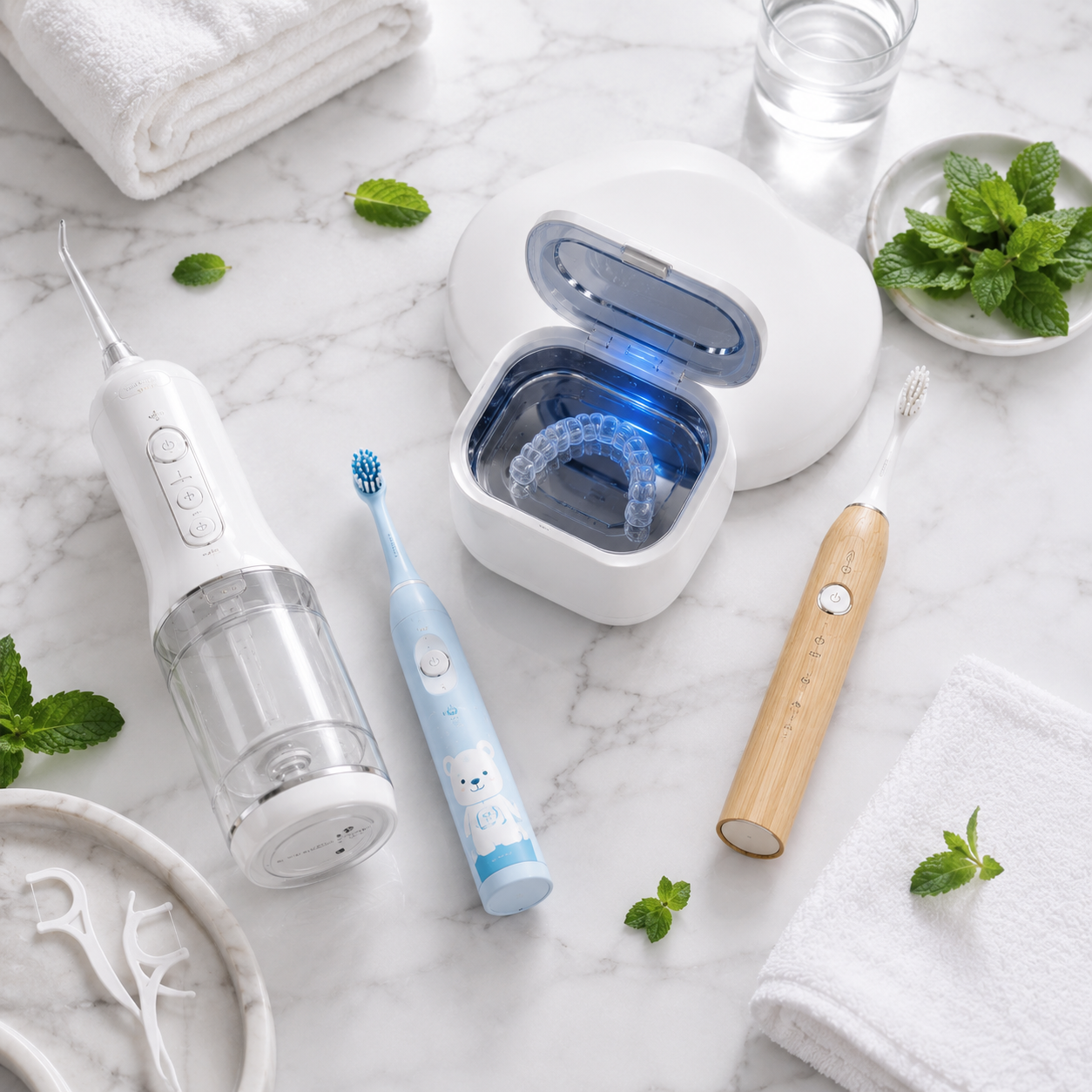
A scale and polish at the dentist costs between 60€ and 150€. A whitening session: up to 300€. And yet, with the right at-home dental devices, you can achieve comparable results from your bathroom for a fraction of the price.
This complete guide explains how to build an effective at-home dental routine, which devices to choose based on your profile, and how to use them properly to get whiter teeth, healthy gums, and fresh breath — with visible results in as little as 7 days.
Why your current dental routine isn't enough
You brush your teeth twice a day. That's good. But according to data published by the French Health Insurance system, more than 90% of French adults suffer from or have suffered from cavities, and nearly one in two adults has some form of periodontal disease (gum problems).
The reason? A manual toothbrush doesn't reach between the teeth, doesn't remove hardened tartar, and doesn't clean the inside of an aligner or denture. The result: bacteria build up where your toothbrush can't reach, creating plaque, tartar, and eventually cavities and gum problems.
The solution isn't to increase the number of dentist appointments. It's to complete your routine with the right tools.
The 4 pillars of perfect at-home dental hygiene
An effective complete dental routine is based on 4 separate actions, in this order:
1. Clean the surfaces of the teeth → sonic electric toothbrush
2. Clean between the teeth → water flosser
3. Clean dentures, aligners, and appliances → ultrasonic cleaner
4. Clean the tongue → tongue scraper
Here's how to choose the right device for each step, based on your profile.
1. The Water Flosser: Why it's a better alternative to string floss
How does a water flosser work?
A water flosser, also called an oral irrigator, shoots a pressurized pulsating stream of water between the teeth and below the gumline. This stream mechanically dislodges plaque and food debris in areas that neither a toothbrush nor floss can reach effectively.
Water flosser or dental floss: which should you choose?
| Criteria | Dental floss | Water flosser |
|---|---|---|
| Between the teeth | ✅ Good | ✅ Excellent |
| Below the gumline | ❌ Difficult | ✅ Very effective |
| Braces | ❌ Awkward | ✅ Ideal |
| Ease of use | ❌ Technical | ✅ Simple |
| Results for gums | ✅ Decent | ✅ Superior |
Dentists' recommendation is clear: the water flosser is more effective than dental floss for people with braces, implants, or sensitive gums. It doesn't replace it completely but is a highly effective addition to a daily routine.
How to use a water flosser properly
Many first-time users make the same mistakes. Here's the exact protocol:
- Fill the reservoir with lukewarm water (never cold if you have sensitive gums — thermal shock can cause pain)
- Start at the lowest pressure — increase gradually over 7 to 10 days
- Lean over the sink, with your mouth slightly open to let the water flow out
- Follow the gumline of each tooth, 2 to 3 seconds per interdental space
- Start with the molars and finish with the incisors
- Use it after brushing, not before
Expected results: reduced gum bleeding from day 7 to day 14, fresher breath from the first week, and a much cleaner feeling than with floss alone.
👉 Our recommendation: HydroJet Pro™
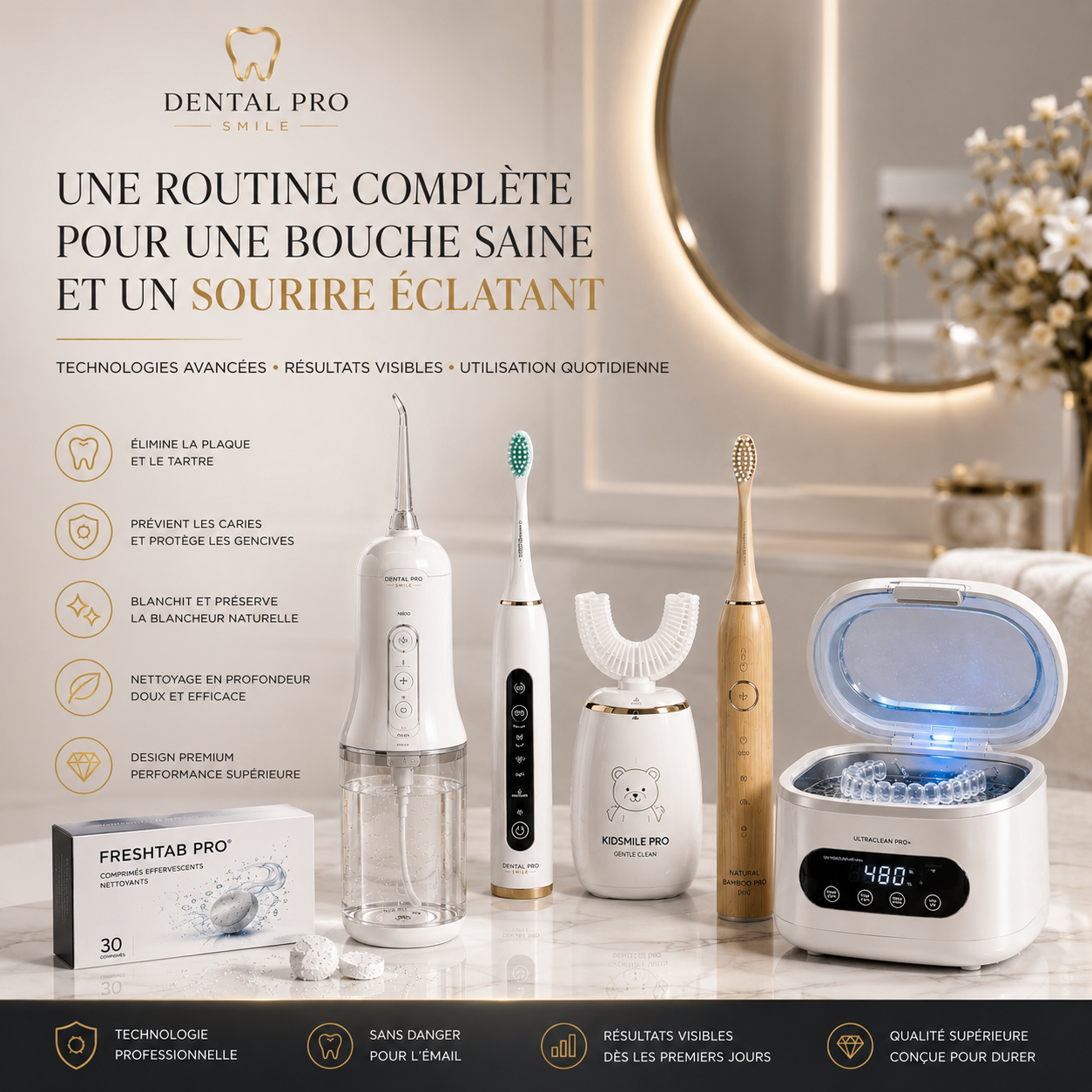
HydroJet Pro™ by DentalPro Smile™ is IPX7 certified — it can be used directly in the shower. Its 5-level adjustable pressure makes it suitable for both sensitive gums and experienced users. Its 300 ml reservoir lets you treat your whole mouth without refilling.
2. Dental Ultrasonic Cleaners: The breakthrough for dentures and aligners
What is an ultrasonic cleaner?
An ultrasonic cleaner generates very high-frequency sound waves (typically 40,000 Hz) in water. These waves create millions of micro-bubbles that burst and release intense mechanical energy — a phenomenon called ultrasonic cavitation. This energy mechanically removes plaque, bacteria, tartar residue, and limescale deposits from every surface of the immersed object, including tiny crevices that a brush can't reach.
Who is a dental ultrasonic cleaner for?
| Profile | Usefulness |
|---|---|
| Clear aligner wearer (Invisalign, etc.) | ✅ Essential — cleans without scratching |
| Denture wearer | ✅ Essential — removes bacteria and tartar |
| Fixed braces wearer | ✅ Very useful for removable parts |
| Night guard wearer (bruxism) | ✅ Very useful |
| Jewelry (rings, bracelets) | ✅ Works perfectly |
| Person without a dental appliance | 🟡 Useful for completing the routine |
How to clean an aligner or denture with an ultrasonic cleaner
- Fill the tank with clean water (tap water is enough — you can add a cleaning tablet for optimal results)
- Immerse the dental appliance or aligner making sure it is completely covered with water
- Start the cycle — generally 3 to 5 minutes depending on the model
- Rinse with clean water and put it back in place
What you should never do: brush a denture or aligner with a toothbrush. The abrasives in toothpaste scratch the surface, creating micro-scratches where bacteria can build up even more easily.
How to clean an aligner with tablets alone — and why that's not enough
Effervescent tablets kill some of the surface bacteria but don't penetrate deeply. The bacteria in the tiny crevices of your aligner survive and multiply. An ultrasonic cleaner, on the other hand, reaches all surfaces at once, effortlessly, without scrubbing.
👉 Our recommendation: UltraClean Pro™ and UltraClean Pro+™
UltraClean Pro™ is perfect for everyday use: dentures, aligners, trays. UltraClean Pro+™ adds a UV function for even more complete disinfection — ideal if you wear your appliance 20 hours a day as recommended with Invisalign.
[Discover UltraClean Pro™ →]
[Discover UltraClean Pro+™ →]
3. The Electric Toothbrush for Kids: How to teach the right habit from the start
Why a specific electric toothbrush for children?
Adult electric toothbrushes are too powerful and too large for a child's mouth. They can cause micro-damage to the still-fragile enamel of baby teeth and first permanent teeth. A suitable children's electric toothbrush has:
- Smaller brush heads to reach every area of a small mouth
- Gentler vibrations to protect developing enamel
- Built-in timer so the child brushes for the recommended 2 minutes
- Fun design to make brushing appealing and build the habit from an early age
At what age should a child start using an electric toothbrush?
| Age | Recommendation |
|---|---|
| 0 to 18 months | Finger brush or damp gauze |
| 18 months to 3 years | Soft manual toothbrush — full supervision |
| 3 to 6 years | Gentle children's electric toothbrush — with supervision |
| 6 to 12 years | Children's electric toothbrush — gradual independence |
| 12 years and up | Can switch to a gentle adult electric toothbrush |
How to teach a child to brush properly
The most common mistake: letting the child do it "however they want" with the electric toothbrush. Here's the method recommended by pediatric dentists:
- Divide the mouth into 4 quadrants : upper right, upper left, lower right, lower left
- 30 seconds per quadrant — the built-in timer helps enormously
- 45° angle to the gums
- Let the brush vibrate — don't scrub like with a manual toothbrush; it does the work for you
- Don't rinse immediately — let the fluoride in the toothpaste work for 2 minutes
👉 Our recommendation: KidSmile Pro™
KidSmile Pro™ was designed for children aged 3 to 15. Its colorful design and ultra-soft brush head make it the ideal companion for creating a positive brushing routine from an early age. The 2-minute timer with a 30-second interval signal naturally guides the child.
4. The Bamboo Electric Toothbrush: Premium dental hygiene without compromising the planet
Bamboo electric toothbrush vs plastic electric toothbrush: the real differences
The question of the environmental impact of electric toothbrushes is a legitimate one. In France, 150 million toothbrushes are thrown away every year, almost all of them made of non-recyclable plastic.
| Criteria | Standard plastic toothbrush | NaturalBambou Pro™ bamboo toothbrush |
|---|---|---|
| Toothbrush body | Non-recyclable ABS plastic | 100% natural biodegradable bamboo |
| Sonic performance | ✅ Excellent | ✅ Identical |
| Durability | 2-3 years | 2-3 years |
| Environmental impact | 🔴 High | 🟢 Minimal |
| Looks | Standard | Natural, premium |
| Price | Standard | Slightly higher |
In terms of brushing performance, the two are strictly equivalent. The sonic technology is in the electronic handle, not the bamboo. Choosing bamboo means making the same choice for dental quality with environmental awareness.
Is the bamboo toothbrush really effective?
Yes, provided it is equipped with a high-quality sonic head. Sonic technology generates between 30,000 and 45,000 vibrations per minute — creating a hydrodynamic effect around the teeth that dislodges plaque even in areas the bristles don't physically reach. The handle material (bamboo or plastic) has no impact on this performance.
👉 Our recommendation: NaturalBambou Pro™
NaturalBambou Pro™ is the only sonic toothbrush in our range with a 100% bamboo handle. Eco-friendly, stylish, and just as high-performing as a premium electric toothbrush. Ideal for those who want a complete dental routine aligned with their values.
[Discover NaturalBambou Pro™ →]
The recommended complete dental routine: the DentalPro Smile™ protocol
Here is the exact protocol to follow for visible results in 7 days:
🌅 Morning (5 minutes)
| Step | Tool | Duration |
|---|---|---|
| 1. Tongue scraper | CleanTongue Pro+™ | 30 seconds |
| 2. Brush teeth | PureBrush Pro™ or NaturalBambou Pro™ | 2 minutes |
| 3. Water flosser | HydroJet Pro™ | 2 minutes |
🌙 Evening (7 minutes)
| Step | Tool | Duration |
|---|---|---|
| 1. Denture/aligner cleaning | UltraClean Pro™ or Pro+™ | 5 minutes (while brushing) |
| 2. Brush teeth | PureBrush Pro™ or NaturalBambou Pro™ | 2 minutes |
| 3. Water flosser | HydroJet Pro™ | 2 minutes |
Total: 12 minutes a day for dental hygiene superior to most in-office treatments.
Frequently asked questions about at-home dental hygiene
Can a water flosser completely replace dental floss?
It complements it more than it replaces it. For the vast majority of users, a water flosser alone is more than enough. For people with fixed braces or very tight spaces, the ideal remains a combination of a water flosser + thin dental floss.
Is the ultrasonic cleaner safe for Invisalign aligners?
Yes, as long as you don't exceed a 5-minute cycle and use room-temperature water. Ultrasound doesn't scratch — unlike toothbrushes, which gradually damage the clear surface of your aligners.
How often should you clean a denture with an ultrasonic cleaner?
Once a day, ideally in the evening. Combined with a morning rinse, this is the most effective protocol for keeping a denture clean, odor-free, and free of limescale deposits.
Is an electric toothbrush not recommended for bleeding gums?
This is the most widespread and most false misconception. Gums bleed because they are inflamed by the presence of bacterial plaque. By removing this plaque more effectively, the electric toothbrush reduces inflammation and therefore bleeding — generally within 2 to 4 weeks of regular brushing.
Can a 3-year-old use an electric toothbrush?
Yes, provided the toothbrush is specifically designed for young children (small head, gentle vibrations) and brushing is done under parental supervision until age 6-7.
Conclusion: investing in your dental hygiene means investing in your health
An untreated cavity costs on average between 80€ and 400€ to treat. Advanced periodontitis may require treatment costing more than 1,000€. By contrast, a complete DentalPro Smile™ setup — water flosser, ultrasonic cleaner, and sonic toothbrush — is a one-time investment that pays for itself from the very first dental appointment avoided.
Your mouth is the gateway to your body. It deserves the same care as the rest of it.
Discover our complete DentalPro Smile™ bundles — free delivery, 1-year warranty, visible results in 7 days or your money back.
[View our bundles →] | [View all our products →]
Article written by the DentalPro Smile™ team — updated in 2026. The information contained in this article is for informational purposes only and does not replace the advice of a dental surgeon.

Leave a comment
This site is protected by hCaptcha and the hCaptcha Privacy Policy and Terms of Service apply.