
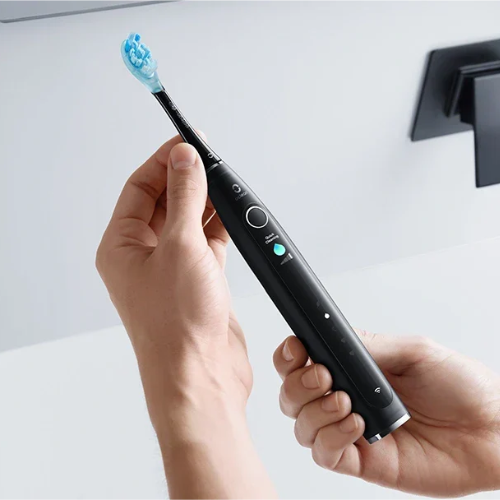
"Sonic". The word appears in every ad for electric toothbrushes. But what does it really mean? And why does it clean better?
The answer is two words: hydrodynamic effect.
It is the physical phenomenon that fundamentally sets the sonic toothbrush apart from all others—manual, rotary, oscillating. It is what allows it to clean areas the bristles never physically reach. It is what explains the documented clinical results on plaque reduction and gum improvement.
And it is a concept that most sonic toothbrush users do not understand—which often prevents them from using their brush optimally.
This guide explains the hydrodynamic effect in plain language, without unnecessary jargon, using the available scientific data—and tells you exactly what it means for your daily brushing routine.
The starting point — What the other brushes do
To understand what the sonic toothbrush does differently, let’s start with what the other brushes do.
The manual toothbrush — Pure mechanical action
A manual toothbrush cleans through direct contact and friction. The bristles physically scrub the tooth surface, mechanically dislodging bacterial plaque. This cleaning is effective where the bristles touch—and only there.
Fundamental limitation: the bristles cannot go where they do not go. Interdental spaces, the deep gingival sulcus, enamel crevices—all these areas remain out of reach of a manual toothbrush, no matter how long or how hard you brush.
The oscillating-rotating toothbrush — Amplified mechanical action
The rotating toothbrush spins and oscillates a round head at 8,000 to 10,000 cycles per minute. It removes plaque with greater mechanical efficiency than a manual toothbrush—but still only through direct contact. Its small round head lets it access certain hard-to-reach areas, but the mechanism remains fundamentally the same: physical contact between the bristles and the surface.
Fundamental limitation: identical to the manual toothbrush—the cleaning stops where the bristles stop.
The sonic toothbrush — The effect that goes beyond contact
The sonic toothbrush vibrates its head at 30,000 to 45,000 vibrations per minute—i.e. 500 to 750 Hz. At this frequency, something fundamentally different happens in your mouth.
The vibrations do not just make the bristles move. They propagate through the oral fluid—saliva and water—and create a hydrodynamic phenomenon that loosens plaque well beyond the areas touched by the bristles.
That is the hydrodynamic effect.
The hydrodynamic effect — Physics in plain language
What is hydrodynamics?
Hydrodynamics is the branch of physics that studies fluids in motion. When an object vibrates in a fluid at high frequency, it creates movements in that fluid that propagate over distance—like the ripples created by a stone thrown into water.
In your mouth, the sonic toothbrush generates movements in the oral fluid. These movements create micro-turbulence that spreads beyond the area of direct bristle contact.
The exact mechanism — Step by step
Step 1 — Generation of vibrations
The sonic toothbrush generates vibrations at 500-750 Hz via a magnetic electric motor. These vibrations cause the brush head to oscillate side to side at a precisely controlled frequency and amplitude.
Step 2 — Propagation through oral fluid
When the vibrating bristles come into contact with the oral fluid (saliva + water), they transfer their vibrational energy to that fluid. The fluid, being a medium for mechanical wave propagation, carries these vibrations over distance—exactly as water carries waves from a stone.
Step 3 — Creation of micro-turbulence
These mechanical waves in the fluid create micro-turbulence—rapid, disordered fluid movements—in areas adjacent to the bristles. These turbulences generate shear forces on nearby tooth surfaces, including those the bristles do not reach.
Step 4 — Plaque removal at a distance
The shear forces created by the micro-turbulence are strong enough to dislodge fresh bacterial plaque (less than 24 to 48h) from tooth surfaces located 2 to 4 millimeters from the bristles.
Step 5 — Acoustic cavitation (at high frequency)
At 40,000-45,000 vibrations per minute, a second phenomenon is added: acoustic cavitation. The vibrations create very rapid pressure changes in the fluid that generate and collapse microbubbles—releasing additional localized mechanical energy at the moment they implode.
This cavitation phenomenon, well known in industrial and dental ultrasonic cleaners, helps loosen plaque in the tiny crevices of the enamel.
What the hydrodynamic effect actually reaches in your mouth
Zone 1 — The gingival sulcus (0 to 3 millimeters below the gum line)
The gingival sulcus is the space between the tooth and the free edge of the gum—a critical area that measures 1 to 3 mm deep in healthy conditions, and can deepen into a "periodontal pocket" in case of inflammation.
A standard toothbrush—manual or rotating—cannot access this area. The bristles may brush the entrance to the sulcus at 45°, but they cannot penetrate this subgingival space.
The hydrodynamic effect of the sonic toothbrush spreads micro-turbulence through the fluid filling the gingival sulcus—reaching plaque in the first 1 to 2 mm of the sulcus without physical contact. Clinical studies document this partial subgingival action of the sonic toothbrush. (Source: Journal of Clinical Periodontology — sonic toothbrush subgingival effects)
What this means in practice: the sonic toothbrush at 45° directed toward the gum line partially reaches the inside of the sulcus—where gingival plaque accumulates and triggers the inflammation responsible for bleeding.
Zone 2 — Interdental spaces (proximal areas)
The spaces between teeth represent about 40% of total tooth surfaces. No brush—sonic or otherwise—can physically enter these closed spaces.
But the hydrodynamic effect of the sonic toothbrush propagates through the fluid filling these spaces—reaching 2 to 4 mm into standard adult interdental spaces.
What this means in practice: the sonic toothbrush partially cleans interdental areas without physical contact. This partial action does not replace a water flosser or dental floss—which reach the full extent of these spaces—but it provides a significant added benefit vs non-sonic toothbrushes.
Zone 3 — Enamel crevices
Tooth enamel is not a perfectly smooth surface. At the microscopic level, it has irregularities, micro-crevices, and grooves where plaque collects. The bristles of a brush are too wide to reach these micro-areas.
The acoustic cavitation of high-frequency sonic toothbrushes generates micro-forces in these crevices that help dislodge microscopic plaque.
What this means in practice: tooth surfaces feel smoother to the tongue after sonic brushing than after manual or rotating brushing—because the micro-areas are cleaned too.
The hydrodynamic effect depends on frequency — Critical thresholds
The hydrodynamic effect is not a binary property (present/absent)—it increases with vibration frequency, following a non-linear curve.
| Vibration frequency | Hydrodynamic effect | Cleaning range |
|---|---|---|
| < 10,000 vib/min (rotating) | ❌ Absent | Physical contact only |
| 10,000 to 20,000 vib/min | 🟡 Emerging | Contact + a few mm |
| 20,000 to 30,000 vib/min | 🟡 Partial | Contact + 1 to 2 mm |
| 30,000 to 40,000 vib/min | ✅ Significant | Contact + 2 to 3 mm |
| 40,000 to 45,000 vib/min | ✅✅ Optimal | Contact + 3 to 4 mm |
| > 45,000 vib/min (ultrasound) | ✅✅ Maximal | Contact + > 4 mm + intense cavitation |
The clinically relevant threshold: the hydrodynamic effect becomes clinically significant starting at 30,000 vibrations per minute. Below this threshold, electric toothbrushes are still superior to manual ones because of amplified mechanical action—but the hydrodynamic effect itself is insufficient to contribute measurably to cleaning nearby areas that are not directly reached.
Two essential conditions for the hydrodynamic effect to work
The hydrodynamic effect is not automatic. Two conditions must be met for it to fully develop.
Condition 1 — Light pressure
When you press hard with your sonic toothbrush, you compress the bristles against the tooth surface and reduce the space between the bristles and nearby areas. This compression reduces the fluid volume in which the turbulences can propagate—limiting the reach of the hydrodynamic effect.
With light pressure, the bristles vibrate freely in the oral fluid—maximizing ripple propagation in all directions.
Practical rule: the weight of the brush alone (about 100 to 150g) is the optimal pressure. Any additional pressure reduces the hydrodynamic effect while also abrading enamel and irritating the gums.
Condition 2 — Sufficient moisture
The hydrodynamic effect needs fluid to propagate. A dry mouth (xerostomia) significantly reduces the propagation of micro-turbulence.
Practical rule: lightly wet the brush head before use. If you suffer from dry mouth, rinsing with water before brushing optimizes the hydrodynamic environment.
The hydrodynamic effect vs ultrasonic cavitation — What is the difference?
The confusion between "sonic toothbrush" and "ultrasonic toothbrush" is common. These two technologies use mechanical waves in fluid—but at very different frequencies with different effects.
| Feature | Sonic toothbrush (750 Hz) | Ultrasonic cleaner (40,000 Hz) |
|---|---|---|
| Frequency | 500 to 750 Hz | 40,000 Hz |
| Main mechanism | Hydrodynamic turbulence | Intense ultrasonic cavitation |
| Range in fluid | 2 to 4 mm | All submerged surfaces |
| Physical contact required | 🟡 Yes + propagation | ❌ No — propagation alone is enough |
| Use | Daily in-mouth brushing | Cleaning dental appliances ex situ |
| Suitable for | Teeth in the mouth | Aligners, dentures, jewelry |
What this means: the sonic toothbrush generates a real but limited-range hydrodynamic effect. The ultrasonic cleaner (such as the UltraClean Pro™) generates ultrasonic cavitation that reaches all surfaces of the submerged object—including micropores. These are two complementary technologies, not interchangeable.
How to maximize the hydrodynamic effect in your routine
Optimization 1 — Optimal angle
The hydrodynamic effect spreads in all directions from the vibrating bristles. But its propagation toward the gingival sulcus is maximized when the brush is positioned at 45° toward the gums—the turbulence is directed preferentially into the sulcus.
Action: keep a strict 45° angle toward the gum line to maximize hydrodynamic penetration into the sulcus.
Optimization 2 — Slow movement speed
The longer you stay on each area, the more time the hydrodynamic effect has to act on adjacent surfaces. Moving quickly from tooth to tooth limits the action time of the turbulence on each area.
Action: guide slowly—3 to 4 seconds per tooth rather than 1 to 2 seconds.
Optimization 3 — Use after flossing
Some dental hygiene experts recommend using the water flosser before the sonic toothbrush—the water flosser slightly widens interdental spaces and distributes fluid in nearby areas, optimizing the hydrodynamic environment for the brush that follows.
Action: try the sequence water flosser → sonic toothbrush in the evening, and see whether the post-brushing clean feeling is different.
Optimization 4 — Mode selection
High-frequency modes (Clean, White) maximize the hydrodynamic effect. Sensitive mode reduces it by design (less intense vibrations). For people who do not have sensitive gums, Clean mode optimizes the hydrodynamic effect.
Does the hydrodynamic effect explain all the benefits of the sonic toothbrush?
No—and it is important to say that for a complete and honest view.
The documented clinical benefits of the sonic toothbrush result from the combination of several factors.
| Factor | Contribution to results |
|---|---|
| Hydrodynamic effect | 🔴 Important — cleaning nearby areas |
| Amplified mechanical action of the bristles | 🔴 Important — surface cleaning |
| Built-in timer | 🟡 Significant — brushing time maintained |
| Easier consistency | 🟡 Significant — adherence |
| Pressure sensor (if present) | 🟡 Significant — correct technique |
The hydrodynamic effect is the technologically distinctive factor of the sonic toothbrush. But the timer (which ensures 2 minutes of brushing) and the pressure sensor (which corrects technique) also contribute significantly to clinical results.
Conclusion — The hydrodynamic effect: physics in the service of your oral health
The hydrodynamic effect is not a marketing claim. It is a documented physical phenomenon that explains why a 750 Hz sonic toothbrush cleans areas inaccessible to any other brush.
By understanding this mechanism, you can optimize your daily use: light pressure, slow movement, a maintained 45° angle, and a well-moistened mouth. These four adjustments maximize turbulence propagation and extend the cleaning reach of your toothbrush beyond direct bristle contact.
At DentalPro Smile™, our PureBrush Pro™ generates exactly 45,000 vibrations per minute—at the optimal frequency for maximum hydrodynamic effect, with partial acoustic cavitation as a complement for the most demanding surfaces.
Discover the PureBrush Pro™ DentalPro Smile™ → 45,000 vib/min · Maximum hydrodynamic effect · Free delivery · 1-year warranty.
👉 dentalpro-smile.com/fr-fr
❓ FAQ
1. Does the hydrodynamic effect work better with water than with saliva alone?
Yes—slightly. Pure water is a better conductor of mechanical waves than saliva, whose higher viscosity slightly dampens turbulence propagation. In practice, the difference is minimal and not clinically significant under normal brushing conditions. If you suffer from severe dry mouth (very thick or nearly absent saliva), wetting the brush head and rinsing your mouth before brushing can noticeably improve the hydrodynamic effect.
2. Can the hydrodynamic effect be seen in action?
Yes—try the following: fill a glass with colored water, place the head of your sonic toothbrush at the surface, and switch it on in Clean mode. You will clearly observe fluid movement away from the bristles—the swirls and turbulence spreading throughout the water in the glass. This is exactly the phenomenon that happens in your mouth during sonic brushing.
3. Is the hydrodynamic effect of a sonic toothbrush comparable to that of an ultrasonic cleaner?
No—the two technologies generate hydrodynamic/acoustic effects but at very different scales. The 40,000 Hz ultrasonic cleaner generates intense ultrasonic cavitation that reaches all surfaces of a submerged object—including micropores. The 750 Hz sonic toothbrush generates hydrodynamic turbulence that spreads a few millimeters through the oral fluid. They are complementary technologies: the brush for teeth in the mouth, the ultrasonic cleaner for removed dental appliances.
4. Can the hydrodynamic effect damage fragile gum tissue?
No—as long as you follow the recommended light pressure. The shear forces created by the hydrodynamic micro-turbulence of a consumer sonic toothbrush are very low—far too weak to traumatize healthy or weakened gum tissue. Risks for sensitive gums come exclusively from direct mechanical pressure from the bristles—not from the hydrodynamic effect.
5. Is the hydrodynamic effect affected by the type of toothpaste used?
Marginally. The viscosity of toothpaste can slightly change the propagation of turbulence—a very thick, sticky toothpaste may dampen the effect. However, the rapid dilution of toothpaste by saliva during brushing reduces this effect to a level that is not clinically significant. Use your usual fluoride toothpaste without changing it.
6. How many millimeters does the hydrodynamic effect actually reach in interdental spaces?
Available studies document a reach of 2 to 4 mm depending on vibration frequency, pressure applied, and the shape of interdental spaces. For tight spaces (< 1mm), propagation is limited by the space itself. For wider spaces, the reach can be 3 to 4 mm. This reach, while real and beneficial, does not cover the entirety of interdental spaces—which is why complementary use of a water flosser or floss is justified for complete coverage.
Sources:
— Journal of Clinical Periodontology — Hydrodynamic effect of sonic toothbrushes
— Journal of Dentistry — Acoustic cavitation in sonic toothbrushes
— American Dental Association — Sonic toothbrush mechanism review : ada.org
— Quintessence International — Fluid dynamics and dental plaque removal
— HAS — Oral hygiene recommendations : has-sante.fr
Informational article only. Does not replace the advice of a dental surgeon. DentalPro Smile™ — 2026.


Leave a comment
This site is protected by hCaptcha and the hCaptcha Privacy Policy and Terms of Service apply.