
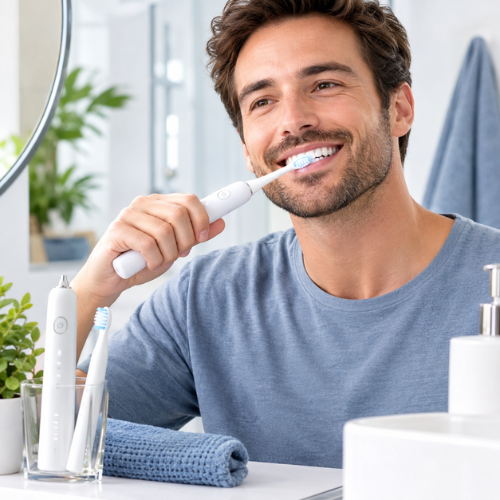
Your gums bleed when you brush your teeth. Or they hurt when the brush touches them. Or you feel like they are "receding" and your teeth seem longer than before.
Faced with these symptoms, the most common reaction is to brush less hard, for less time, or even avoid the painful areas. That is understandable. And it is exactly what you should not do.
Sensitive gums do not need less brushing. They need a different kind of brushing — with the right tool, the right technique, and the right mode.
In France, periodontal disease — which includes gingivitis and periodontitis — affects around 50% of adults over 35 according to available data. It is the leading cause of tooth loss in adults after 40. And in the vast majority of cases, it is directly linked to insufficient or improper oral hygiene.
This guide gives you the exact criteria for choosing the electric toothbrush suited to your sensitive gums, the recommended usage protocol, and what you can expect in terms of results.
Understanding why your gums are sensitive — The cause before the solution
Before choosing a toothbrush, it is crucial to understand why your gums react. Not all sensitive gums are sensitive for the same reason — and the solution varies depending on the cause.
Cause 1 — Gingivitis (the most common)
Gingivitis is inflammation of the gums caused by the buildup of bacterial plaque at the tooth-gum junction. Inflamed gums bleed easily when touched by the brush — not because the brush is too hard, but because inflamed tissues are fragile and highly vascularized.
Crucial paradox: stopping brushing because it bleeds makes gingivitis worse. Plaque builds up further, inflammation increases, bleeding gets worse. Regular brushing with a suitable toothbrush is precisely the treatment for gingivitis.
Cause 2 — Gum recession
The gum gradually recedes, exposing the root of the teeth. This exposed root area (covered with cementum, not protected by enamel) is extremely sensitive to mechanical and thermal stimuli. Brushing with a toothbrush that is too hard or with incorrect technique can make this recession worse.
Cause 3 — Abrasion from excessive brushing
Ironically, brushing too vigorously with excessive pressure can cause the gum sensitivity it is supposed to treat. Repeated mechanical abrasion progressively irritates and recedes the gums.
Cause 4 — Associated dentin sensitivity
When the gums recede, the enamel-cementum junction (the neck of the tooth) and the root become exposed. This area is rich in dentinal tubules that transmit stimuli directly to the nerve. Sensitivity perceived as "gum" sensitivity is sometimes actually dentin sensitivity.
The essential criteria for a toothbrush suited to sensitive gums
Criterion 1 — The presence of a Sensitive mode
This is the most important criterion. A Sensitive mode reduces the frequency or amplitude of vibrations or oscillations — producing effective cleaning action but one that is clearly less aggressive on inflamed gum tissue.
A toothbrush without a Sensitive mode is not suitable for sensitive gums — even if it is technically high quality for average users.
Criterion 2 — Softness of the bristles
The bristles on the brush head should be ultra-soft (extra-soft) for very sensitive gums, or soft (soft) for moderately sensitive gums. Medium or hard bristles are not recommended.
| Bristle hardness | Abrasion index | Suitable profile |
|---|---|---|
| Extra-soft (ultra-soft) | Very low | Very sensitive gums, gum recession |
| Soft (soft) | Low | Sensitive gums, moderate gingivitis |
| Medium (medium) | Moderate | Healthy gums, general use |
| Hard (hard) | High | Not recommended — enamel and gum abrasion |
Criterion 3 — The pressure sensor
A pressure sensor that signals when you press too hard is especially valuable for people with sensitive gums. The natural tendency is to increase pressure, thinking it will "clean better" — which is precisely what makes the gum problem worse.
Criterion 4 — The small brush head
A small brush head provides better precision and control around sensitive gum areas. It makes it easier to maintain the 45° angle more precisely in hard-to-reach areas — especially behind the lower molars where the gums are often more reactive.
Criterion 5 — Gum Care mode or gum massage
Some toothbrushes offer a Gum Care mode specifically designed to stimulate blood circulation in the gums and gradually strengthen gum tissue. This mode uses specific pulses that have shown clinical benefits for periodontal health in certain studies.
Sonic toothbrush vs oscillating toothbrush — Which is better for sensitive gums?
That is a fair question — and the clinical answer clearly favors the sonic toothbrush for this specific profile.
The sonic toothbrush in Sensitive mode:
- Diffuse, progressive vibrations — less mechanical shock on tissues
- Hydrodynamic effect that cleans without aggressive direct contact
- Gentle action on gum inflammation
- Less of a "shock" sensation on sensitive areas
The oscillating toothbrush:
- More localized and direct mechanical action
- May feel more aggressive on inflamed gums
- Effective on plaque but potentially uncomfortable with active gingivitis
Recommendation for sensitive gums: sonic toothbrush with Sensitive mode and pressure sensor.
The brushing protocol suited to sensitive gums
Having the right toothbrush is not enough. The technique must also be adapted.
Phase 1 — The first 2 weeks (adjustment)
Mode         : Sensitive only
Pressure     : Brush weight only — no added pressure
Duration     : Full 2 minutes despite discomfort
Frequency    : 2 times a day without exception
Angle        : 45° toward the gum — maintained strictly
What will happen: bleeding may slightly increase in the first few days — that is normal. Existing plaque is removed, creating a temporary inflammatory reaction. Bleeding generally decreases by 50% between day 7 and day 14.
Phase 2 — Weeks 3 and 4 (consolidation)
Mode         : Sensitive + occasional attempt at Clean mode
Pressure     : Still minimal
Duration     : 2 minutes
Frequency    : 2 times a day
New         : Add the water flosser in gentle mode
Adding the water flosser starting in week 3 is crucial. Interdental spaces — inaccessible to the brush — are often the main source of persistent gum inflammation.
Phase 3 — From month 2 onward (maintenance)
Mode         : Standard Clean + Sensitive if needed occasionally
Pressure     : Minimal — maintain the habit
Duration     : 2 minutes
Frequency    : 2 times a day
Water flosser : Daily in gentle to moderate mode
Expected results — Week by week
| Period | Observed results |
|---|---|
| Day 1 to Day 3 | Possible slight increase in bleeding — normal |
| Day 7 | Bleeding reduced by 30 to 50% on average |
| Day 14 | Bleeding almost absent in simple gingivitis cases |
| Day 30 | Gums visibly less swollen, healthier pink color |
| Day 60 | Significant improvement in overall periodontal health |
⚠️ These timelines are estimates based on available clinical data for mild to moderate gingivitis. Results vary depending on the initial condition of the gums and the consistency of the routine. Advanced periodontitis requires professional treatment.
What you must absolutely avoid if you have sensitive gums
To avoid — Mistakes that worsen gum sensitivity
Avoid vigorous horizontal brushing
The back-and-forth horizontal motion with strong pressure is the main cause of gum abrasion. With an electric toothbrush, this movement is unnecessary — the motor does the work.
Avoid highly abrasive toothpaste
"Intensive whitening" toothpastes with a high RDA worsen abrasion on already weakened gum areas. Choose a toothpaste for sensitive gums or a standard toothpaste with moderate RDA.
Avoid ignoring areas that bleed
That is the natural reaction — and the most harmful one. The areas that bleed are precisely the ones that need cleaning the most. Avoiding those areas lets plaque build up and worsens inflammation.
Avoid changing the brush too late
Frayed bristles no longer follow the contour of the teeth and gums — they "skip" over areas to be cleaned and can irritate the gums without cleaning them effectively.
Avoid brushing immediately after an acidic meal
Enamel and cementum are temporarily weakened after an acidic meal. Brushing within 30 minutes worsens abrasion on already vulnerable tissues.
When to see a dentist despite good brushing
A proper brushing routine with a suitable toothbrush resolves the vast majority of simple gingivitis cases in 2 to 4 weeks. But some situations absolutely require professional consultation.
| Situation | Required action |
|---|---|
| Persistent bleeding after 4 weeks of proper routine | Dental consultation — possible periodontitis |
| Spontaneous bleeding without brush contact | Urgent consultation — possible non-periodontal cause |
| Painful gums + fever + localized swelling | Emergency — possible abscess |
| Teeth that move or seem less firmly anchored | Prompt consultation — advanced periodontitis |
| Bleeding that increases despite proper routine | Consultation — possible systemic factors (pregnancy, diabetes, medication) |
Conclusion — Sensitive gums are not inevitable
Gum sensitivity is a signal — not a sentence. In the vast majority of cases, it simply means bacterial plaque has built up in areas that your current routine does not clean effectively.
The right electric toothbrush, used with the right mode and the right technique, turns that signal into results in 14 days. Not into a promise of a miracle cure — into a clinically observable and measurable result.
At DentalPro Smile™, our PureBrush Pro™ range offers 5 modes, including a Sensitive mode specifically designed for reactive gums — with an integrated pressure sensor and ultra-soft bristles. Our NaturalBambou Pro™ offers the same specifications in an eco-friendly version.
Discover the DentalPro Smile™ range → Free delivery · 1-year warranty · Visible results in 14 days.
👉 dentalpro-smile.com/fr-fr
❓ FREQUENTLY ASKED QUESTIONS
1. My gums have been bleeding when I brush for years — is that serious?
Chronic gum bleeding over several years signals established gingivitis that may have progressed to early periodontitis. It is not an immediate emergency, but it is a serious sign that deserves a dental consultation to assess the condition of the periodontal tissues. At the same time, improving your brushing routine with a suitable toothbrush can already produce significant results.
2. Can you use an electric toothbrush when the gums are very inflamed and painful?
Yes — with Sensitive mode and minimal pressure. It may be tempting to switch to a manual toothbrush "to avoid pain," but an electric toothbrush in Sensitive mode cleans more effectively with less pressure than any manual toothbrush. The discomfort of the first few uses quickly decreases once the plaque responsible for the inflammation is removed regularly.
3. Can gum recession be reversed by better brushing?
No. Gum recession (the gum pulling back and exposing the tooth root) is irreversible once established. Better brushing can stop or slow its progression, but it cannot make the gum grow back. Advanced cases may require a gum graft performed by a periodontist. That is why early prevention is crucial.
4. Is the water flosser suitable for very sensitive gums?
Yes, provided you start at the lowest pressure and increase very gradually over 2 to 3 weeks. A water flosser in gentle mode is especially suitable for sensitive gums because it cleans interdental spaces without direct mechanical contact with the tissues. It is often less painful than floss on very inflamed gums.
5. How often should the brush head be replaced for sensitive gums?
The same recommendation applies: every 12 weeks. But if you use Sensitive mode with very low pressure, the bristles wear out less quickly and can remain effective for up to 14-16 weeks. On the other hand, if you tend to press harder (which the pressure sensor alerts you to), replace it every 8 to 10 weeks — frayed bristles increase gum irritation.
6. Is toothpaste for sensitive gums really different?
Yes. Toothpastes for sensitive gums generally contain either potassium nitrate (which reduces nerve transmission at the dentin level), stannous fluoride (which has additional anti-bacterial properties on gingival plaque), or hydroxyapatite (which remineralizes exposed areas). These formulas are clinically more suitable for people with sensitive gums than standard or whitening toothpastes.
Sources :
— HAS — Periodontal disease recommendations: has-sante.fr
— Journal of Clinical Periodontology — Sonic toothbrush and gingivitis
— French Society of Periodontology — Hygiene recommendations 2025
— American Academy of Periodontology — Gingival sensitivity guidelines
— paymed.pro — Periodontal health France 2026
Informational article only. It does not replace the advice of a dentist or periodontist. DentalPro Smile™ — 2026.

Leave a comment
This site is protected by hCaptcha and the hCaptcha Privacy Policy and Terms of Service apply.