
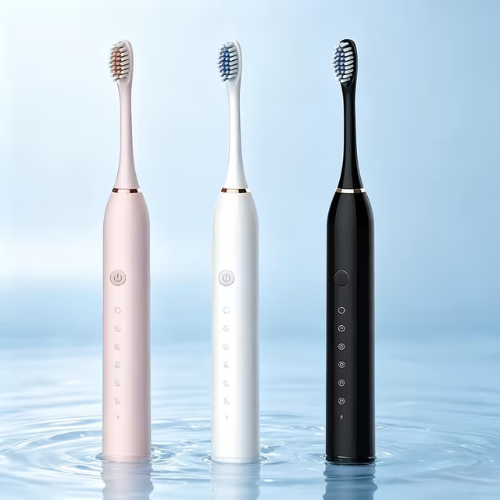
The best-selling electric toothbrush in France doesn’t cost €150. It costs between €30 and €50.
And in many cases, it delivers clinical results comparable to premium models — provided you know which criteria to look at and which ones do not compromise your dental health.
The electric toothbrush market has evolved considerably in recent years. Sonic technology — which was reserved for high-end models 5 years ago — is now available in affordable toothbrushes costing 30 to 50€. The features that remain exclusive to expensive models (Bluetooth, smartphone app, advanced pressure sensor) have no direct clinical impact on your dental health.
This comparison helps you make the right choice — without spending more than necessary, without sacrificing the essentials.
What You Can Get for Less Than 50€ in 2026 — and What You Can't
Before comparing the models, let's be clear about what a €50 budget does and does not allow in 2026.
What you get for under €50
| Feature | Available < €50 | Impact on dental health |
|---|---|---|
| Sonic technology | ✅ Yes | 🔴 Critical — essential |
| 30,000 to 40,000 vib/min | ✅ Yes | 🔴 Review |
| 2-minute timer | ✅ Yes | Review |
| Signal quadrant 30 sec | ✅ Most | 🟡 Important |
| Sensitive Mode | ✅ Most | 🟡 Important |
| White Fashion | Some | Useful |
| 14-day battery life | ✅ Yes | Practical |
| IPX7 waterproof | ✅ Most | 🟢 Practical |
| Replacement head included | ✅ Often 1-2 | Economic |
What you don't get for under €50
| Missing feature | Dental health impact |
|---|---|
| Advanced pressure sensor | Useful but can be offset by technique |
| Bluetooth connection / app | No clinical impact |
| Battery life 30 days | Comfort only |
| 5 brushing modes | 2 to 3 modes are enough |
| Travel case included | 🟢 Comfort only |
| Multiple replacement heads included | Economy only |
Conclusion: less than 50€, you get everything that matters clinically for your dental health. What you sacrifice is comfort, connected gadgets, and non-essential premium features.
Selection criteria — What sets a good budget brush apart from a bad one
In the range of brushes under €50, the differences in quality are real and significant. Here are the 6 criteria that separate the good ones from the bad.
The actual vibration frequency criterion
Beware of marketing claims. Some low-priced "electric" toothbrushes actually operate at 8,000 to 15,000 vibrations per minute — not enough to generate a real hydrodynamic effect.
Minimum acceptable threshold: 30,000 vibrations per minute.
Ideal threshold within this budget: 38 000 to 40 000 vibrations per minute.
Criterion 2 — The presence of a timer with quadrant signal
The 2-minute timer is essential. The quadrant signal every 30 seconds is strongly recommended. Without it, the effective brushing time for most users drops to 45-60 seconds — compromising most of the benefits of an electric toothbrush.
The availability and price of replacement heads — Criterion 3
The most overlooked criterion when buying — and the most important over time. A €30 toothbrush with replacement heads at €20 each costs more over 3 years than a €50 toothbrush with heads at €8.
Mandatory check before purchase: search for the price and availability of replacement heads for this exact model. If the heads are not available on reliable French websites, avoid the brush—regardless of its initial quality.
Criterion 4 — The number of modes
Minimum 2 modes for a quality budget toothbrush: Clean and Sensitive. Sensitive mode is non-negotiable for universal use — it is essential for sensitive gums, beginners, and post-treatment phases.
Criterion 5 — Water resistance
IPX7 is the recommended standard for safe use in a humid environment. Avoid brushes labeled only "splash-resistant" (IPX4 or lower) — insufficient for a bathroom with stea
frequent use.
The warranty and after-sales service criterion 6
In the budget range, the minimum warranty is 1 year. A 2-year warranty is a positive sign that the manufacturer has confidence in its product. Check that after-sales service can be reached in French.
The profiles and their needs — Which budget brush should you choose for your situation
Profile 1 — First purchase, adult with no particular issues
Needs: basic sonic technology, timer, at least 2 modes, replacement heads available.
What we're looking for in this budget:
- Frequency of vibration ≥ 30,000 vib/min
- 2-minute timer with quadrant signal
- 2 modes minimum (Clean + Sensitive)
- 1 replacement head included
- Minimum 1-year warranty
Optimal budget: 35 to 45€ for this profile — there's no point going below 30€, where component quality starts to compromise durability.
Profile 2 — Sensitive gums, tight budget
Requirements: Sensitive mode essential, light pressure, soft bristles.
What we're looking for in this budget:
- Mode Sensitive with genuinely reduced vibrations (not just a marketing gimmick)
- Head with "soft"-rated bristles
- Pressure sensor if available within this budget (rare but possible)
Optimal budget: 40 to 50€ — the low end of the market range for users with sensitive gums who need a Sensitive mode that genuinely works.
Profile 3 — Adult seeking natural whitening
Requirements: High frequency, White mode if possible, bristles suitable for polishing.
What we're looking for in this budget:
- Frequency ≥ 38,000 vibrations/min (more effective on staining)
- White mode or polishing if available
- Head with a "cross-action" design for better surface coverage
Optimal budget: 45 to 50€ — models with White mode in this budget offer excellent value for money.
Profile 4 — Eco-conscious, budget under control
Needs: bamboo handle or sustainable materials, sonic performance preserved.
What we're looking for in this budget:
- Certified bamboo handle
- Equivalent sonic technology to plastic models
- Replacement heads available
Optimal budget: 45 to 55€ — bamboo brushes are slightly more expensive than their plastic counterparts. Below 45€, the quality of the bamboo handle may be compromised.
Mistakes to avoid when buying a budget brush
Mistake 1 — Relying solely on the lowest price
A €10-15 brush sold as "electric" is generally a basic oscillating brush with 8,000-10,000 oscillations per minute — far from sonic performance. It may be slightly better than a manual toothbrush, but it does not offer the clinical benefits of a true sonic toothbrush.
Minimum quality threshold: Don't go below €25-30 if you want a brush with real added value compared with a manual brush.
Error 2 — Buying Without Checking the Replacement Heads
The most common trap in the budget market: an attractive toothbrush at €20-25 whose replacement heads are impossible to find in France 6 months after purchase. The result: a toothbrush with a worn-out head that's unusable.
Mandatory verification: Before making any purchase, look for replacement heads for the exact model on French e-commerce websites. If you can't find them at a reasonable price, move on to the next model.
Error 3 — Confusing "vibrations" and "oscillations"
A brush stating "40,000 movements per minute" may refer either to 40,000 sonic vibrations (excellent) or to 20,000 back-and-forth oscillations counted twice (i.e. 10,000 actual cycles — insufficient). Read the technical description carefully and explicitly look for the term "sonic".
Mistake 4 — Neglecting head compatibility
Certain brands offer multiple models at different prices with head attachment systems that are incompatible with each other. A head purchased for model X may not work on model Y from the same brand. Always check exact compatibility.
Error 5 — Buying without checking the warranty
A €40 brush with a 6-month warranty is less cost-effective than a €50 brush with a 2-year warranty. If it fails after 8 months, the first one costs you a replacement, while the second is covered.
The price-quality ratio — What you really get at each price point
| Price range | What you get | What's missing |
|---|---|---|
| Less than 20€ | Basic oscillating toothbrush, 1 mode, without a reliable timer | Technology sonic, durability, available heads |
| 20 to 30€ | Basic sonic, simple timer, 1 to 2 modes | Signal quadrant, advanced modes, limited durability |
| 30 to 40€ | Correct sonic, timer + quadrant signal, 2 to 3 modes | Mode Gum Care, pressure sensor, long battery life |
| €40 to €50 | High-performance sonic, 3 to 4 modes, good battery life | Advanced pressure sensor, Bluetooth, 5 modes |
| 50 to 80€ | High-frequency sonic, 5 modes, pressure sensor | Bluetooth, coaching app |
| > 80€ | Everything included + Bluetooth + app + accessories | Nothing essential more |
Table conclusion: The biggest quality leap is between the €20-30 and €30-40 price ranges. Between €40-50 and €50-80, value for money starts to decline for purely clinical features.
How much does a budget brush really cost over 3 years?
For a fair comparison, the 3-year cost is the only figure that matters.
Example calculation — Brush at 40€:
| Post | Cost |
|---|---|
| Brush purchase | 40€ |
| Replacement heads (4/year × 3 years = 12 heads at 6€) | 72€ |
| Electricity (negligible) | < €1 |
| Total over 3 years | 113€ |
| Monthly cost | ~€3.14/month |
For €3.14 per month, you benefit from significantly superior cleaning performance compared with a manual brush — and a potential reduction in dental care costs that more than makes up for this investment.
Should you choose a brush DentalPro Smile™ or a major brand within this budget?
This is the legitimate question many consumers are asking. Here is the honest answer.
Major brands in this budget:
- Wide brand awareness and an extensive distribution network
- Easily available replacement heads in supermarkets
- More clinical studies on their products
- After-sales service established
DentalPro Smile™ in this budget:
- Optimized value for money for the French market
- Direct delivery from the online store
- Dedicated customer service in French
- Replacement head range permanently available
- Designed for the specific needs of the French-speaking market
Our advice: For a first purchase on a tight budget, both options are valid. The main deciding factor should be the availability of replacement heads at a reasonable price over the long term — check this point for any brand before buying.
Conclusion — €50 well invested is better than €150 poorly chosen
A €40–50 brush that perfectly matches your profile, with a functional timer, an effective Sensitive mode, and replacement heads available, will give you excellent clinical results.
A €150 toothbrush with Bluetooth and voice coaching, used without proper technique or with a head worn out after 6 months, will produce poor results.
Budget is not the determining factor in the effectiveness of an electric toothbrush. Basic sonic technology, the timer, and regular use are.
At DentalPro Smile™, our PureBrush Pro™ delivers sonic performance at 45,000 vibrations per minute, 5 modes including Sensitive and White, a 2-minute timer with quadrant pacer, and an integrated pressure sensor — at an affordable price with replacement brush heads always available.
Discover the PureBrush Pro™ DentalPro Smile™ → Premium performance · Affordable price · Free delivery · 1-year warranty.
dentalpro-smile.com/fr-fr
❓ FREQUENTLY ASKED QUESTIONS
1. Can a €30 electric toothbrush really deliver the same results as a €150 toothbrush?
For the key clinical outcomes (plaque reduction, improved gum health), yes — provided the €30 toothbrush is a real sonic toothbrush with a timer and Sensitive mode. Clinical studies comparing entry-level and mid-range sonic toothbrushes show similar results for plaque reduction at 12 weeks. What changes at €150 is comfort, connected features, and long-term durability — not basic cleaning effectiveness.
2. How can you verify that the advertised vibration frequency is real?
Search for independent tests of the model on specialized comparison sites or dental forums. Reputable manufacturers publish technical data sheets with frequencies measured in the laboratory. Be wary of product sheets that mention only "movements per minute" without specifying whether they are sonic cycles or oscillations counted back and forth. The term "sonic" in the technical data sheet is a good indicator.
3. Are electric brushes sold on marketplaces at very low prices reliable?
It's variable. Marketplaces are full of €10-20 brushes from unknown brands whose actual vibration frequency, durability, and accessory availability are impossible to verify before purchase. For a first purchase in this budget range, prioritize brands available on recognized French websites with reachable customer service. The risk with unknown brands: a decent brush for the first few months, then replacement heads that are impossible to find or a breakdown outside the warranty.
4. Is it better to choose a €50 toothbrush with expensive heads or a €70 toothbrush with less expensive heads?
Calculate the total cost over 3 years according to the formula in this article. In general, a €50 toothbrush with €10 heads costs 50 + 120 = €170 over 3 years. A €70 toothbrush with €6 heads costs 70 + 72 = €142. The toothbrush that is slightly more expensive to buy can be more economical over time if its heads are cheaper. The 3-year calculation is always more reliable than the purchase price alone.
Are cheaper electric toothbrushes damaged more quickly?
In general, yes—but lifespan varies considerably depending on the brand and model within the same price range. A €40 toothbrush from a reputable brand, made with reasonably good-quality materials, can last 3 years. A €40 toothbrush from an unknown brand may last only 12 to 18 months. The quality indicators to check are: the rigidity of the handle (no thin plastic that cracks), the quality of the head attachment mechanism, and the corrosion resistance of the electrical contacts.
6. Does a low-end brush head reduce the effectiveness of a good brush?
Yes—significantly. Lower-quality heads have bristles that are less dense, less even, spread out more quickly, and conform less well to the shape of the teeth. A good toothbrush with a poor-quality head delivers mediocre results. Invest in decent-quality replacement heads, even if you have an entry-level toothbrush—that’s where brushing quality really makes the difference.
Sources:
— Cochrane Review — Powered vs. manual toothbrushes for oral health
— Journal of Clinical Dentistry — Budget electric toothbrush comparative study
— American Dental Association — Consumer Guide to Electric Toothbrushes: ada.org
— 60 Million Consumers — Electric Toothbrush Comparison 2026
— HAS — Dental hygiene recommendations: has-sante.fr
Article for informational purposes only. Does not replace the advice of a dentist. DentalPro Smile™ — 2026.


Leave a comment
This site is protected by hCaptcha and the hCaptcha Privacy Policy and Terms of Service apply.