
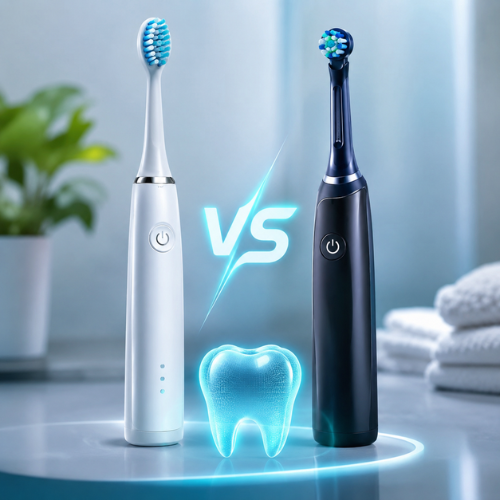
You’re standing in the oral hygiene aisle. Or on an e-commerce page. And you have to choose between two technologies that seem to do the same thing — but whose mechanisms are fundamentally different.
On one side, the sonic toothbrush. It vibrates at such a high frequency that it creates turbulence in the oral fluid. On the other, the oscillating-rotating toothbrush. Its small round head spins and oscillates with surgical mechanical precision.
Both are scientifically superior to the manual toothbrush. Both are recommended by dentists. Both generate convincing marketing claims.
So which should you choose? The answer depends on your profile — not on the ads. And that’s exactly what this guide will give you: a personalized answer, based on the available clinical data, with no commercial bias.
Understanding the mechanisms — What really happens in your mouth
Before comparing them, you need to understand them. Because the difference between these two technologies is not just a matter of speed or noise. It’s a matter of physics.
How does a sonic toothbrush work?
A sonic toothbrush generates high-frequency vibrations — between 30,000 and 45,000 vibrations per minute depending on the model. These vibrations do more than move the bristles across the tooth surface.
At this frequency, the vibrations spread through the oral fluid (saliva and water) and create micro-turbulence — what is called the hydrodynamic effect. This turbulence dislodges bacterial plaque within a 2 to 3 millimeter radius around the bristles, including in areas the bristles do not physically reach.
In practice: the sonic toothbrush partially cleans between the teeth and below the gumline — even without direct access.
How does an oscillating-rotating toothbrush work?
The oscillating-rotating toothbrush works on a direct mechanical principle. Its small round head turns one way, then the other, performing 8,000 to 9,900 oscillations per minute depending on the model. Some models add a vertical pulsation (back-and-forth motion) to increase plaque removal efficiency.
There is no hydrodynamic effect. Cleaning is purely mechanical: the bristles physically rub each tooth surface. It is a more concentrated, more localized action, and mechanically more aggressive on stubborn plaque.
The clinical comparison — What the studies say
This is where the debate gets serious. Several meta-analyses have compared the two technologies.
| Criterion | Sonic toothbrush | Oscillating toothbrush |
|---|---|---|
| Plaque reduction at 3 months | Better in some studies | Better in other studies |
| Gingivitis reduction | ✅ Documented sonic advantage | ✅ Also effective |
| Interdental cleaning | ✅ Partial hydrodynamic effect | 🟡 Limited to physical contact |
| Hard-to-reach areas | ✅ Fluid spread | 🟡 Depends on the head |
| Gentleness on gums | ✅ Usually gentler | 🟡 More mechanical |
| Effectiveness on early tartar | 🟡 Good | ✅ Mechanically superior |
| Fading stains whitening | ✅ Hydrodynamic effect | 🟡 Purely mechanical |
| Noise generated | 🟡 Moderate | 🔴 Louder |
| Battery life | ✅ Better (up to 30d) | 🟡 10 to 14 days |
| Feel in the mouth | 🟡 Diffuse vibration | 🟡 Localized rotation |
What the science honestly says: no study establishes a definitive and universal superiority of one technology over the other. Brushing quality depends more on consistency and technique than on the technology itself.
What is established: both are significantly superior to the manual toothbrush for reducing plaque and gingivitis.
The practical differences studies don’t measure
Beyond the clinical data, there are important practical differences that randomized studies do not capture — and that directly affect your daily experience.
The feel in the mouth
The sonic toothbrush creates a diffuse vibrating sensation throughout the mouth — sometimes unsettling for new users, who think it "does nothing." That is precisely the hydrodynamic effect in action. Most users get used to it in 3 to 5 days.
The rotating toothbrush produces a more localized, more "active" sensation, which many users instinctively associate with effective cleaning. This sensation is psychologically reassuring — but it does not necessarily reflect better clinical effectiveness.
Battery life
This is a practical criterion that is often underestimated. Modern sonic toothbrushes reach 30 days of battery life on a full charge — meaning monthly recharging. Rotating toothbrushes are generally limited to 10 to 14 days. For frequent travelers, the difference is significant.
Noise
Rotating toothbrushes are generally noisier — some models reach 70 dB. Quality sonic toothbrushes operate between 45 and 55 dB. If you live with someone who gets up at different times, or if you’re sensitive to noise in the morning, this is a factor to consider.
Head size
The rotating toothbrush uses a small round head of 15 to 18mm — which makes it easier to reach back molars and hard-to-access areas. The sonic toothbrush uses a head closer to a traditional brush (20 to 25mm), slightly less precise in very posterior areas. For smaller mouths, the rotating head can be an advantage.
Your profile — Which technology is right for you?
Profile 1 — Sensitive gums, frequent bleeding
Recommendation: Sonic toothbrush in Sensitive mode
The rotating toothbrush, because of its more aggressive mechanical action, may irritate already inflamed gums more. The sonic toothbrush in Sensitive mode generates reduced vibrations that clean without traumatizing. Combined with daily water flossing, it significantly reduces bleeding in 2 to 4 weeks.
Profile 2 — Heavy tartar, strong teeth, no gum issues
Recommendation: Oscillating-rotating toothbrush
The direct mechanical action of the rotating toothbrush is particularly effective at removing stubborn plaque deposits before they calcify. If tartar builds up quickly and your gums are not sensitive, the rotating brush may be mechanically more effective.
Profile 3 — People looking to whiten their teeth
Recommendation: High-frequency sonic toothbrush, White mode
The hydrodynamic effect of the sonic toothbrush is particularly effective on extrinsic stains — deposits of coffee, tea, and red wine that build up on plaque. In White or Polish mode, the sonic toothbrush at 40,000-45,000 vib/min removes these staining deposits even in hard-to-reach areas.
Profile 4 — Braces wearers
Recommendation: Sonic toothbrush with orthodontic head
The sonic toothbrush with a special orthodontic head (V-shaped bristles that wrap around the brackets) is the optimal solution. Its hydrodynamic effect cleans around brackets without requiring precise movements that are difficult with an appliance in the mouth.
Profile 5 — People with a small mouth or difficult posterior areas
Recommendation: Oscillating toothbrush with a small round head
The small round head of the rotating toothbrush (15-18mm) reaches the back molars more easily — especially in people with a small mouth opening or wisdom teeth in a difficult position.
Profile 6 — Eco-conscious profile
Recommendation: Bamboo sonic toothbrush
Sonic technology is available in models with a 100% natural bamboo handle — with no compromise on performance. It’s the obvious choice for people concerned about their environmental footprint.
Common mistakes with each technology
Mistakes with the sonic toothbrush
Mistake 1 — Scrubbing like a manual toothbrush
This is the most common mistake. The sonic brush should be guided gently — the vibrations do the work. Scrubbing harder does not improve cleaning and can wear down enamel.
Mistake 2 — Using the strongest mode from the start
Start with Sensitive mode for 7 to 10 days to get your gums used to the vibrations. Gradually move up to more intense modes.
Mistake 3 — Pressing hard to "make sure it cleans"
Excessive pressure cancels the hydrodynamic effect and irritates the gums. Light contact — just the weight of the brush — is optimal.
Mistakes with the oscillating toothbrush
Mistake 1 — Moving too fast from tooth to tooth
The rotating toothbrush needs 2 to 3 seconds per tooth for the oscillation to do its job. Moving too fast significantly reduces effectiveness.
Mistake 2 — Ignoring the lingual surfaces
The inner surfaces of the teeth (tongue side) are the areas most neglected with the rotating toothbrush. Always rotate the brush to reach these surfaces.
Mistake 3 — Pressing to compensate
As with the sonic toothbrush, excessive pressure is counterproductive. The mechanical rotation does the work — pressure adds nothing and abrades the enamel.
The right way to test both technologies
If you’re truly torn between the two, here is the test protocol recommended by dental hygienists.
Weeks 1-4 : use one brush (sonic or rotating) for 4 full weeks, morning and evening, without exception.
At day 28 : evaluate using these 3 criteria :
- Persistent clean-teeth feeling throughout the day
- Change in gum bleeding (increase, decrease, disappearance)
- Overall comfort of use (feel in mouth, noise, gum sensation)
If one criterion is unsatisfactory, test the other technology for 4 weeks. The comparison will give you a personal and undeniable answer — much more reliable than any general clinical study.
Conclusion — The real answer to sonic vs oscillating
There is no universally best technology. There is a best technology for your profile.
If you have sensitive gums, want to whiten your teeth naturally, or wear orthodontic appliances: the sonic toothbrush is your technology. If you build up tartar quickly, have strong teeth with no gum problems, and prefer localized, precise mechanical action: the rotating toothbrush may be more effective for you.
What does not change between the two technologies: the need for regular use twice a day, correct technique, and changing the head every 12 weeks.
At DentalPro Smile™, we chose sonic technology for our entire adult range — because its benefits for the gums, its hydrodynamic effect, and its gentleness make it the technology best suited to most French adult profiles. Our PureBrush Pro™ and NaturalBambou Pro™ brushes embody this technology at its best.
Discover the DentalPro Smile™ range → Free delivery · 1-year warranty · Visible results in 7 days.
👉 dentalpro-smile.com/fr-fr
❓ FAQ
1. Is the sonic toothbrush really more effective than the rotating toothbrush?
No clinical study establishes a definitive universal superiority. Both technologies are significantly superior to the manual toothbrush. The sonic toothbrush has an advantage for sensitive gums and partial interdental cleaning through the hydrodynamic effect. The rotating toothbrush may be mechanically more effective on early tartar. The choice depends on your specific profile.
2. Can you switch from a rotating toothbrush to a sonic toothbrush without adjustment?
Yes, but an adjustment period of 5 to 10 days is normal. The vibrating feel of the sonic toothbrush is different from the localized rotation of the oscillating brush. Start with Sensitive mode and gradually increase the intensity. Most users fully adapt in one to two weeks.
3. Are sonic toothbrushes compatible with crowns and bridges?
Yes. Sonic technology is compatible with ceramic, metal-ceramic, composite, and zirconia crowns, as well as conventional bridges. The hydrodynamic effect cleans effectively around crown margins without damaging them. Use Sensitive mode initially to check for any sensitivity in treated areas.
4. Which technology do French dentists recommend most?
Both technologies are recommended by French dentists, with a slight preference for the sonic toothbrush in recent recommendations for profiles with sensitive gums. The final decision always depends on the individual patient’s profile, and your dentist remains the best advisor for your specific situation.
5. Does the sonic toothbrush work better with a specific toothpaste?
No. The sonic toothbrush works with any standard fluoride toothpaste. The hydrodynamic effect is created by vibrations in the oral fluid — it does not depend on the toothpaste formula. Avoid only very abrasive toothpastes (RDA > 150) that can wear down enamel, especially with high-frequency use.
6. Is the oscillating toothbrush suitable for people with dental implants?
The oscillating toothbrush can be used with dental implants, but with caution. Avoid pressing directly on the implant-gum junction with the rotating head. The sonic toothbrush in Sensitive mode is generally preferred by implant specialists for peri-implant areas, because its action is less mechanically aggressive on supporting tissues.
Sources :
— HAS — Oral health prevention recommendations: has-sante.fr
— American Dental Association — Electric toothbrush guidelines : ada.org
— Cochrane Database of Systematic Reviews — Powered versus manual toothbrushing
— Journal of Clinical Periodontology — Sonic vs oscillating toothbrush studies
— emmi-dent.fr — Ultrasonic technology compared
Informational article only. Does not replace the advice of a dentist. DentalPro Smile™ — 2026.

Leave a comment
This site is protected by hCaptcha and the hCaptcha Privacy Policy and Terms of Service apply.