
The question seems straightforward. The answer, however, is more nuanced than you might think.
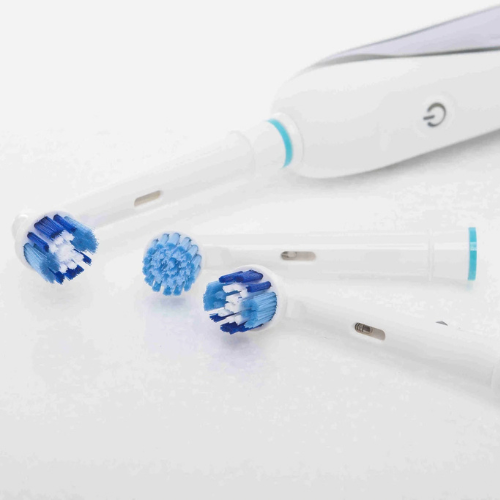
Sharing an electric toothbrush by simply changing the head is a cost-saving solution adopted by many couples, families and housemates. One handle at 60€ instead of two at 60€ each - the savings are tempting.
And technically, if everyone has their own head, the problem is solved - right?
Not quite. An electric toothbrush handle is not an inert, sterile surface. It accumulates toothpaste residue, saliva and oral bacteria - in the grooves, around the button and in the attachment collar. And even a personal brush head comes into contact with this shared handle every time it is used.
This guide explains exactly what is genuinely risky, what is acceptable with precautions, and when sharing becomes clearly inadvisable.
What you really share when you share a handle
Many people believe that changing the head is enough to make sharing completely safe. That is not the whole picture. Here is what remains shared even when everyone has their own head.
Shared element 1 - The attachment collar (head-to-handle connection)
The attachment collar is where the brush head fits onto the handle. It is one of the areas of the toothbrush with the highest buildup of bacterial residue - toothpaste, saliva and oral aerosols released during brushing accumulate there.
When you put your head on the handle after your partner has used theirs, your head comes into contact with residue left in the collar by the previous head.
What accumulates there: oral bacteria, saliva residue, oral viruses during active infections, and fungi (Candida) during a yeast infection.
Shared element 2 - The on/off button
The button is operated with damp fingers - often after placing the head in the mouth. If someone has an oral or viral infection, pathogens can transfer from their hand to the button, then from the next user's hand to their mouth.
Shared element 3 - The handle itself
Even without direct contact with the mouth, the handle accumulates oral aerosols released during brushing. These tiny droplets settle over the entire surface of the handle and can remain viable for several hours, depending on the pathogens involved.
The real risks - What science says about oral transmission
Transmission 1 - Cavity-causing bacteria
Streptococcus mutans - the main bacterium responsible for cavities - can be transmitted through saliva. Studies have documented its transmission between partners and between parents and children through shared items such as cutlery and toothbrushes. (Source: Journal of Dental Research - S. mutans transmission)
What this means for sharing a handle: if one user has particularly virulent cavity-causing bacteria and cross-contamination is possible through the shared collar, the other user may be exposed to more aggressive strains they did not previously have.
Transmission 2 - Herpes viruses (HSV-1)
Herpes simplex virus type 1 - responsible for cold sores - spreads easily through saliva and survives for several hours on surfaces. A handle shared while one user has an active cold sore is a possible route of transmission to the other user.
HSV-1 survival on surfaces: up to 4 hours on a damp surface at room temperature.
Transmission 3 - Respiratory viruses
Rhinoviruses (the common cold), influenza viruses and SARS-CoV-2 spread through the air and through contact with surfaces. During an active infection, oral aerosols deposited on the handle may contain viral particles that remain viable for several hours.
Transmission 4 - Candida albicans
The fungus responsible for oral thrush can survive for several days on dry surfaces. If one user has an active infection, the shared handle can be a source of contamination.
What transmission through a shared handle really means
An important distinction: the risk of transmission through a shared handle - with separate heads and no direct contact between one person's head and the other person's mouth - is significantly lower than the risk of transmission through direct routes such as kissing, shared cutlery or direct contact.
The risk is not zero, but it is moderate and depends on specific factors such as active infections and inadequate handle hygiene.
Situations by risk level
✅ Low risk - Acceptable with precautions
Healthy couple with no active infection
Two healthy adult partners with no active oral infection who share a handle using separate heads and clean the handle regularly have a low risk of cross-contamination.
Couples generally have similar oral bacteria after living together for a long time, further reducing the risk of transmitting "foreign" strains.
Precautions to maintain:
- Use strictly individual, clearly labelled heads
- Clean the handle (collar + button) before each head change
- Do not share during infections (herpes, sore throat, cold)
- Thoroughly clean the handle monthly
🟡 Moderate risk - Avoid if possible
Adult family members (siblings, adults living together)
Oral bacteria differ more between family members who are not partners. The risk of transmitting "foreign" bacterial strains is higher than for a couple.
Recommendation: invest in two handles if your budget allows. If sharing is unavoidable, take strict precautions (disinfect the collar between users).
🔴 High risk - Clearly inadvisable
Sharing between parent and child
Children are more vulnerable immunologically. Transmission of S. mutans from parents to children through oral routes, including toothbrushes, is a documented risk factor for cavities in children. Sharing a handle between parent and child is not recommended.
Sharing during an active infection
Active cold sores, sore throat, oral thrush, COVID-19, flu - sharing should be suspended during any infection. The infected user should use a separate handle (or a temporary manual toothbrush) for the entire duration of the infection.
Sharing involving immunocompromised people
People undergoing chemotherapy, transplant recipients and those with immune disorders should avoid sharing a handle altogether - their susceptibility to opportunistic infections makes any potential source of contamination unacceptable.
Hygiene rules if you choose to share
If you decide to share a handle after assessing your risk level, these rules will minimise the remaining risks.
Rule 1 - Clearly identify heads and never swap them
Each user has their own head - never swap them, even temporarily. Identify the heads by colour, an adhesive label or a mark.
Tip: buy different-coloured heads for each user. The immediate visual difference helps prevent mix-ups.
Rule 2 - Clean the collar before every head change
Before putting your head on the handle after someone else has used it:
1. Remove the previous head
2. Use a cotton bud soaked in isopropyl alcohol
   to clean the handle's attachment collar
3. Leave to dry for 15 seconds
4. Rinse the collar under running water
5. Attach your head
This 30-second procedure significantly reduces the bacterial load on the collar before it comes into contact with your head.
Rule 3 - Clean the entire handle weekly
Once a week, clean the entire handle with a cotton bud + isopropyl alcohol or white vinegar:
- Attachment collar (inside and outside)
- On/off button and the area around it
- Body of the handle
- Base (charging contact area)
Rule 4 - Store heads separately
Store each head separately - on separate holders, in different cases or clearly spaced apart. Heads stored side by side can contaminate each other through contact or aerosols.
Rule 5 - Stop sharing immediately if someone has an infection
At the first symptom of an oral or respiratory infection (cold sore, sore throat, cough, cold), the affected user should use a separate manual toothbrush until fully recovered.
Do not resume sharing until: symptoms have completely disappeared + the head has been replaced.
The budget-friendly alternative - Two handles for less
If saving money is the main reason for sharing, there is an alternative that is often a better deal.
The calculation:
| Option | Initial cost | Annual cost of heads | 3-year total |
|---|---|---|---|
| 1 shared premium handle (60€) + 2 × 4 heads (8€ × 8) | 60€ | 64€ | 252€ |
| 2 mid-range handles (35€ × 2) + 2 × 4 heads (6€ × 8) | 70€ | 48€ | 214€ |
| 2 entry-level handles (25€ × 2) + 2 × 4 heads (5€ × 8) | 50€ | 40€ | 170€ |
The financial takeaway: two decent entry-level handles often cost less over 3 years than one shared premium handle - with cheaper heads and zero risk of cross-contamination.
The special case of children - An absolute rule
Children should never share an adult's handle.
Even with separate heads. Even with perfectly healthy parents.
The reasons:
Reason 1 - Unsuitable size
An adult handle is designed for adult hands and an adult mouth. An adult head fitted to an adult handle may be too large to reach the back of the mouth in a child under 10.
Reason 2 - Unsuitable intensity
The modes and power settings of an adult toothbrush are designed for mature adult enamel. When used on a child's developing enamel - even with a child's head - they may be too intense.
Reason 3 - Transmission of S. mutans
Transmission of S. mutans from parents to children is a documented risk factor for early cavities. Sharing a handle is another potential route of transmission.
The universal rule: every child should have their own electric toothbrush - designed for their age, with their own head and handle.
Summary table - Who can share and under what conditions?
| Situation | Risk level | Recommendation |
|---|---|---|
| Healthy adult couple, separate heads | 🟢 Low | Acceptable with precautions |
| Adult couple during an active infection | 🔴 High | Stop sharing |
| Adult family members, separate heads | 🟡 Moderate | Not recommended - preferably use 2 handles |
| Parent - child, separate heads | 🔴 High | Strongly discouraged |
| Child - child, separate heads | 🟡 Moderate | Not recommended |
| Immunocompromised person | 🔴 High | Not allowed |
| Housemates who are not partners | 🟡 Moderate | Not recommended - preferably use separate handles |
Conclusion - Separate heads are necessary but not enough
Sharing an electric toothbrush handle with separate heads is better than sharing both the head and the handle. But it is not the same as having two completely separate handles.
For healthy adult couples with no active infection, the risk is low enough to be acceptable with the precautions described. For everyone else - parents and children, family members and immunocompromised people - two separate handles are both more hygienic and often more economical over 3 years.
At DentalPro Smile™, our PureBrush Pro™ handles are priced to make two handles affordable for a family - with compatible replacement heads for the entire range.
Explore the DentalPro Smile™ range → One handle per person · Heads always available · Free delivery · 1-year warranty.
👉 dentalpro-smile.com/fr-fr
❓ FREQUENTLY ASKED QUESTIONS
1. If I change the brush head and disinfect the collar, is sharing completely safe?
It is much safer, but the risk is not strictly zero. Disinfecting the collar eliminates most pathogens but may not eliminate certain viruses that are highly resistant when dry. For two healthy adults with no active infection, this residual risk is acceptable. For more vulnerable groups (immunocompromised people, children and those with active infections), sharing is still not recommended even with disinfection.
2. My partner and I often catch the same viruses - is sharing really a problem?
For a couple living together, common respiratory viruses spread so much more directly through physical contact and shared air than through a toothbrush handle that the handle is indeed a minor route of transmission. The real risk of sharing a handle relates more to specific oral bacteria (S. mutans) and herpes viruses, for which transmission through surfaces is better documented. If you already share glasses, kiss and share cutlery, a shared handle adds little extra risk.
3. Can an electric toothbrush head be disinfected for temporary sharing?
No - disinfecting the bristles of a brush head is not enough to eliminate all the pathogens lodged between them. Even soaking it in hydrogen peroxide or white vinegar does not guarantee complete elimination. The porous bristles and the spaces between them provide hiding places where pathogens can survive and are difficult to sterilise without professional equipment. Never share brush heads - even "disinfected" ones.
4. If I am the only person using the toothbrush but also use it on my tongue, do I need a separate head?
No - there is no reason for one person to have two heads when brushing their teeth and tongue with the same toothbrush. The tongue is part of the oral cavity, so the bacteria on your tongue are already present in your mouth. However, turn off the toothbrush before moving on to your tongue (this reduces the gag reflex) and rinse the head thoroughly afterwards.
5. Our family has an electric toothbrush with 4 heads included - can we all use them on the same handle?
Technically, yes - that is exactly how some manufacturers intend their "family packs" with multiple heads for one handle to be used. These packs assume that each family member uses their own head on the shared handle. The precautions described in this article apply, especially clearly identifying heads and cleaning the collar between users. The rule for children still applies: for those under 10, a handle suited to their age is preferable.
6. How long does S. mutans survive on a toothbrush handle?
Streptococcus mutans survives for several hours on damp surfaces at room temperature - and longer in tiny crevices protected from drying out, such as the attachment collar. In vitro studies have documented its survival for up to 24 hours in these conditions. This is the main reason why cleaning the collar between users is the most important precaution if you choose to share a handle.
Sources:
- Journal of Dental Research - S. mutans transmission and caries risk
- British Dental Journal - Toothbrush contamination and cross-contamination
- American Dental Association - Toothbrush hygiene guidelines: ada.org
- Journal of Clinical Microbiology - Viral survival on dental surfaces
- HAS - Family dental hygiene recommendations: has-sante.fr
This article is for informational purposes only. It is not a substitute for advice from a dentist. DentalPro Smile™ - 2026.

Leave a comment
This site is protected by hCaptcha and the hCaptcha Privacy Policy and Terms of Service apply.