

Do your gums bleed slightly when you brush your teeth? Do you sometimes have bad breath despite brushing regularly? Can you feel tartar under your tongue?
You’re probably saying to yourself: "That’s normal, that’s how it is for everyone."
It’s not normal. And it’s not inevitable.
According to data from the French Health Insurance system, more than 90% of French adults suffer from or have suffered from tooth decay, and nearly one in two adults has some form of periodontal disease — that is, gum disease. (Source: ameli.fr — Oral health)
These figures are no coincidence. They reveal a systemic problem in our daily oral hygiene routines. Routines that most of us never really learned—because no one ever truly taught us.
In this article, we'll review the 5 most common dental problems, understand why they occur, and above all how to solve them effectively and for the long term — right from your bathroom.
Problem 1 — Bleeding gums: no, it’s not normal
What you feel
You brush your teeth and your toothbrush comes away with pink or red marks. You spit blood. Your gums are sometimes swollen, tender to the touch, or feel slightly tight.
You’ve learned to accept it. You may think you brush too hard. Or that it’s hereditary.
What’s really happening
The gums bleed because they are inflamed. And they are inflamed because there is a buildup of bacterial plaque at their base—precisely where your manual toothbrush does not reach effectively.
This plaque, if not removed daily, triggers an inflammatory response in the gum tissue. It is this inflammation that causes bleeding. It is not that your toothbrush is too hard. It is the plaque that has built up in an inaccessible area.
At this stage, if this chronic inflammation is left untreated, it can progress to periodontitis — a gradual destruction of the bone tissue that supports your teeth. It is the leading cause of tooth loss in adults in France. (Source: French National Authority for Health — Periodontal diseases)
The solution
The bleeding goes away when the inflammation goes away. And the inflammation goes away when plaque is completely and regularly removed — including between the teeth and under the gumline.
The key is to incorporate effective interdental cleaning into your daily routine. Clinical studies show that regular interdental cleaning significantly reduces gum inflammation within 2 to 4 weeks of consistent use. (Source: Journal of Clinical Periodontology, 2019)
What this changes in practice: Integrate 2 to 3 minutes of daily interdental cleaning into your evening routine. Visible results in 7 to 14 days for the vast majority of non-advanced cases.
The Bad Breath Problem 2 — Where It Really Hides
What you feel
You brush your teeth twice a day. You use mouthwash. And yet — in the middle of the day, after a meal, or in the morning when you wake up — that feeling of bad breath comes back.
It's socially embarrassing. It can sometimes be a source of anxiety. And mint candies don't address the root cause.
What is really happening
In 85 to 90% of cases, bad breath—called halitosis—originates in the mouth. (Source: British Dental Journal, systematic review 2021)
The three main sources are:
The back of the tongue. The top surface of the tongue harbors a massive amount of anaerobic bacteria that produce volatile sulfur compounds—responsible for the characteristic odor. A toothbrush does not clean the tongue effectively.
2. Interdental spaces. Food residue trapped between the teeth ferments and produces foul-smelling gases. Brushing alone does not reach it.
The base of the gums. Even shallow gum pockets harbor colonies of anaerobic bacteria that thrive sheltered from oxygen.
A mouthwash temporarily masks the problem. It does not eliminate it.
The solution
A complete oral hygiene routine which includes three distinct steps: cleaning the surface of the teeth, interdental cleaning, and tongue cleaning. Together, these three steps—practised regularly—eliminate bacterial sources rather than masking their production.
Expected result: A significant improvement in breath freshness from the first week for typical cases. Long-lasting fresh breath in 2 to 4 weeks.
The problem 3 — Tartar: why your toothbrush alone is no longer enough
What you feel
You run your tongue over your teeth and feel rough deposits, especially behind the lower incisors and around the molars. Your teeth have lost their natural smoothness. Your dentist mentions it at every visit.
What is really happening
The tartar—or dental calculus—is calcified bacterial plaque. Once mineralized, it adheres to the surface of the tooth and can no longer be removed by brushing. It requires either professional mechanical treatment (scaling) or regular, effective loosening beforehand—before the plaque calcifies.
The buildup takes about 24 to 72 hours to start mineralizing. That's why consistent and effective daily brushing is essential. (Source: American Dental Association — Dental Calculus)
What most people don't know: a manual toothbrush does not generate enough mechanical energy to create a hydrodynamic effect around the teeth — that is, turbulence in the oral fluid that dislodges plaque even where the bristles do not physically reach. High-frequency sonic toothbrushes produce this effect. (Source: Journal of Dentistry, comparative review of manual vs. sonic toothbrushes, 2022)
The solution
A brushing frequency and effectiveness that prevent plaque from calcifying. Plus a deep-cleaning action for interdental spaces and hard-to-reach surfaces — especially dentures, braces, and aligners, which accumulate tartar faster than natural teeth.
Expected result: visible reduction in tartar observed by dentists in their patients who adopt a complete and regular routine, generally within 4 to 8 weeks.
Problem 4 — Yellow teeth and stains: what really causes them
What you feel
Your teeth have lost their natural whiteness. Stains appear — yellow, beige, or gray — despite regular brushing. You no longer dare to smile fully in photos.
What’s really happening
There are two types of tooth discoloration, with radically different causes and solutions.
Extrinsic staining (on the surface): caused by coffee, tea, red wine, tobacco, or certain highly pigmented foods. These stains build up on plaque and tartar. They can be removed with effective brushing and regular scaling.
Intrinsic colorations (in the enamel or dentin): caused by certain medications, fluorosis, trauma, or the natural aging of the enamel. These stains do not respond to brushing alone and require professional treatment.
The vast majority of people who complain about "yellow" teeth have extrinsic staining — which can therefore be effectively treated at home with a complete brushing routine that includes a suitable polishing mode.
The solution
Eliminate plaque and staining deposits daily and effectively, using a technique and equipment that reach all surfaces. Results vary depending on the nature and age of the stains, but a visible improvement within 7 to 30 days is reported by the vast majority of users who adopt a complete routine.
Issue 5 — Poorly cleaned dentures, aligners, and braces
What you're feeling
You wear dentures, a clear aligner (such as Invisalign), a night guard for bruxism, or a removable orthodontic appliance.
You rinse it. Sometimes you scrub it. But there’s still a slight odor. A whitish residue appears. And you’re never really sure it’s truly clean.
What’s really happening
The surface of dentures and aligners is microporous. Even when it looks clean to the naked eye, this surface harbors bacterial and fungal colonies in its tiny crevices. A regular toothbrush gradually scratches these surfaces—creating even more micro-crevices where bacteria can settle.
A study published in the Journal of Prosthetic Dentistry (2021) showed that ultrasonic cleaning removes significantly more bacterial biofilm from dentures than manual brushing, without damaging the materials.
The bacteria from a poorly cleaned aligner or denture are reintroduced into the mouth every time it is worn. Candida albicans, Streptococcus mutans — microorganisms directly linked to cavities, gum infections, and bad breath.
The solution
A clean using ultrasonic cavitation—which generates millions of microbubbles that unclog every surface of the device in just a few minutes, without mechanical contact and without scratching. Combine with suitable cleaning tablets for complete disinfection.
Expected result: Clean dentures or aligners thoroughly in 3 to 5 minutes. Odors eliminated. Extends the life of the appliance.
What all these solutions have in common
If you've read this article this far, you've probably recognized one or more of these issues in your daily life.
What emerges from the analysis of these 5 problems is clear: a manual toothbrush used twice a day is insufficient for complete oral hygiene and to effectively prevent cavities, gum disease, tartar, and bad breath.
It's not a matter of willpower or discipline. It's a matter of tools.
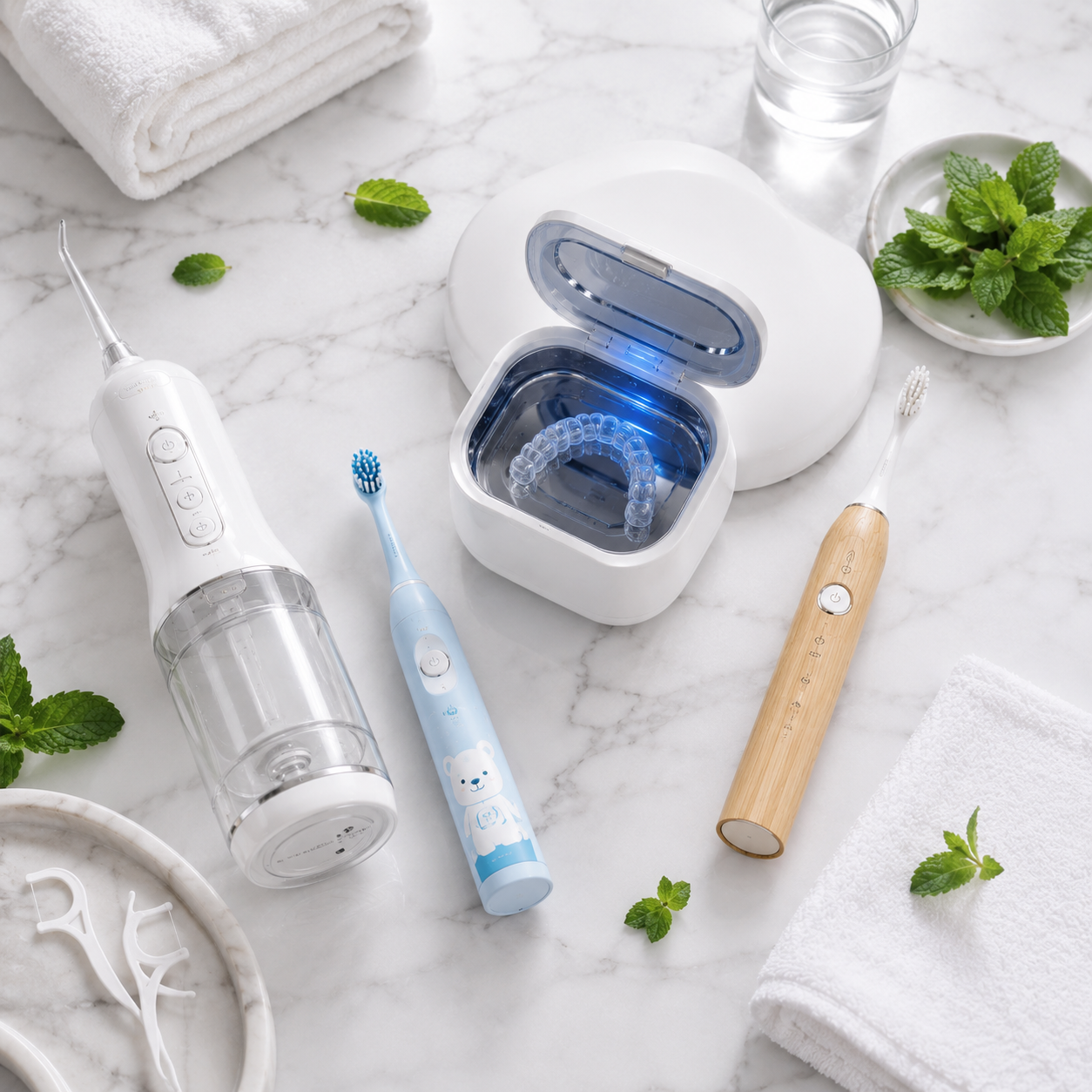
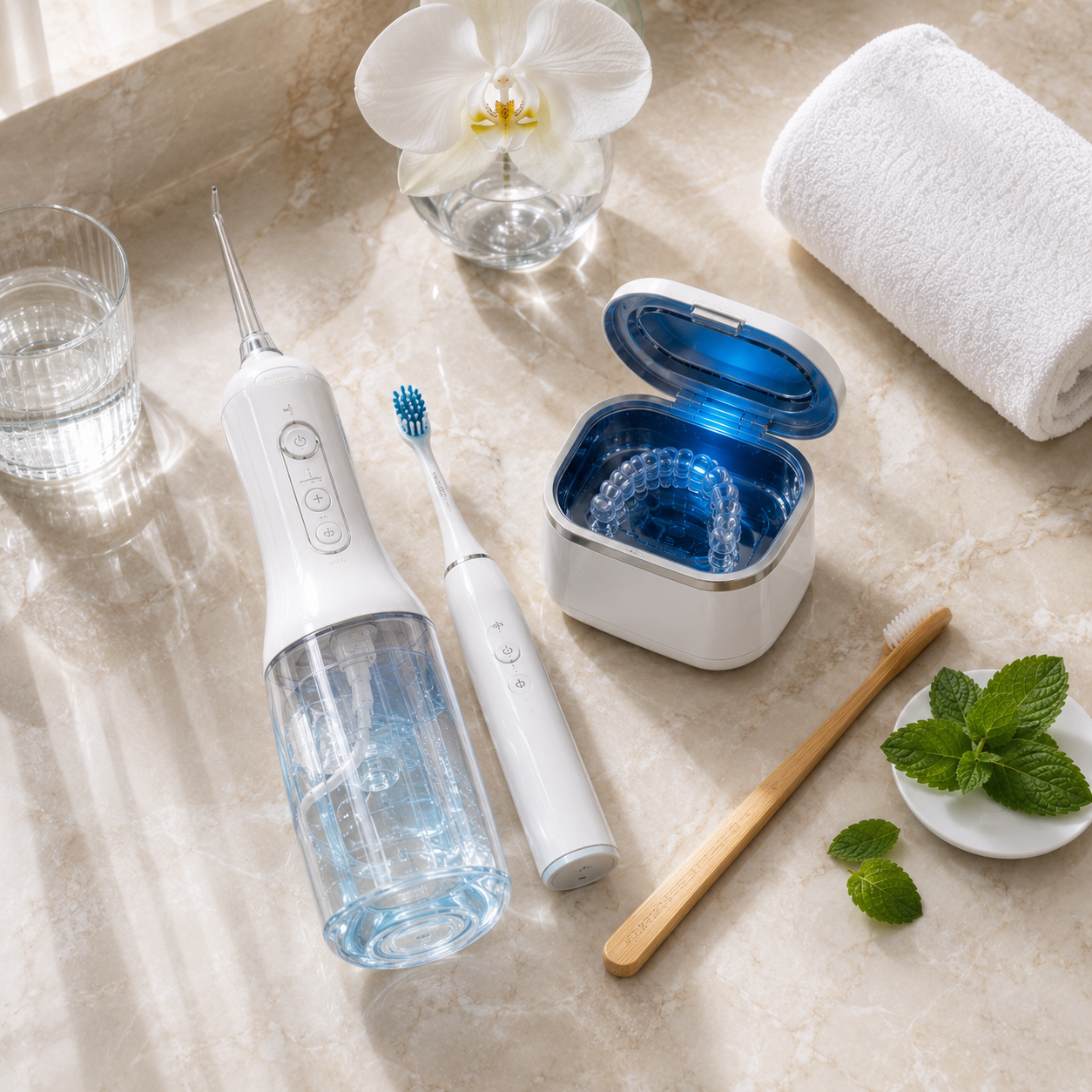
Domestic dental hygiene equipment has evolved considerably in recent years. Sonic toothbrushes, water flossers, ultrasonic cleaners, tongue scrapers—these technologies, once reserved for dental offices, are now available for home use at a fraction of the cost of an appointment.
Result: daily dental care at a level close to the dentist's office, from your bathroom, in less than 10 minutes a day.
Your complete dental routine in 10 minutes a day
| Moment | Step | Duration | Benefit |
|---|---|---|---|
| Morning | Tongue cleaning | 30 sec | Immediate fresh breath |
| Morning | Sonic brushing | 2 min | Plaque and stain removal |
| Morning | Interdental cleaning | 2 min | Prevention of cavities and gingivitis |
| Evening | Prosthesis/aligner cleaning | 5 min (in parallel) | Complete biofilm removal |
| Evening | Sonic brushing | 2 min | Night plate detachment |
| Evening | Interdental cleaning | 2 min | Removal of fermentable residues |
Total: 8 to 10 minutes per day. For teeth that are every bit as good as after a professional scale and polish.
Frequently Asked Questions
No, these solutions do not replace visits to the dentist?
No—and no serious specialist will tell you otherwise. Annual or twice-yearly visits to the dentist remain essential for a complete diagnosis, professional scaling, and screening for non-visible problems. On the other hand, an effective at-home routine significantly reduces the frequency and cost of these procedures.
What results can you expect, and how soon?
Results vary depending on the issue and how long it has been present. For bleeding gums and bad breath, improvements are generally seen within 7 to 14 days. For tartar and staining, allow 4 to 8 weeks of regular use.
Are these tools dangerous for enamel?
High-quality sonic toothbrushes and water flossers, when used correctly, are safe for enamel. Household ultrasonic cleaners operate at frequencies and power levels suited to dental appliances and jewelry — they do not scratch. It is recommended to start at the lowest pressure or power setting and increase gradually.
From what age can this equipment be used?
The electric toothbrushes designed for children can be used from age 3, under parental supervision. Water flossers are not recommended before age 6. Ultrasonic cleaners are intended for adults and teenagers with braces.
Conclusion
Your bleeding gums, your persistent bad breath, your recurring tartar — these are not inevitabilities. They are not signs of poor hygiene. They are signals that your current routine has blind spots your current tools do not address.
The good news: filling these blind spots requires neither medical expertise nor a major investment. It requires the right equipment, used the right way, every day.
At DentalPro Smile™, we have designed a complete range of home dental hygiene products to cover each of these blind spots — for children as well as adults, for people with braces as well as those simply looking for whiter teeth and fresher breath.
Discover the full DentalPro Smile™ range → Visible results in just 7 days or your money back.

Leave a comment
This site is protected by hCaptcha and the hCaptcha Privacy Policy and Terms of Service apply.