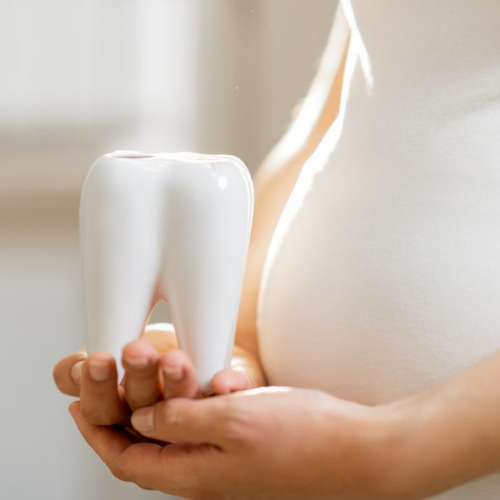
"Pregnancy and teeth" — a combination few women truly anticipate.
Between morning sickness, fatigue, and the thousand concerns of those nine months, dental health often takes a back seat. And yet, pregnancy is one of the times in life when oral hygiene deserves the most attention — for you and your future child.
Pregnancy gingivitis — inflammation of the gums linked to the hormonal changes of pregnancy — affects between 60 and 75% of pregnant women according to available studies. (Source: compiled data — French dental societies and clinical reviews)
This is not a coincidence. It is the direct consequence of the major hormonal changes that accompany pregnancy — and it is predictable and preventable.
Why does pregnancy affect dental health?
Hormonal changes — The central mechanism
During pregnancy, estrogen and progesterone levels rise considerably. These hormones alter the inflammatory response of gum tissues to bacterial plaque.
In practice: an amount of plaque that would cause mild inflammation in a non-pregnant woman can cause significant gingivitis in a pregnant woman — with the same hygiene routine.
The gums become more reactive, more sensitive, and more likely to bleed.
Morning sickness — An underestimated aggravating factor
Repeated vomiting exposes enamel to highly corrosive stomach acids (pH < 2). If this happens several times a day for several weeks, enamel erosion can be significant.
What you should do after each episode of vomiting:
- Do NOT brush your teeth immediately (the enamel is temporarily softened by the acids)
- Rinse your mouth with water or a diluted baking soda solution (neutralizes acidity)
- Wait 30 to 60 minutes before brushing your teeth
Sugar cravings — An increased risk of cavities
Food cravings during pregnancy can lead to more frequent consumption of sugary foods. Every intake of sugar triggers acid production by cavity-causing bacteria for 20 to 30 minutes. The frequency of sugary snacks is a greater risk factor for cavities than the total quantity consumed.
Trimester by trimester — What to do
1st trimester (weeks 1-12)
Priority: preventive dental consultation as soon as possible.
Ideally, a dental check-up should be done before conception or at the very beginning of pregnancy. It helps treat existing cavities and establish a suitable routine before hormonal changes intensify.
What is safe in the 1st trimester:
- Scale and polish ✅
- Conservative treatments (fillings) ✅ if urgent
- Dental X-rays with protection ✅ (minimal radiation, lead apron)
What is generally postponed:
- Non-urgent treatment → 2nd trimester preferred
- Tooth extraction → if possible, postpone unless urgent
- Whitening → completely discouraged throughout pregnancy
2nd trimester (weeks 13-26)
The most favorable period for dental treatment.
Nausea is generally reduced, the belly is not yet uncomfortably large for lying back in the dental chair, and fetal risk from treatment is minimal.
This is the ideal time for:
- Scale and polish if not done in the 1st trimester
- Treatment of identified cavities
- Adjustment of the hygiene routine
3rd trimester (weeks 27-40)
Non-urgent treatment is generally postponed until after delivery as a precaution — not because of direct risk to the fetus, but because of maternal discomfort (prolonged lying down is difficult) and as a general precaution.
Absolutely continue: the reinforced daily hygiene routine.
The dental routine during pregnancy — What to strengthen
Pregnancy is not the time to reduce your dental hygiene — it is the time to strengthen it.
Brushing — Adapt without reducing
If nausea makes brushing difficult in the morning, here are some practical adjustments:
- Switch toothpaste to a more neutral flavor (mild mint or unflavored)
- Brush at a time of day when nausea is less intense
- Use a smaller brush head if the gag reflex is pronounced
- Use the "Sensitive" mode of a sonic toothbrush — less intense
Never skip morning brushing even in case of nausea. Adapt — but keep going.
Interdental cleaning — Now essential
With gums being more reactive, daily interdental cleaning becomes even more critical during pregnancy. A water flosser on gentle mode is especially well suited to the sensitive or inflamed gums of pregnant women.
Diet — Limit sugars between meals
Every sugary snack triggers an acid episode lasting 20 to 30 minutes. Three balanced meals are better than six sugary snacks for dental health. If snacks are necessary, choose fresh fruit, dairy products, or vegetables.
Maternal dental health and baby's health — The documented link
Studies have established a link between untreated maternal periodontitis and certain obstetric complications. (Source: compiled reviews — Journal of Periodontology, data on the association between periodontitis and pregnancy)
⚠️ These scientific data are still debated within the scientific community. I cannot claim direct causality without risking oversimplifying a complex reality. What can be stated is this: treating periodontitis during pregnancy is beneficial for maternal health — and that alone justifies reinforced hygiene.
Mother-to-child bacterial transmission
Streptococcus mutans — the main cavity-causing bacterium — is not present at birth. It is transmitted to the child, mainly by the mother, in the first months of life through saliva.
What this means in practice:
- Avoid sharing the spoon or bottle teat with the baby
- Do not "clean" the pacifier by putting it in your mouth
- Maintain optimal maternal oral hygiene to reduce the load of S. mutans that can be transmitted
FAQ
Can you go to the dentist when you are pregnant?
Yes — and it is even recommended. A dental check-up during pregnancy is advised by the French National Authority for Health. Conservative treatment, scale and polish, and emergencies can be handled safely, especially in the 2nd trimester. (Source: HAS — pregnancy monitoring recommendations)
Is an electric toothbrush safe during pregnancy?
Yes. A sonic toothbrush with "Sensitive" mode is perfectly safe throughout pregnancy. It may even be preferable if the gums are very sensitive, because it cleans effectively without excessive pressure.
Does pregnancy really make you "lose teeth"?
The popular belief "one child = one lost tooth" is a myth in the sense that pregnancy does not directly make teeth fall out. However, insufficient hygiene during pregnancy, combined with hormonal changes, can worsen pre-existing periodontal problems. Reinforced hygiene eliminates this risk.
Should you take calcium supplements to protect your teeth during pregnancy?
Calcium needs increase during pregnancy. If the diet is insufficient in calcium, supplementation may be recommended by a doctor — but for fetal bone development, not to "protect maternal teeth," whose calcium cannot be "stolen" by the fetus as the popular myth suggests.
Conclusion
Pregnancy is a period of heightened vigilance for dental health — not because pregnancy destroys teeth, but because hormonal changes make the gums more vulnerable when hygiene is insufficient. Strengthening your routine, seeing your dentist in the 2nd trimester, and adjusting your diet: three simple actions to get through those nine months with healthy teeth and gums.
PureBrush Pro™ DentalPro Smile™ in Sensitive mode — designed for the most reactive gums, including those of expectant mothers.
👉 dentalpro-smile.com/fr-fr
RECOMMENDED RELATED ARTICLES:
→ Article 3: Bleeding gums — common during pregnancy
→ Article 8: Electric toothbrush for children — to prepare baby's dental health
→ Article 18: Diet and dental health
Article for informational purposes only. Does not replace the advice of an obstetrician-gynecologist or a dentist. DentalPro Smile™ — 2026.

Leave a comment
This site is protected by hCaptcha and the hCaptcha Privacy Policy and Terms of Service apply.