
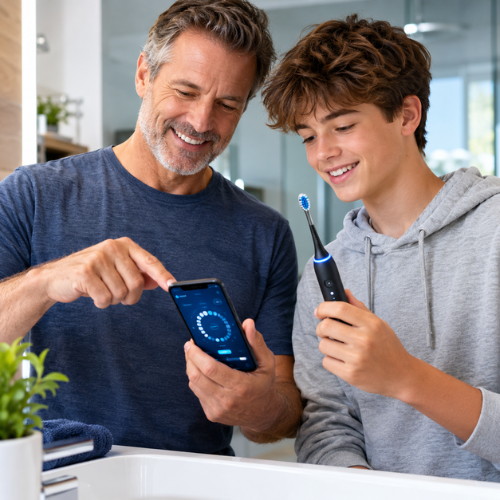
A built-in Bluetooth connection. An app on your phone. Real-time coaching while you brush. Weekly stats on your oral hygiene.
The connected electric toothbrush is one of the hottest consumer tech products of recent years. And it raises a legitimate question that manufacturers obviously don’t ask: is it really better for your teeth?
The honest answer is nuanced — and depends entirely on your profile.
For some people, the connectivity of an electric toothbrush can make a real, measurable clinical difference to their oral health. For others — the majority, based on available data — it’s a feature from which they won’t get the promised benefits after the first 6 weeks.
This guide objectively analyzes what connectivity really adds, what clinical studies confirm, and for whom investing in a connected toothbrush makes sense.
What a connected electric toothbrush actually does
Before assessing the value of connectivity, you need to understand exactly what it offers technically.
Feature 1 — Brushing time tracking
The toothbrush sends each brushing session’s duration to the app in real time. The app displays the duration, compares it to the 2-minute target, and records the history.
Added value vs. built-in timer : the built-in timer on the brush (present on all quality brushes, even non-connected ones) already performs this function. Tracking in the app adds historical visualization — but not real-time guidance.
Feature 2 — Brushed-area detection
This is the most technically ambitious feature — and the least mature. The brush’s accelerometer and gyroscope record 3D movements in real time. The app interprets this data to infer which area of the mouth is being brushed.
What independent tests reveal :
The accuracy of this detection varies significantly depending on the model and the user. Distinguishing between the outer and inner surfaces of the same area, or between two adjacent teeth, is still difficult to achieve 100% accuracy with current inertial sensors. Area accuracy (upper left / upper right / lower left / lower right) is generally good. Tooth-by-tooth accuracy is much more approximate.
Feature 3 — Pressure measurement
The accelerometer measures movement changes related to applied pressure. When you press too hard, the head deviates slightly — creating a measurable signal. The app can display pressure in real time and the history of excessive-pressure episodes.
Added value vs. integrated pressure sensor : the built-in pressure sensor (red LED + motor slowdown) on quality non-connected brushes already performs this function in real time. The app adds history and trend visualization.
Feature 4 — Real-time coaching
The app guides brushing zone by zone with a visual representation of the mouth. It signals when to change zones, indicates areas with excessive pressure, and alerts you if an area is under-brushed.
This is the feature with the greatest potential clinical impact — in theory. In practice, holding your phone in front of your face for 2 minutes of brushing is cumbersome. Studies show that fewer than 40% of users use real-time coaching beyond the first week.
Feature 5 — Weekly reports and long-term tracking
The app generates weekly and monthly reports — average duration, best- and worst-covered areas, pressure trends, month-over-month changes.
Value for dental checkups : some dentists are starting to ask for this data to objectify the patient’s routine and identify chronically neglected areas. This use is still limited, but growing.
Feature 6 — Goal ranges and gamification
Some apps add challenges, brushing streaks, badges, and rewards to maintain motivation. This gamification approach has shown positive short-term results on adherence in pediatric studies — with an effect that fades in adults.
What clinical studies actually say
Studies have assessed the impact of connected electric toothbrushes on clinical oral health metrics — plaque reduction, gum improvement, adherence.
Study 1 — Journal of Clinical Periodontology (2022)
A randomized study comparing a connected sonic toothbrush with coaching vs. an identical sonic toothbrush without connectivity on 84 participants over 12 weeks documented :
- Improved brushing coverage in the connected group at 4 weeks : +18% of areas correctly covered
- Greater plaque reduction in the connected group at 4 weeks : +12% vs control group
- At 12 weeks : narrowing of the gap — +7% only for coverage and +5% for plaque
- App usage at 12 weeks : 38% of participants were still using it regularly
(Source : Journal of Clinical Periodontology — connected toothbrush clinical outcomes)
Study 2 — British Dental Journal (2023)
A meta-analysis of 6 studies evaluating connected toothbrushes with coaching vs. non-connected ones over periods of 8 to 24 weeks concluded :
- Significant clinical benefit at 4 to 8 weeks : confirmed
- Clinical benefit at 6 months : not statistically significant in most studies
- Factor most correlated with results : app usage frequency
Authors’ conclusion : the benefit of connectivity is real but conditional on regular long-term app use — a behavior observed in fewer than one-third of users at 6 months.
What this data means for you
| Profile | Expected benefit of connectivity |
|---|---|
| Uses the app daily at 6 months | ✅ Real and lasting clinical benefit |
| Uses the app for the first few weeks then stops | 🟡 Initial benefit that fades |
| Does not use the app | ❌ No additional benefit vs. a non-connected brush |
The adoption paradox — Why most people abandon the app
This is the most documented phenomenon in studies on connected toothbrushes — and the least emphasized by manufacturers.
Barriers to regular app use
Barrier 1 — The physical hassle of real-time coaching
Holding your phone in front of the mirror, with your hands occupied by the brush, while avoiding splashing the screen — it’s cumbersome. Many users glance distractedly at the screen or abandon it quickly.
Barrier 2 — Notification overload
Reminders, reports, badges — after a few weeks, these notifications become background noise and are ignored or turned off.
Barrier 3 — Lack of novelty
The app is stimulating in the first few weeks when the data is new. After 4 to 8 weeks, patterns stabilize and the app no longer feels surprising — extrinsic motivation fades.
Barrier 4 — Dependence on phone charge
Using the app requires a charged phone in the bathroom. For some profiles, this is a significant extra constraint.
What this reveals about the real value of connectivity
Connectivity is most useful for people who naturally integrate digital tools into their health routines — and who maintain app use over the long term. That is a minority profile in the general population.
For whom is the connected toothbrush really worth the extra cost?
Profile A — Clearly justified
People undergoing periodontal treatment or post-treatment
Objective tracking of brushing areas and pressure allows the dentist to check and adjust the routine between visits. Several periodontists are starting to integrate this data into their clinical follow-up.
People with identified chronically neglected areas
If your dentist consistently tells you "you’re not brushing the inner surfaces of the lower left molars enough," real-time visualization of those areas can correct that specific mistake.
Parents monitoring their children’s brushing routine
Some apps allow the parent to see in real time or later whether their child brushed properly — duration, covered areas, pressure. For this profile, connectivity is a very useful parental-supervision feature.
People highly motivated by quantified data ("quantified self" profile)
For people who already track their steps, sleep, and diet through apps — the connected toothbrush fits naturally into that health-data ecosystem.
Profile B — Clearly not justified
People who don’t regularly use health apps
If you don’t usually use tracking apps regularly (fitness, diet, sleep), you probably won’t use the brushing app beyond a few weeks.
People with already excellent oral hygiene
If your dentist consistently finds little tartar, no bleeding, and no neglected areas — your technique is already excellent. Connectivity cannot improve what is already optimal.
People on a tight budget
A quality sonic toothbrush at €45-55 with a timer, pressure sensor, and multiple modes produces clinical results close to a connected toothbrush at €150 — for 70% less.
Does connectivity replace the built-in pressure sensor?
This is a common misconception. No — the two features are distinct and complementary.
| Feature | Brush with sensor only | Connected brush without sensor | Connected brush with sensor |
|---|---|---|---|
| Real-time pressure alert | ✅ LED + motor slowdown | 🟡 Via app only | ✅ LED + app |
| Pressure history | ❌ | ✅ In the app | ✅ |
| Works without a phone | ✅ | ❌ | ✅ |
| Learning the correct technique | ✅ Immediate feedback | 🟡 Delayed feedback (if app is open) | ✅✅ |
Conclusion : the built-in pressure sensor with immediate alert (LED + slowdown) is clinically more useful for real-time correction — even without an app. The app enriches with history but is not more effective at correcting technique at the moment it happens.
Data privacy — An often overlooked aspect
The connected toothbrush collects data on your daily routine — brushing time, duration, intensity, sometimes location. This data is transmitted to the manufacturer’s servers via your smartphone.
Legitimate questions to ask :
- Where is this data stored? In Europe or outside the EU?
- Is it compliant with the GDPR?
- Can it be shared with third parties (insurers, employers, health services)?
- What happens to the history if the manufacturer shuts down or is acquired?
These questions are not paranoid — they are legitimate and the answers vary by manufacturer. Before buying a connected toothbrush, check the manufacturer’s privacy policy regarding collected health data.
Alternatives to connectivity for getting the same benefits
If the benefits of connectivity appeal to you but the extra cost or app dependence puts you off, these alternatives produce similar results.
Alternative 1 — Smartphone timer + quadrants
Use your phone’s stopwatch. Divide the mouth into 4 quadrants. 30 seconds per quadrant. It’s identical to what basic coaching from a connected app offers — for free.
Alternative 2 — Monthly plaque disclosing tablet
A plaque-disclosing tablet after brushing once a month identifies your chronically neglected areas precisely — with an accuracy that accelerometer-based zone detection still can’t match. Cost : €1 to €2 per month.
Alternative 3 — Dental checkup as objective feedback
Your dentist during scaling has a clinical view of your residual plaque and tartar areas — much more precise than app data. Use this feedback: ask your dentist at each visit which areas you are cleaning insufficiently.
Conclusion — Connectivity is a behavior-improvement tool, not a cleaning technology upgrade
The connected electric toothbrush does not clean your teeth better than a good non-connected sonic toothbrush — at equivalent motor performance. What it can do is improve your brushing behavior — duration, coverage, pressure — so you use your brush more effectively.
This behavioral benefit is real but conditional on regular long-term app use — a behavior observed in fewer than one-third of users at 6 months. For the other two-thirds, connectivity is an extra cost with no lasting clinical benefit.
At DentalPro Smile™, we chose to focus our product budget on sonic technology (45,000 vib/min), the built-in pressure sensor, and the 5 modes — the features that deliver clinical results without depending on a third-party app.
Discover the PureBrush Pro™ DentalPro Smile™ → Clinical performance without extra connectivity cost · Free shipping · 1-year warranty.
👉 dentalpro-smile.com/fr-fr
❓ FAQ
1. Does a connected toothbrush need a permanent internet connection to work?
No — the brush itself works without an internet connection or even without a phone. It is synchronizing data with the app that requires Bluetooth (direct brush-to-phone communication, with no internet needed for the session itself) and internet for cloud backups and reports. When traveling without connection, the brush works normally and stores data locally to sync when the connection is restored.
2. Does a connected toothbrush battery drain faster because of Bluetooth?
Yes — slightly. The Bluetooth Low Energy (BLE) module uses a small amount of extra power during transmission. The impact on battery life is generally around 5 to 10% — or 1 to 3 days less on a 30-day battery life. This delta is acceptable given the potential value of the feature.
3. Can you use the connected toothbrush without ever using the app?
Yes — the brush works perfectly as a standard electric toothbrush without turning on Bluetooth or installing the app. The timer, pressure sensor, and modes work independently of connectivity. If you never use the app, you’ve simply paid the extra Bluetooth cost without getting the benefits — which matches our analysis of the profiles for whom connectivity is not justified.
4. Is the brushing data collected protected by the GDPR?
If the manufacturer is established in the European Union or sells to European consumers, the GDPR applies. Check that the privacy policy explicitly mentions GDPR compliance, that data is stored on servers in the EU (or in countries with an equivalent level of protection), and that you can request deletion of your data. In practice, major brands generally comply with the GDPR, but transparency about secondary data use (research, product improvement) varies.
5. Is area detection accurate enough to be clinically useful?
For large-quadrant detection (4 zones — upper right, upper left, lower right, lower left), accuracy is generally good on quality models. For finer detection (outer vs. inner surface, or tooth by tooth), accuracy remains approximate in 2026. Clinically, quadrant detection is sufficient to identify major neglected areas — which is confirmed by the studies cited in this article.
6. Can a connected toothbrush replace dentist visits?
No — and no responsible manufacturer claims it does. The connected toothbrush can improve your daily hygiene and provide useful data to your dentist, but it in no way replaces the clinical exam, professional scaling, cavity detection, or diagnosis of periodontal disease. Semiannual checkups remain essential regardless of how sophisticated your home-hygiene equipment is.
Sources :
— Journal of Clinical Periodontology — Connected toothbrush clinical outcomes study
— British Dental Journal — Meta-analysis smart toothbrush efficacy 2023
— American Dental Association — Digital health tools in oral care : ada.org
— HAS — Oral hygiene recommendations 2025 : has-sante.fr
— Journal of Medical Internet Research — App adherence in dental health interventions
Informational article only. It does not replace the advice of a dentist. DentalPro Smile™ — 2026.

Leave a comment
This site is protected by hCaptcha and the hCaptcha Privacy Policy and Terms of Service apply.