
Each year in France, around 150 million plastic toothbrushes are thrown away. Impossible to recycle through standard channels, they end up in landfill or are incinerated — representing around 2,000 tonnes of plastic.
(Source: compiled data — French waste management associations and hygiene market studies)
And that does not include toothpaste tubes (non-recyclable multilayer plastic), dental floss cases, mouthwash caps, and individual brush head packaging.
The bathroom is the second-largest source of plastic waste in a French household, after the kitchen.
The good news: it is now possible to build a complete, high-performance, almost zero-waste dental routine — without sacrificing a single gram of effectiveness.
The environmental impact of a conventional dental routine
Before suggesting alternatives, let us assess the impact of the standard routine:
| Product | Waste generated | Replacement frequency | Recyclable? |
|---|---|---|---|
| Plastic manual toothbrush | ABS/nylon body + head | Every 12 weeks | ❌ No |
| Toothpaste tube | Multilayer plastic | Every 1-2 months | ❌ Rarely |
| Dental floss + case | Plastic + nylon | Weekly | ❌ No |
| Mouthwash | Plastic bottle | Monthly | ♻️ Partially |
| Electric toothbrush heads | Plastic + bristles | Every 12 weeks | ❌ No |
Estimated for one person over 10 years: around 130 manual toothbrushes, 60 toothpaste tubes, 40 floss cases, and dozens of mouthwash bottles.
Eco-friendly alternatives — Honest assessment
Alternative 1 — The bamboo manual toothbrush
The claim: the bamboo handle is biodegradable, unlike ABS plastic.
The nuanced reality: the bamboo handle accounts for around 70% of the brush's mass. The bristles are still nylon — non-biodegradable. For proper composting, the bristles must be removed before discarding the handle.
Performance: identical to a standard manual toothbrush — meaning inferior to a sonic electric toothbrush.
Verdict: a good first step, but limited performance. Bamboo is a real but partial environmental improvement.
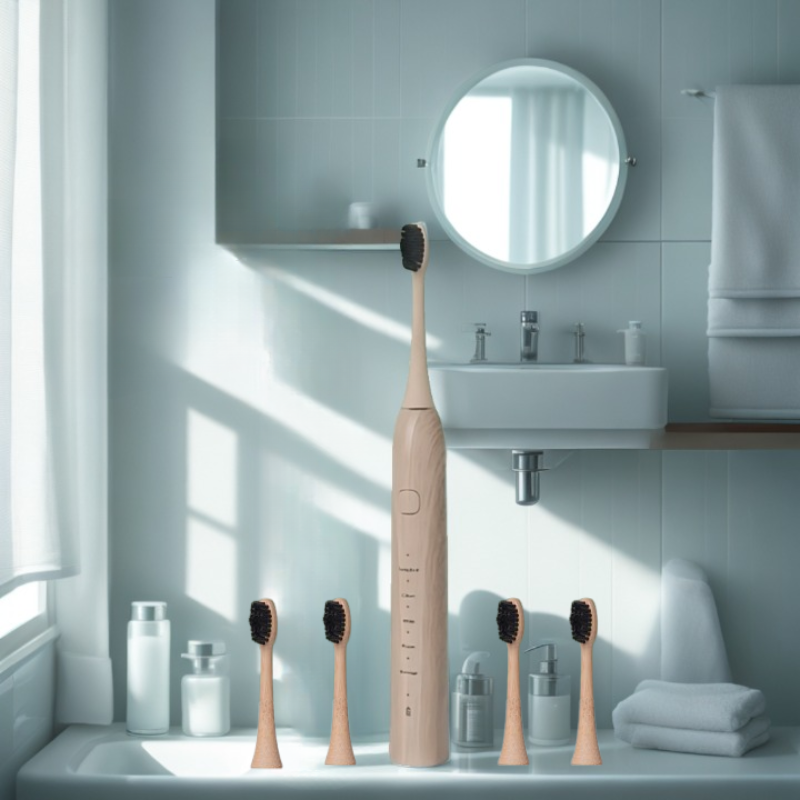
Alternative 2 — The sonic toothbrush with a bamboo handle
The claim: the sonic performance of a premium electric toothbrush with a 100% natural bamboo handle.
The reality: the handle contains electronic components (battery, motor) that are not biodegradable. However, bamboo replaces the ABS plastic outer body — significantly reducing the amount of plastic. The battery and electronics can be processed through WEEE recycling channels (Waste Electrical and Electronic Equipment).
Performance: identical to the best plastic sonic toothbrushes — no compromise on effectiveness.
Verdict: the best performance/ecology balance. Durable bamboo handle, electronics recyclable through WEEE, brush heads to be replaced every 3 months.
Alternative 3 — Solid toothpaste (tablets or bar)
The claim: zero plastic tube, concentrated formula, easier to transport.
The reality: effectiveness depends heavily on the formula. The crucial point: the presence of fluoride.
Official French recommendations (HAS, Ameli.fr) recommend using fluoride toothpaste to prevent cavities. Some natural solid toothpastes do not contain fluoride — which makes them less clinically effective.
What to check: that the solid toothpaste contains sodium fluoride (NaF) or sodium monofluorophosphate (MFP) at a concentration appropriate for age.
Verdict: an excellent alternative if and only if it contains fluoride. Always check the fluoride content before buying.
Alternative 4 — Dental floss made from natural silk or corn
The claim: floss made from natural silk or corn starch is biodegradable, unlike standard nylon.
The reality: interdental performance is comparable to nylon floss for most users. Some natural-fibre flosses have slightly lower resistance in very tight spaces.
Case: check that the case is made of glass or refillable steel — not just the floss.
Verdict: a very good eco-friendly choice with comparable performance. The water flosser remains the most effective and most durable alternative (no recurring waste once purchased).
Alternative 5 — The water flosser — the most durable solution
The often-overlooked environmental argument: a water flosser lasts 3 to 5 years with maintenance. Its only "waste" is the water used (a few centilitres per session) and replacement tips (1 to 2 per year — a few grams of plastic).
Compared with 52 dental floss cases per year (for two uses per week), the annual tip creates infinitely less waste.
Verdict: paradoxically, the water flosser is one of the most eco-friendly choices for interdental cleaning — often overlooked in zero-waste guides.
The complete zero-waste routine — Optimized version
| Step | Eco-friendly product | Environmental impact |
|---|---|---|
| Brushing | Bamboo sonic toothbrush (NaturalBambou Pro™) | 🟢 Bamboo handle + WEEE recycling |
| Toothpaste | Fluoridated solid tablet | 🟢 Zero plastic tube |
| Interdental cleaning | Water flosser | 🟢 Almost zero recurring waste |
| Tongue cleaning | Stainless steel scraper | 🟢 Lasts for years |
| Breath spray | Refillable bottle | 🟢 Zero recurring packaging |
| Denture/aligner | Ultrasonic cleaner + tablets | 🟢 Replaces disposable plastics |
How to assess the real impact of your routine — The practical calculation
Conventional routine — 1 person over 10 years:
- ~130 plastic manual toothbrushes
- ~60 toothpaste tubes
- ~520 dental floss cases (if used weekly)
- Total: several kilos of non-recyclable plastic
Eco-optimized routine over 10 years:
- 1 bamboo toothbrush handle replaced every 5 years × 2 = 2 handles
- 1 electronic motor recycled through WEEE
- ~40 brush heads (reduced plastic vs full toothbrush)
- 0 toothpaste tubes (paper tablets)
- 1 water flosser + 10 tips over 10 years
- Total: estimated 70 to 80% reduction in plastic waste related to dental hygiene
FAQ
Are fluoride-free toothpastes really less effective?
According to current recommendations from HAS and the ADA, fluoride is the most clinically proven effective component for cavity prevention. Fluoride-free toothpastes do not have the same evidence base. For adults with normal cavity risk, a fluoridated solid or liquid toothpaste is still recommended.
Is bamboo really biodegradable in home compost?
Bamboo is compostable but requires active compost to break down properly. In landfill, it can take several years. Nylon bristles must absolutely be removed before any composting or landfill disposal — they are not biodegradable.
Can electric toothbrush heads be recycled?
The main electric toothbrush brands offer recycling programmes for used heads (notably Oral-B and Philips). Some programmes are available in France through dedicated collection points. Check the take-back programmes available from your toothbrush manufacturer.
Does a water flosser use a lot of water?
A full cleaning cycle (2 to 3 minutes) uses between 150 and 300 ml of water depending on the model — less than one glass. This is negligible consumption compared with other bathroom uses.
Conclusion
Eco-friendly, high-performance dental hygiene is no longer a compromise. The bamboo sonic toothbrush, fluoridated solid toothpaste, water flosser, and stainless steel scraper make it possible to build a complete routine that reduces plastic waste by 70 to 80% — without sacrificing the clinical effectiveness of a single step.
NaturalBambou Pro™ DentalPro Smile™ — the 100% bamboo sonic toothbrush that proves performance and environmental responsibility can coexist perfectly.
👉 dentalpro-smile.com/fr-fr
RECOMMENDED RELATED ARTICLES:
→ Article 1: Choosing your adult electric toothbrush — performance criteria
→ Article 2: Water flosser — the most durable eco option for interdental cleaning
→ Article 10: Natural whitening — consistency with an eco-conscious approach
Article for informational purposes only. Does not replace the advice of a dental surgeon. DentalPro Smile™ — 2026.

Leave a comment
This site is protected by hCaptcha and the hCaptcha Privacy Policy and Terms of Service apply.