
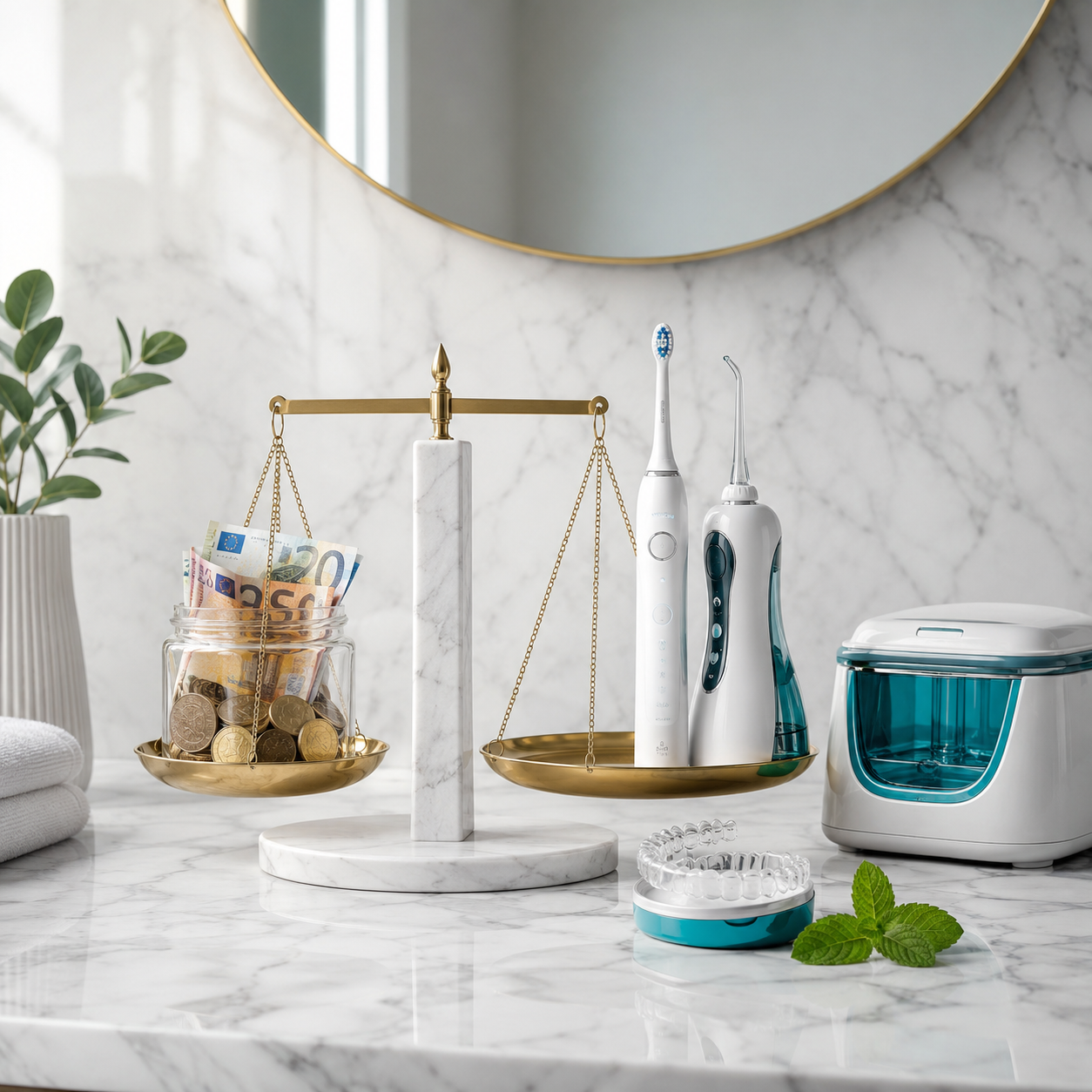
In 2026, 29% of French people had to forgo dental treatment over the past two years.
One in three French people.
Not because they didn’t want to get treatment. But because the cost of dental care—even when partially reimbursed—leaves out-of-pocket expenses that many households simply cannot afford.
The cost of dental care can vary depending on the type of procedure, the materials used, and the complexity of the treatment. Whether it’s a scale and polish, a crown, or an implant, dental prices can sometimes raise questions or even concerns.
And yet — this is the fact that few media outlets report — the vast majority of this treatment could have been avoided.
Not by going to the dentist less often. Not by ignoring problems. But by adopting an effective preventive routine that eliminates the root causes of cavities, tartar, and gum disease — before they require costly treatment.
This guide explains exactly how home prevention can significantly reduce your annual dental bill — and how to calculate what you really stand to gain.
The reality of dental costs in France in 2026 — Verified figures
Before going any further, here is the factual information from official sources.
What health insurance actually reimburses
In 2026, the reimbursement rate is set at 60% of the Social Security reimbursement base for covered dental care. In 2024, 47% of prosthetic procedures have no out-of-pocket cost for the patient thanks to the 100% Health scheme.
Dental reimbursement depends on how information is transmitted between the dentist, Social Security, and the supplementary health insurance provider. Dental implants and cosmetic dentistry remain excluded from Social Security reimbursement in 2026.
In short: basic preventive care is partially covered. Complex restorative care is reimbursed very little, if at all.
The real costs of routine care in 2026
| Care | Contracted fee (Sector 1) | Social Security reimbursement | Average out-of-pocket cost |
|---|---|---|---|
| Denture cleaning (2 arches) | 43,38€ | ~€26 | ~17€ |
| Check-up consultation | 30€ | 18€ | 12€ |
| Resin filling (cavity) | €40 to €60 | Partial | 15€ to 40€ |
| Root canal treatment (front tooth) | ~€300 | Partial | €150 to €250 |
| Ceramic crown | €500 to €1,100 | Base €120 | €400 to €1,000 |
| Dental implant | 1 500€ to 3 000€ | 0€ | 1,500€ to 3,000€ |
(Verifiable sources: Ircem.com — CCAM in force as of 01/01/2026, Eurodentaire.com, Ameli.fr)
The average out-of-pocket cost for dental care is around 15% in 2026, excluding dental implants — but complex procedures (implants, advanced prosthetics) are still only minimally reimbursed or not reimbursed at all.
Why 29% of French people give up — and what it really costs them
The forgoing of dental care is a documented vicious circle.
Scaling waiver (€17 out-of-pocket cost)
         ↓
Build-up of unremoved limescale
         ↓
Gingival inflammation → early-stage periodontitis
         ↓
Carrying in uncleaned areas
         ↓
Root canal treatment required (€150 to €250 out-of-pocket)
         ↓
Or extraction + implant (€1,500 to €3,000 not reimbursed)
A €17 preventive treatment you skip can cost up to €3,000 a few years later.
It’s not a paradox. It’s the relentless logic of neglected oral health.
The focus on prevention and the commitment to reducing inequalities in access to dental care in France remain a national priority. But the cost of dental care in France remains problematic.
What Home Prevention Can Really Prevent — Clinical Data
Here are the most costly curative treatments, and their documented link to insufficient prevention.
The leading cause of restorative dental treatment in France
A cavity is the result of a buildup of bacterial plaque that has not been removed from a tooth surface. The bacterium Streptococcus mutans The bacteria ferments dietary carbohydrates and produces acids that gradually demineralize enamel.
What this means for your budget: an early detected cavity costs €40 to €60 to treat (filling). The same cavity, if left undetected for 2 years, may require a root canal (€300+) followed by a crown (€500 to €1,100).
What prevention avoids: the daily and complete removal of bacterial plaque — including from between the teeth — deprives Streptococcus mutans biofilm that allows it to survive and produce acids. Clinical studies published in the Journal of Clinical Periodontology show that regular interdental cleaning significantly reduces the incidence of interdental cavities.
The buildup of tartar — the trigger for a chain of costly treatments
The buildup of tartar is more than just unsightly. It is a direct factor in the development of periodontal disease — the leading cause of tooth loss in adults in France. (Source: French National Authority for Health — Periodontal Diseases)
Once calcified, tartar can only be removed at the dentist's office. But its development can be significantly slowed by effective, regular brushing that removes plaque before it mineralizes (a process that begins within 24 to 72 hours).
What prevention avoids: by reducing tartar buildup between appointments, you reduce the intensity and duration of professional scale cleanings — and you may potentially space their frequency from twice a year to once a year for low-buildup profiles.
The Hidden, Costly Reality of Gum Disease
The diseases silently progress for years before becoming clinically visible. At an advanced stage, their treatment—surgical or non-surgical periodontology—entails significant costs with partial reimbursement.
The warning signs you can spot yourself:
- Bleeding gums when brushing (an early sign of inflammation)
- Swollen or red gums
- Sensitivity around the gumline
- Persistent bad breath despite brushing
What prevention makes possible: detected early, these signs can be reversed by improving oral hygiene alone — without professional intervention. At an advanced stage, intervention by a periodontist becomes essential.
The calculation every French person should make — Prevention budget vs. curative budget
Here is the honest, figures-based comparison over 10 years.
Scenario A — Without an effective preventive routine (the current situation for the majority)
| Expense item | Estimated annual cost | On a 10-year basis |
|---|---|---|
| 2 scalings/year (out-of-pocket cost) | 34€ | 340€ |
| 1 to 2 fillings/year | €30 to €100 | 300€ to 1,000€ |
| 1 root canal treatment in 10 years | — | 150€ to 250€ |
| 1 crown over 10 years | — | €400 to €1,000 |
| Basic hygiene products | 30€ | 300€ |
| Estimated total over 10 years | 1,490€ to 2,890€ |
With a complete preventive routine
| Expense item | Cost | Over 10 years |
|---|---|---|
| Complete dental equipment | 100€ to 200€ | 100€ to 200€ (one-time) |
| Tops + consumables | 40€ to 60€/year | €400 to €600 |
| 1 scaling/year (out-of-pocket cost) | 17€ | 170€ |
| Curative care (reduced) | €0 to €60/year | €0 to €600 |
| Estimated total over 10 years | €670 to €1,570 |
Estimated potential savings: €820 to €1,320 over 10 years.
⚠️ These estimates are for guidance only. Actual savings vary depending on each person’s oral health profile. Consult your dentist for a personalised assessment.
What the 100% Health reform really changes — and what it doesn’t change
Since the 100% Health reform, dental prostheses have been divided into three care categories: 100% Health (no out-of-pocket cost), a moderate out-of-pocket category, and a free-pricing category.
What the 100% Health reform covers:
- Certain crowns on root canal-treated teeth (excluding visible smile teeth in certain cases)
- Some bridges and removable prostheses in the specified cart
- Free annual dental check-ups for ages 3-24 (M'T dents)
What 100% Health Reform does not cover:
- The cost of dental implants is not covered by French Social Security (zero reimbursement).
- Adult orthodontics (except in very specific cases)
- The Whitening and Cosmetic Dentistry
- The prostheses selected outside the 100% Health basket
- Complex periodontal care
In 2026, the pricing system contrasts standard, accessible care, which is covered by agreement and well reimbursed, with complex, expensive treatments that the patient must pay for out of pocket. DentalPro Smile™
The logical conclusion: Prevention remains the only strategy that structurally reduces your exposure to non-reimbursed care—because it reduces the need for it at the source.
The 5 most cost-effective preventive investments — Ranked by ROI
Here are the preventive measures ranked by real return on investment, based on the remedial costs they help avoid.
#1 — Daily interdental cleaning
Cost: 0€ to 15€/month depending on the tool
Curative treatment avoided: interdental cavities (€40 to €1,100+ per tooth)
KING: the most important of all preventive measures
Interdental cavities are the hardest to detect early and the most expensive to treat. They develop exclusively in the spaces your toothbrush cannot reach. Effective daily interdental cleaning helps prevent them directly.
#2 — Effective sonic brushing
Cost: 40€ to 100€ (one-time investment)
Avoided curative care: accumulation of tartar → gum disease → periodontitis
ROI: very high over 3 to 5 years
High-frequency sonic brushes generate a hydrodynamic effect that dislodges plaque, including in hard-to-reach areas—significantly reducing the rate of tartar buildup between appointments.
#3 — Daily tongue cleaning
Cost: 5€ to 15€ (one-time investment)
Problem avoided: chronic bad breath, general bacterial overgrowth
KING: immediate and long-lasting
The tongue is the primary source of bad breath in 85 to 90% of cases. Daily cleaning reduces the overall bacterial load in the mouth — and by extension, the risk of gum infection.
#4 — Daily cleaning of dental appliances
Cost: 50€ to 150€ (ultrasonic cleaner — one-time investment)
Curative care avoided: under-aligner cavities, denture stomatitis, premature deterioration of the appliance
ROI: very high for aligner wearers (treatment costing €2,500-€5,500 to protect)
#5 — The free annual dental check-up (M'T dents)
Cost: 0€ for ages 3-24
Value: early detection of issues before they become costly
KING: incalculable — a cavity detected early costs 10 to 20 times less to treat
The 3 to 24 age group can benefit from a free annual dental check-up. If you have children in this age range, it’s a benefit worth using every year.
The complete preventive routine in 12 minutes a day — The protocol DentalPro Smile™
Here is the optimal daily routine based on recommendations from professional oral health societies, adapted for realistic everyday use.
🌅 Morning — 5 minutes
| Step | Action | Duration | Preventive ROI |
|---|---|---|---|
| 1 | Tongue cleaning | 30 sec | Reduced halitosis · Reduced bacterial load |
| 2 | Sonic brushing | 2 min | Plaque removed · Stains lifted |
| 3 | Interdental cleaning | 2 min | Helps prevent cavities between teeth |
| 4 | Do not rinse immediately | — | Active fluoride on enamel |
🌙 Evening — 7 minutes
| Step | Action | Duration | Preventive ROI |
|---|---|---|---|
| 1 | Cleaning of dental appliance (if worn) | 5 min | Biofilm removed · Device protected |
| 2 | Sonic brushing | 2 min | Evening plaque removed before night |
| 3 | Interdental cleaning | 2 min | Eliminated fermentable residues |
12 minutes a day. To protect a dental budget of several thousand euros over 10 years.
What you can do today — without an appointment, without a prescription
Effective dental prevention does not require a prescription. It requires the right tools and a regular routine.
This week:
- Evaluate your current routine — are you covering the spaces between your teeth?
- ✅ Check the condition of your toothbrush — splayed bristles indicate 30% lower effectiveness
- ✅ Start the language cleanup if it isn’t already part of your routine
- Schedule your annual dental check-up if you haven't already
This month:
- Evaluate your equipment — is your current brush suited to your needs?
- ✅ If you wear an aligner or a denture, reassess your cleaning routine
Frequently Asked Questions About Dental Costs and Prevention
Does dental health insurance solve the problem of out-of-pocket costs?
Partially. A dental insurance policy never reimburses based on the actual cost of treatment, but always on the reimbursement basis set by Social Security. Social Security provides a minimum reimbursement baseline. The supplementary insurance then tops up this coverage, most often as a percentage of the reimbursement basis. For expensive treatment outside the 100% Health basket (particularly implants), even good supplementary insurance still leaves a significant out-of-pocket cost. Prevention remains the most effective strategy for limiting the need for this treatment. Eurodentaire
Should I still go to the dentist even with good oral hygiene?
Yes — without exception. Home care reduces the frequency and intensity of treatments, but does not replace them. Your dentist detects problems that are not visible to the naked eye (early cavities, early-stage periodontitis, mucosal lesions) and performs professional scaling that your home routine cannot replace. The goal is to make these visits less frequent and less costly — not to eliminate them.
How long does it take to see an impact on your dental health?
The first improvements are often noticeable quickly: reduced gum bleeding within 2 to 4 weeks, improved breath within 1 to 2 weeks. The impact on tartar reduction is observed by the dentist at the next visit, generally after 3 to 6 months of a complete routine. The financial impact is measured over 2 to 5 years.
⚠️ These timeframes are indicative. Results vary depending on each person's initial oral health.
Is dental prevention affordable for every budget?
Yes. The most important preventive measures — tongue cleaning, proper brushing, interdental cleaning — can be carried out with affordable equipment. Investing in higher-performance equipment (sonic toothbrush, water flosser) pays for itself within a few months in view of the restorative care it helps to avoid.
Are there any subsidies for dental hygiene equipment?
I cannot confirm the existence of specific assistance for home dental hygiene equipment in 2026 without checking on ameli.fr. However, the M'T dents programme offers free annual check-ups for ages 3 to 24 — something you should absolutely make the most of.
Conclusion — The equation is simple
43% of French people see their dentist each year. 40% of patients only make an appointment in the event of a problem or an emergency. Eurodentaire
Those 40% — the ones who wait for the problem — structurally pay more than those who practice regular prevention.
The difference is not in income level. It is in the daily routine and the tools used.
12 minutes a day. The right equipment. An annual check-up with the dentist.
It's the equation that turns your dental health from an unpredictable expense into a controlled investment.
At DentalPro Smile™, we have designed a complete range to cover every step of this preventive routine — for children as well as adults, for people with braces as well as those without.
Discover the full range DentalPro Smile™ → Free delivery · 1-year warranty · Visible results in 7 days
Sources cited and verifiable:
— Eurodentaire.com — Health budget 2026: Are dental treatments more expensive? (April 2026)
— Eurodentaire.com — Dental Care Prices 2026 (May 2026)
— Eurodentaire.com — Dental care reimbursement 2026 (February 2026)
— Ircem.com — Current CCAM scaling rate as of 01/01/2026
— Ameli.fr — Reimbursement for contracted dental care
— French National Authority for Health — Periodontal diseases: has-sante.fr
— Journal of Clinical Periodontology — Interdental cleaning & caries prevention
— Ahrefs.com — Google France’s 100 most frequently asked questions (January 2026)
Article written by the team DentalPro Smile™ — 2026. Content intended for informational and educational purposes only. Does not replace the advice or diagnosis of a dental surgeon. Budget estimates are indicative and vary depending on each individual situation.

Leave a comment
This site is protected by hCaptcha and the hCaptcha Privacy Policy and Terms of Service apply.