
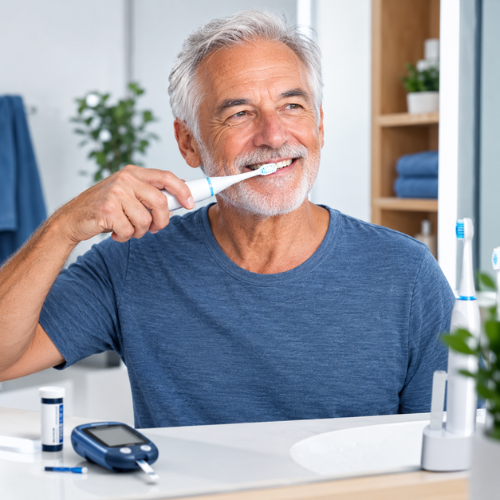
In France, approximately 4.5 million people live with diagnosed diabetes - and probably just as many are unaware that they have it.
(Source: Santé Publique France - Diabetes prevalence 2024)
Among the many complications of diabetes, periodontal disease is often described as the "sixth complication" - alongside retinopathy, nephropathy, neuropathy, cardiovascular disease and impaired wound healing.
But the link between diabetes and dental health goes beyond a typical complication. A growing number of clinical studies show that the relationship is bidirectional : diabetes worsens periodontal disease, and periodontal disease worsens blood sugar control.
This link fundamentally changes how people with diabetes should think about dental hygiene - not as a routine for comfort, but as an active part of managing their condition.
The link between diabetes and dental health: what the science says
Direction 1 - Diabetes worsens dental health
Diabetes causes several physiological changes that directly increase vulnerability to oral health problems.
Change 1 - Chronic high blood sugar and the oral environment
High blood glucose levels are reflected in gingival fluid and saliva. A glucose-rich oral environment encourages the growth of periodontal disease-causing bacteria, which use this glucose as an additional source of nutrients.
Change 2 - Neutrophil dysfunction
Neutrophils are the first immune cells to respond to bacterial gum infections. In people with diabetes, their ability to carry out chemotaxis (moving towards the infection site) and phagocytosis (eliminating bacteria) is impaired. The local immune system responds less effectively to plaque around the gums, allowing inflammation to take hold and progress more rapidly.
Change 3 - Microangiopathy and impaired healing
Diabetes causes changes in the small blood vessels (microangiopathy) that reduce the local blood supply to the gums. Gums with a reduced blood supply repair damage more slowly, and plaque-related gum damage progresses more quickly to periodontitis.
Change 4 - Xerostomia (dry mouth)
Approximately 40 to 60% of people with diabetes report dry mouth, caused by dehydration associated with high blood sugar and sometimes by medication. Xerostomia reduces the protective flow of saliva, increases the risk of tooth decay and encourages fungal infections (oral thrush).
What this means in numbers:
| Population | Risk of periodontal disease |
|---|---|
| Adults without diabetes | Baseline |
| People with well-controlled type 2 diabetes (HbA1c < 7%) | × 1.5 to 2 |
| People with poorly controlled type 2 diabetes (HbA1c > 8%) | × 2.5 to 3 |
| People with type 1 diabetes since childhood | × 2 to 4 |
(Source: Journal of Clinical Periodontology - diabetes and periodontal disease meta-analysis)
Direction 2 - Periodontitis worsens blood sugar control
This is the most important discovery in dental research over the past 20 years, and it changes how oral health should be incorporated into diabetes care.
The mechanism:
Periodontitis is a chronic bacterial infection that triggers a systemic inflammatory response. The pro-inflammatory cytokines produced (IL-1β, TNF-α, IL-6) have a direct effect on insulin sensitivity - they cause insulin resistance that worsens blood sugar control.
Simply put: a chronic gum infection (periodontitis) causes systemic inflammation that interferes with insulin's action, making diabetes harder to control.
The clinical studies:
Meta-analyses published in the Journal of Dental Research and Diabetes Care show that effective periodontal treatment (scaling below the gum line and improved hygiene) produces a measurable reduction in HbA1c - an average of 0.3 to 0.5 percentage points. (Source: Diabetes Care - periodontal treatment and glycemic control meta-analysis)
This figure may seem modest, but a 0.5% reduction in HbA1c is clinically significant and, in some cases, comparable to adding a second-line diabetes medication.
Major clinical conclusion: treating and preventing periodontitis in a person with diabetes is not only good for their gums - it may also benefit their blood sugar control.
What diabetes means in practice when choosing an electric toothbrush
Adaptation 1 - Make Sensitive mode the permanent priority
The gum tissue of a person with diabetes, even without active periodontitis, is more fragile than normal - healing is slower and the inflammatory response is impaired. The electric toothbrush's Sensitive mode is particularly well suited to this profile.
Rule for people with diabetes: use Sensitive mode by default, switching back to Clean mode only if your gums are clinically healthy and your blood sugar is well controlled.
Adaptation 2 - Pressure sensor - essential
Diabetic microangiopathy reduces the blood supply to the gums. Gums with a reduced blood supply are more vulnerable to excessive mechanical pressure. The pressure sensor protects these weakened gums from accidental injury caused by brushing too hard.
Adaptation 3 - Extra-soft bristles
Alongside Sensitive mode, a brush head with extra-soft bristles is recommended for people with diabetes who have fragile gums or impaired healing.
Adaptation 4 - Brush more frequently
For people with diabetes, some specialists recommend brushing 3 times a day (morning, after lunch and evening) rather than 2, to reduce the time plaque has to accumulate in an oral environment more favourable to bacteria.
The specific dental hygiene protocol for people with diabetes
Protocol goals
Goal 1 → Minimise the bacterial load around the gums
Goal 2 → Protect vulnerable gums
Goal 3 → Prevent or control periodontitis
Goal 4 → Contribute indirectly to blood sugar control
Full protocol - Morning
1. Tongue scraper (30 sec)
   → Bacteria that accumulate on the tongue overnight are particularly
     problematic in a high-glucose environment

2. Sonic brushing in SENSITIVE mode (2 min)
   → Angle at 45° towards the gum line - maintain consistently
   → Pressure: weight of the brush only
   → Spit without rinsing

3. Water flosser in GENTLE mode (2-3 min)
   → Essential - the spaces between teeth are the
     primary site of colonisation by periodontal pathogens

4. Antiseptic mouthwash (30 sec) - if recommended by your dentist
   → Chlorhexidine 0.12% during high-risk periods only
   → Do not use continuously for > 2 weeks without dental advice
Full protocol - Lunch (if possible)
Rinse with water or a neutral mouthwash (30 sec)
→ Removes food residue after meals without brushing

If brushing is possible:
→ SENSITIVE mode - a quick 1 min 30
→ Spit without rinsing
Full protocol - Evening (most critical)
1. Water flosser (2-3 min)
   → Before brushing if there is significant debris

2. Sonic brushing in SENSITIVE or GUM CARE mode (2 min)
   → Pay particular attention to the gum line
   → Be sure to spit without rinsing

3. Targeted water flossing (2 min)
   → Complete the cleaning between teeth

4. Tongue scraper (30 sec)

5. Do not eat anything afterwards - let the fluoride work all night
Diabetes-specific oral complications - Recognise and act
Complication 1 - Oral candidiasis (thrush)
People with diabetes are more susceptible to infections caused by Candida albicans - a fungus naturally present in the mouth that can proliferate with high blood sugar, xerostomia or a weakened immune system.
Signs: creamy white deposits on the tongue, cheeks or roof of the mouth that wipe off easily but leave redness underneath. Burning or soreness in the mouth.
What to do:
- Replace the brush head immediately
- Clean the ultrasonic cleaner or dentures more thoroughly
- See your doctor for antifungal treatment
- Check your blood sugar control with your diabetes specialist
Complication 2 - Rapidly progressing gingivitis and periodontitis
In people with poorly controlled diabetes, gingivitis can progress to periodontitis more quickly than in someone without diabetes, and periodontitis can progress more aggressively.
Warning signs:
- Persistent bleeding despite good hygiene
- Rapidly receding gums
- Loose teeth
- Recurring periodontal abscesses
What to do: seek an urgent appointment with a periodontist. Tell the periodontist that you have diabetes and share your recent HbA1c result.
Complication 3 - Dry mouth syndrome (xerostomia)
Signs: persistent dry mouth, chronic thirst, changes in breath and difficulty swallowing dry foods.
Brushing adaptations:
- Thoroughly wet the brush head before use
- Rinse your mouth with water before brushing to provide enough fluid for the hydrodynamic effect
- Use a saliva gel or xylitol lozenges between brushing sessions
- Avoid mouthwashes containing alcohol (they worsen dryness)
Complication 4 - Delayed healing after dental treatment
Any dental procedure (extraction, deep scaling or surgery) carries a risk of impaired healing in people with diabetes.
Recommendations:
- Always tell your dentist that you have diabetes and share your current HbA1c
- Aim for an HbA1c < 7% before any planned dental surgery
- After any invasive treatment: follow post-operative instructions carefully
- Monitor the treated area and seek advice promptly if healing seems abnormal
Timing your brushing around blood sugar and meals
An often overlooked aspect for people with diabetes: brushing times can be adapted to blood sugar levels and meals.
Brushing and low blood sugar
During a low blood sugar episode (blood glucose < 0.70 g/L), the absolute priority is to raise your blood sugar. Never delay treating low blood sugar to brush your teeth. Once you have raised and stabilised your blood sugar, you can brush normally - but if you used fruit juice or a sugary drink, wait 30 min.
Brushing and meals
For people with diabetes, the standard recommendation not to brush immediately after an acidic meal applies - but the more important factor is cleaning between the teeth after meals to remove fermentable food debris in an environment already favourable to bacteria.
Coordinating with your diabetes care team
Oral care for people with diabetes is most effective when it is part of a multidisciplinary approach.
What your diabetes specialist or doctor needs to know
Tell your doctor about any significant dental problems - recurring gingivitis, diagnosed periodontitis or repeated dental abscesses. These conditions can contribute to insulin resistance and unstable blood sugar.
What your dentist needs to know
Your dentist should be informed that you have diabetes at every appointment. Share your recent HbA1c result - it helps them assess procedural risks, understand why your healing may be slower and adjust how often they recommend check-ups.
Recommended frequency of dental check-ups for people with diabetes
| Level of blood sugar control | Recommended frequency of dental visits |
|---|---|
| HbA1c < 7% (well controlled) | Every 6 months |
| HbA1c 7 to 9% (moderate control) | Every 3 to 4 months |
| HbA1c > 9% (poorly controlled) | Every 2 to 3 months + consultation with a periodontist |
Complementary products particularly useful for people with diabetes
The water flosser
Essential for people with diabetes - even more so than for the general population. The spaces between teeth are the main site of colonisation by periodontal pathogens, and people with diabetes are more vulnerable to them. Daily water flossing is non-negotiable in this protocol.
The ultrasonic cleaner
Highly recommended for people with diabetes who wear dentures or aligners. Poorly cleaned dentures are a source of recurring thrush - particularly problematic in a high-glucose environment. An ultrasonic cleaner removes fungal biofilm more effectively than brushing dentures alone.
Chlorhexidine mouthwash
Useful when prescribed by a dentist during high-risk periods (active gingivitis, after treatment). Chlorhexidine is the most clinically studied antiseptic mouthwash for reducing bacterial plaque. It should not be used continuously for more than 2 weeks without dental advice - it can alter the oral microbiome and stain teeth.
Xylitol lozenges
Xylitol is a sugar alcohol that cannot be fermented by cavity-causing bacteria - it is not metabolised into acid by S. mutans. Studies show that xylitol actively inhibits S. mutans and stimulates saliva production. Particularly useful for people with diabetes who experience xerostomia.
Conclusion - Dental hygiene is part of diabetes care
This guide may have presented a more medical view of dental hygiene than you expected. That is deliberate - because for people with diabetes, that is exactly what it is.
A rigorous dental hygiene protocol - a sonic toothbrush in Sensitive mode, daily water flossing, brushing 2 to 3 times a day and more frequent dental check-ups - is not just good for your gums. It can help reduce the chronic systemic inflammation sustained by periodontitis and marginally improve your blood sugar control.
For a person with diabetes, every tool that contributes to overall management of the condition is worth considering. A sonic electric toothbrush is one such tool.
At DentalPro Smile™ , our PureBrush Pro™, with Sensitive mode, pressure sensor and built-in timer, paired with our HydroJet Pro™ in gentle mode, is the optimal combination for people with diabetes.
Discover the DentalPro Smile™ range for people with diabetes → PureBrush Pro™ + HydroJet Pro™ · Free delivery · 1-year warranty.
👉 dentalpro-smile.com/fr-fr
❓ FREQUENTLY ASKED QUESTIONS
1. Can treating my periodontitis really improve my HbA1c?
Meta-analyses published in Diabetes Care document an average HbA1c reduction of 0.3 to 0.5 percentage points after effective periodontal treatment in people with diabetes. This is clinically significant - in some cases comparable to adding a second-line diabetes medication. The improvement is explained by a reduction in the chronic systemic inflammation sustained by periodontitis, which contributed to insulin resistance. Periodontal treatment does not replace diabetes treatment - it supports it.
2. Can I use an electric toothbrush normally if my diabetes is well controlled (HbA1c < 6.5%)?
If your diabetes is very well controlled and your gums are clinically healthy, the standard adult protocol applies - Clean mode for daily brushing and a water flosser in the evening. A dental check-up every 6 months is still recommended. However, even with well-controlled diabetes, remain alert to any signs of gingivitis (bleeding, redness), as the inflammatory response remains more susceptible than in the general population.
3. Can oral thrush recur despite good dental hygiene?
Yes - if the main trigger (chronic high blood sugar, immunosuppressant medication or severe xerostomia) is not controlled, thrush can recur despite good hygiene. Every recurrence of oral thrush should prompt a check of blood sugar control and an assessment of risk factors with your doctor. Denture hygiene (ultrasonic cleaner + prescription antifungal solution) is particularly important for preventing recurrences.
4. Can diabetes medications affect oral health?
Some diabetes medications have oral effects. Metformin may slightly reduce the persistent metallic taste in some patients. SGLT-2 inhibitors (empagliflozin, dapagliflozin) increase urinary glucose and can encourage genital fungal infections, with a possible increase in the risk of oral thrush. Sulfonylureas can cause low blood sugar, which may need to be treated with sugar - an important consideration given the risk of tooth decay. Tell your dentist about all your medications.
5. Does gestational diabetes require the same dental precautions?
The same basic precautions apply, but with two additional factors: pregnancy itself increases the risk of pregnancy gingivitis, and gestational diabetes amplifies that risk. An early dental appointment as soon as gestational diabetes is diagnosed is recommended. Periodontal treatment during pregnancy (scaling) is safe and recommended by obstetric societies. Tell your dentist about your pregnancy and gestational diabetes.
6. How do I explain to my dentist that my diabetes can affect healing?
Simply share your recent HbA1c result (within the past 3 months) and your current treatment. Mention any history of difficult healing after previous dental treatment. Your dentist will adjust their decisions accordingly: favouring less invasive procedures when HbA1c is high, prescribing preventive antibiotics if indicated and scheduling closer post-operative follow-ups. An HbA1c < 7% is generally considered the threshold below which dental surgical risk is acceptable for planned, non-urgent procedures.
Sources:
- Santé Publique France - Diabetes prevalence in France 2024: santepubliquefrance.fr
- Journal of Clinical Periodontology - Diabetes and periodontal disease meta-analysis
- Diabetes Care - Periodontal treatment and glycemic control
- HAS - Diabetes and oral health recommendations: has-sante.fr
- American Diabetes Association - Standards of Medical Care in Diabetes 2024: diabetes.org
This article is for informational purposes only. It does not replace advice from a dentist, diabetes specialist or doctor. DentalPro Smile™ - 2026.


Leave a comment
This site is protected by hCaptcha and the hCaptcha Privacy Policy and Terms of Service apply.