
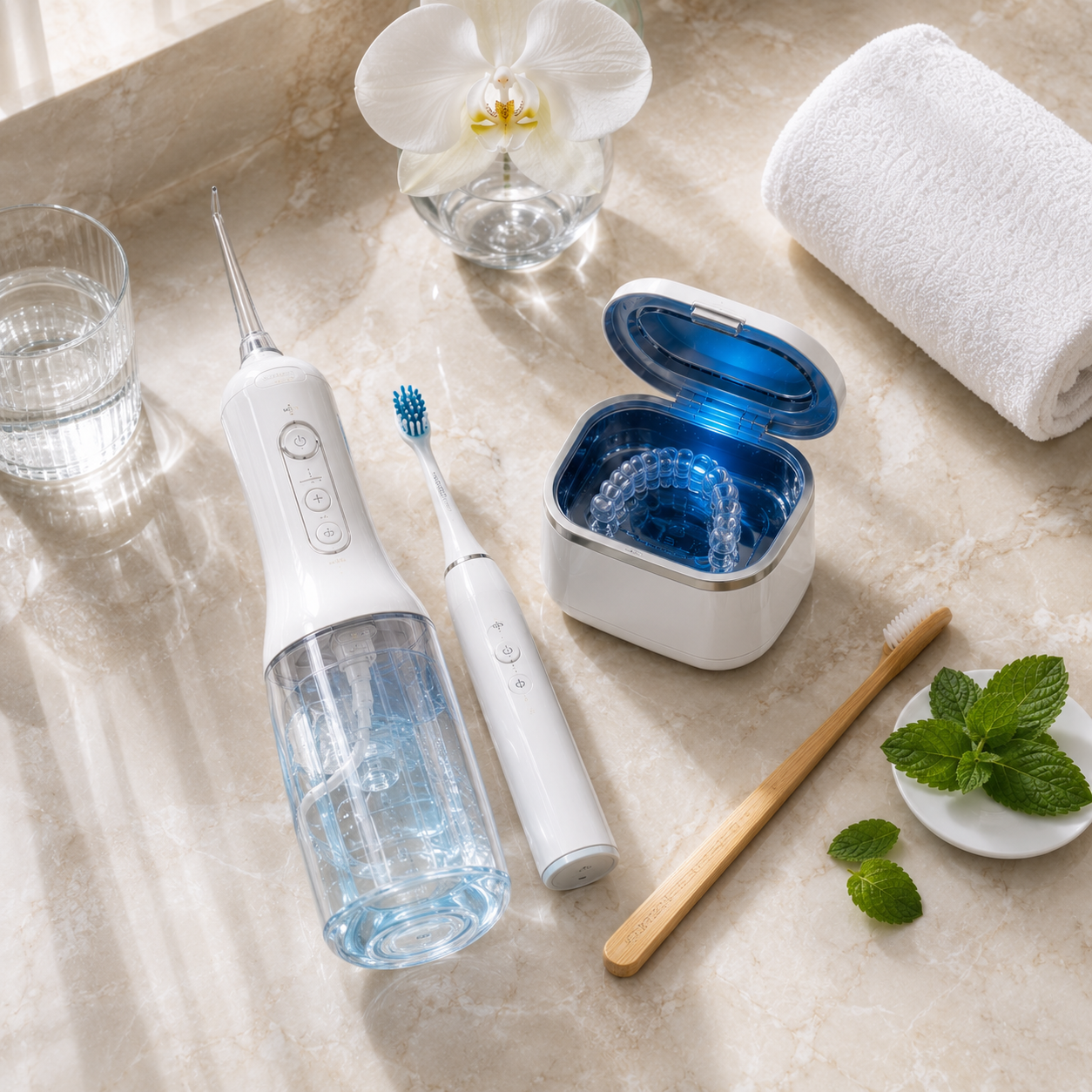
Your dentist has been telling you the same thing for years. Brush your teeth twice a day. Use dental floss. Come back in 6 months.
You follow that advice. More or less.
And yet, at every visit, it's the same story: tartar. Slightly inflamed gums. A small cavity here and there. And a bill that hurts.
In France, a visit to the dentist costs on average between 23€ for a basic consultation and several hundred euros for specialized care. (Source: Ameli.fr — 2024 standard fees) Multiplied by a family of 4 over 10 years, dental care becomes a significant household expense.
What no one tells you: most of these costs are avoidable. Not by magic. Not by a home remedy. But by a truly complete dental routine — one your school or your dentist never really taught you in detail.
In this guide, you'll discover why your current routine probably has 3 major blind spots, what they actually cost you, and how to fix them once and for all in less than 10 minutes a day.
Why your current dental routine isn't enough — the numbers behind the truth
Let's start with a fact that surprises most people.
A standard manual toothbrush, used conventionally, only effectively cleans 60 to 70% of tooth surfaces. (Source: Journal of Clinical Dentistry, comparative review of manual vs sonic brushing, compiled data)
The remaining 30 to 40% — interdental spaces, the gum line, the inner surface of the lower molars, the underside of the tongue — are left to bacterial plaque buildup.
If this plaque is not removed within 24 to 72 hours, it begins to mineralize and form tartar. Tartar that your brush alone can no longer remove. (Source: American Dental Association — Dental Calculus fact sheet)
It's the vicious cycle 90% of adults live through:
Incomplete brushing
→ Residual plaque
→ Mineralization (tartar)
→ Gum inflammation
→ Potential cavities
→ Dental appointment
→ Bill
→ Incomplete brushing
→ (repeat)
Breaking out of this cycle isn't about more willpower. It's about better tools and a more complete routine.
The 3 blind spots in your dental routine
Blind spot #1 — Interdental spaces: the most dangerous area in your mouth
Between each tooth there is a space that your brush, no matter which one, cannot physically reach. It is in these spaces that:
- Bacterial plaque builds up undisturbed
- Food debris ferment and produce foul-smelling sulfur compounds (the main cause of bad breath)
- Interdental cavities develop — the hardest to detect and the most expensive to treat
What this actually costs you: an undetected interdental cavity may require a filling (between 30€ and 60€ depending on the dentist), or even a crown (between 400€ and 1 200€). (Source: Ameli.fr 2024 fee schedule)
The solution: effective daily interdental cleaning. Clinical studies published in the Journal of Clinical Periodontology show that regular interdental cleaning reduces gingivitis significantly within 4 to 12 weeks, depending on the method used and consistency.
Blind spot #2 — The tongue: the ignored source of your bad breath
The surface of the tongue — especially the back portion — harbors massive colonies of anaerobic bacteria. These bacteria produce volatile sulfur compounds (VSCs) directly responsible for bad breath.
According to a systematic review published in the British Dental Journal (2021), between 85 and 90% of halitosis (chronic bad breath) cases have an oral origin. And in most of these cases, the tongue is the main source — ahead of interdental spaces and gum pockets.
What your mint toothpaste actually does: it masks VSCs for 15 to 45 minutes. It does not eliminate them. The odor-producing bacteria are still there. They resume production as soon as the flavor effect fades.
What works: mechanically cleaning the tongue surface every day measurably reduces the bacterial load and provides lasting improvement in breath freshness. Results are usually noticeable from the first week of regular use.
Blind spot #3 — Dentures, aligners and braces: the invisible bacterial reservoir
If you wear a removable dental appliance — partial or full denture, Invisalign-style clear aligner, night bruxism guard, orthodontic retainer — you're facing a specific challenge.
These devices have a microporous surface that, even after rinsing, harbors colonies of bacteria and fungi (notably Candida albicans) in its micro-crevices. A study published in the Journal of Prosthetic Dentistry (2021) showed that manual brushing of dentures creates micro-scratches that paradoxically encourage bacterial adhesion — making the problem worse instead of solving it.
Practical consequences:
| Poorly cleaned appliance | Bacterial risk | Clinical consequence |
|---|---|---|
| Denture | Candida albicans, Streptococcus | Denture stomatitis, bad breath |
| Invisalign aligner | Polybacterial biofilm | Faster cavities, persistent odor |
| Bruxism guard | Anaerobic bacteria | Gum infection, night breath |
What works: ultrasonic cavitation cleaning — which creates microbubbles reaching every surface at once, with no mechanical contact and no scratching — combined with suitable cleaning tablets. Full cycle in 3 to 5 minutes.
The truth about white teeth: what really works
This is the topic with the most misinformation going around. Here's the factual clarification.
What causes yellow teeth — the two distinct categories
| Type of staining | Causes | Treatable at home? |
|---|---|---|
| Extrinsic (surface) | Coffee, tea, red wine, tobacco, certain foods | ✅ Yes — through regular effective brushing |
| Intrinsic (deep) | Medications, fluorosis, trauma, age | ❌ No — requires professional treatment |
The vast majority of people complaining about "yellow" teeth have extrinsic staining. This staining builds up on plaque and tartar — meaning it gets worse in direct proportion to inadequate brushing.
The logical consequence: more effective brushing — which creates a hydrodynamic effect that dislodges stains from all surfaces — produces a visible and lasting improvement in tooth color, without whitening chemicals.
High-frequency sonic toothbrushes (typically 30,000 to 45,000 vibrations per minute) generate this type of hydrodynamic effect — documented in several Journal of Dentistry publications comparing manual and sonic brushes for reducing extrinsic staining.
What a poor dental hygiene routine really costs over 10 years
Here are the real numbers, based on Ameli.fr 2024 standard fees and market prices observed in France:
| Dental care | Unit cost | Typical frequency | Cost over 10 years |
|---|---|---|---|
| Scaling | 28,92€ (reimbursed base rate) + extra charges | 2x/year | 580€ - 1 200€ |
| Simple filling (cavity) | 30€ - 60€ | 1-2x/year for the average adult | 300€ - 1 200€ |
| Root canal treatment | 300€ - 800€ | 1-2x over 10 years | 300€ - 1 600€ |
| Crown | 400€ - 1 200€ | 1x every 10-15 years | 400€ - 1 200€ |
| Average adult total | 1 580€ - 5 200€ |
(Sources: Ameli.fr 2024 fees, UFC-Que Choisir — dental pricing study 2023)
What a complete at-home dental hygiene setup costs: a one-time investment of 80€ to 200€ depending on the products chosen. Amortized over 10 years, that's less than 20€ per year.
The question isn't "can I afford to properly equip myself?" It's "can I afford not to?"
The perfect dental routine in 2026: the complete protocol
Here is the protocol based on current recommendations from leading oral health organizations, adapted for a realistic daily routine.
🌅 Morning routine — 5 minutes
| Order | Action | Duration | Why it matters |
|---|---|---|---|
| 1 | Tongue cleaning | 30 seconds | Removes bacteria accumulated overnight — the main source of morning breath |
| 2 | Sonic brushing | 2 minutes | Lifts plaque and staining from all accessible surfaces |
| 3 | Interdental cleaning | 2 minutes | Removes plaque from areas inaccessible to the brush |
🌙 Evening routine — 7 minutes
| Order | Action | Duration | Why it matters |
|---|---|---|---|
| 1 | Denture/aligner cleaning | 5 min (in parallel) | Removes biofilm accumulated during the day |
| 2 | Sonic brushing | 2 minutes | Evening brushing is the most important — saliva decreases at night, reducing natural protection |
| 3 | Interdental cleaning | 2 minutes | Removes food debris before overnight fermentation |
Total: 12 minutes per day. For results that outperform most in-office care between visits.
The 7 mistakes 95% of adults make in their dental routine
Mistake 1 — Rinsing your mouth immediately after brushing
Rinsing washes away the fluoride in toothpaste before it has time to act on the enamel. Current recommendations from the French National Authority for Health advise spitting without rinsing, or waiting at least 30 minutes. (Source: HAS — Oral health prevention recommendations 2022)
Mistake 2 — Scrubbing instead of letting the brush vibrate
With a manual toothbrush, the friction motion is necessary. With a sonic or oscillating electric toothbrush, it's the opposite: the device's mechanical motion does the work — scrubbing additionally is counterproductive and can wear down enamel.
Mistake 3 — Replacing the brush too late
According to the American Dental Association, a manual toothbrush should be replaced every 3 months or as soon as the bristles are misshapen. Worn or splayed bristles lose up to 30% of their cleaning effectiveness.
Mistake 4 — Brushing immediately after an acidic meal
After consuming acidic foods or drinks (fruit juice, soda, wine), enamel is temporarily softened. Brushing within the next 30 minutes can abrade this weakened enamel. Wait 30 to 60 minutes.
Mistake 5 — Using toothpaste that is too abrasive
Not all toothpastes are equal in terms of abrasiveness. The RDA index (Relative Dentin Abrasivity) ranges from 0 to 250. Intensive whitening toothpastes can reach 150-200 RDA — a level that gradually wears enamel and dentin with daily use. (Source: Journal of the American Dental Association)
Mistake 6 — Ignoring the tongue
As noted above: the tongue is the main source of bad breath in 85 to 90% of cases. Yet fewer than 30% of adults clean their tongue daily. (Source: British Dental Journal, 2021)
Mistake 7 — Neglecting appliance cleaning
A poorly cleaned aligner or denture reintroduces into the mouth the bacteria removed during brushing. Appliance cleaning should be as regular and as serious as brushing itself.
Frequently asked questions — What patients ask most
How long does it take to see results with a better routine?
For bad breath: improvement is often noticeable as early as day 3 to day 7. For gum bleeding: significant reduction in 2 to 4 weeks depending on the initial severity. For extrinsic staining (yellow teeth): visible improvement in 4 to 8 weeks of regular routine. For tartar reduction: noticed by dentists at the next visit, usually after 3 to 6 months.
Can better dental hygiene replace the dentist?
No, absolutely not. Dental visits remain essential for diagnosis, screening for conditions not visible to the naked eye, and curative care. However, effective home hygiene reduces the frequency and cost of these procedures by preventing a large share of problems.
Is ultrasonic cleaning of dental appliances safe?
Yes, for standard removable appliances (resin dentures, polyurethane aligners, guards). Home ultrasonic cleaners operate at suitable frequencies and power levels — they do not scratch or damage materials. They are not recommended for appliances containing sensitive metal parts without prior verification from the healthcare professional.
At what age should a serious dental routine begin?
As soon as the first teeth appear — around 6 months. For children aged 3 and up, an appropriate electric toothbrush (soft heads, reduced vibration) is recommended by pediatric dentistry organizations. The goal is twofold: protect baby teeth (which influence the proper development of permanent teeth) and establish a positive habit from an early age.
Is mouthwash useful?
It can be a helpful addition in some cases (active gingivitis, recent surgery, fixed orthodontics) but it does not replace any of the previous steps. A mouthwash used instead of brushing or interdental cleaning has no proven preventive effect on cavities or periodontal disease. (Source: Cochrane Review — Mouthwash for preventing dental caries, 2020)
In summary: what you stand to gain
An adult who adopts a complete dental routine — effective brushing, interdental cleaning, tongue cleaning, appliance care — can expect:
✅ A significant reduction in gum bleeding within 2 to 4 weeks
✅ Fresher breath as early as the first week
✅ Visibly whiter teeth in 4 to 8 weeks
✅ Less tartar at the next dental visit
✅ Fewer restorative treatments and lower long-term costs
✅ Renewed confidence in your smile every day
This is not a sales promise. It's the logical result of more complete and more consistent hygiene, documented by independent clinical studies.
At DentalPro Smile™, our mission is simple: give you access to the best at-home dental hygiene tools at an affordable price, so this transformation is within everyone's reach.
👉 Discover the full DentalPro Smile™ range — Free delivery · 1-year warranty · Visible results in 7 days
Sources cited in this article:
— Ameli.fr — Standard dental care fees 2024
— American Dental Association — Dental Calculus & Toothbrush Replacement Guidelines
— Journal of Clinical Periodontology — Interdental cleaning & gingivitis reduction
— British Dental Journal — Systematic review on halitosis, 2021
— Journal of Prosthetic Dentistry — Ultrasonic cleaning of dental prostheses, 2021
— Haute Autorité de Santé — Oral health prevention recommendations 2022
— Cochrane Review — Mouthwash for preventing dental caries, 2020
— Journal of the American Dental Association — Dentin Abrasivity (RDA) guidelines
— UFC-Que Choisir — French dental pricing study, 2023
Article written by the DentalPro Smile™ team — 2025. Content for informational and educational purposes. Does not replace the advice or diagnosis of a dental surgeon.

Leave a comment
This site is protected by hCaptcha and the hCaptcha Privacy Policy and Terms of Service apply.