
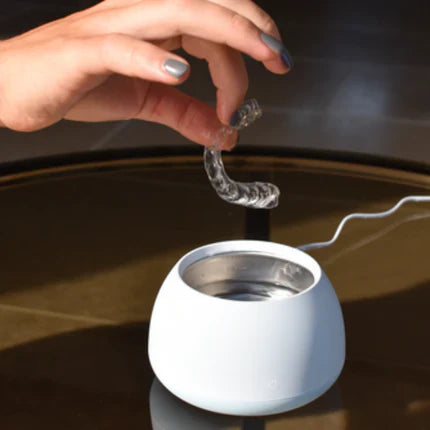
What is a professional ultrasonic cleaner?
An ultrasonic cleaner uses high-frequency sound waves (typically 40 kHz) to create a phenomenon called cavitation:
-
Formation of microbubbles
-
Controlled implosion
-
Removal of microscopic particles
Result:
Deep cleaning without mechanical abrasion.
Why choose UltraClean Pro™?
1️⃣ Non-abrasive cleaning
Ideal for:
-
Gold, silver, platinum jewelry
-
Glasses and frames
-
Dental aligners
-
Electric toothbrush heads
-
Precision instruments
2️⃣ Time-saving
Average cycle: 3 to 5 minutes
Even cleaning across the entire surface.
3️⃣ Home and semi-professional versatility
Usable at home with performance close to professional equipment.
Main applications
🔹 Jewelry cleaning
Removal of:
-
Soap residue
-
Light tarnish
-
Greasy deposits
🔹 Eyewear cleaning
Cleans:
-
Nose pads
-
Hinges
-
Invisible microparticles
🔹 Dental cleaning
Compatible with:
-
Orthodontic aligners
-
Whitening trays
-
Dental prostheses
Comparison: Ultrasonic vs manual cleaning
| Criterion | Manual cleaning | Ultrasonic |
|---|---|---|
| Access to internal areas | Limited | Complete |
| Risk of scratching | Possible | Minimal |
| Time | Long | Short |
| Consistent result | Variable | Yes |
FAQ SEO / SGE
Is an ultrasonic cleaner dangerous?
No, when used according to the instructions.
Can all jewelry be cleaned?
No. Some porous stones (e.g., opal) should be avoided.
What frequency is ideal?
40 kHz is standard for effective home use.


Leave a comment
This site is protected by hCaptcha and the hCaptcha Privacy Policy and Terms of Service apply.