
Your denture spends between 16 and 22 hours a day in your mouth. It is in constant contact with your saliva, oral bacteria, food, and the mucous membranes of your palate and gums.
In France, around 10 million people wear a removable denture — partial or full. (Source: DRESS data — Directorate for Research, Studies, Evaluation and Statistics)
And most of them do not clean their denture properly. Not out of neglect, but because no one ever really explained how — or what actually happens to their denture when care is insufficient.
What happens to your denture in 24 hours
An acrylic resin denture has a microscopically porous surface. Even when it looks clean to the naked eye, that surface harbors microorganisms in its pores — areas that neither rinsing nor simple brushing can reach.
The 3 types of buildup that accumulate:
| Type of buildup | Composition | Consequence if not removed |
|---|---|---|
| Bacterial biofilm | Streptococcus, Lactobacillus | Residual decay, gingivitis |
| Candidiasis | Candida albicans | Painful denture stomatitis |
| Denture tartar | Mineralized calcium salts | Bad breath, discomfort, denture deterioration |
The denture stomatitis — inflammation of the palatal mucosa under the denture caused by Candida albicans — affects up to 65% of full-denture wearers according to some studies. (Source: Journal of Prosthetic Dentistry — epidemiological data)
Cleaning methods — What works and what doesn't
❌ What you should never do
Brush with toothpaste
This is the most common mistake. Toothpaste contains abrasives that scratch the acrylic resin of the denture — creating invisible micro-grooves that trap even more bacteria and fungi. The denture deteriorates prematurely and becomes increasingly difficult to clean.
Boil the denture
Heat warps acrylic resin. A warped denture no longer fits properly, creates painful pressure points, and requires costly relining.
Use pure bleach
Corrosive to the resin and metal parts (clasps). May leave dangerous chemical residues.
Leave the denture to air-dry
Acrylic resin can warp as it dries out. The denture should be kept in water or in its soaking solution when not worn.
✅ Recommended cleaning protocol
Daily cleaning — The optimal protocol:
| Step | Action | Frequency | Duration |
|---|---|---|---|
| 1 | Rinse with lukewarm water after each meal | 3x/day | 30 sec |
| 2 | Gentle brushing with a dedicated denture brush + mild soap | 2x/day | 2 min |
| 3 | Soak in ultrasonic cleaner | 1x/day (evening) | 5 min |
| 4 | Soak in cleaning solution (tablets) | 1x/day (night) | 15-30 min |
| 5 | Rinse thoroughly before putting back in mouth | Each time you put it back in | 30 sec |
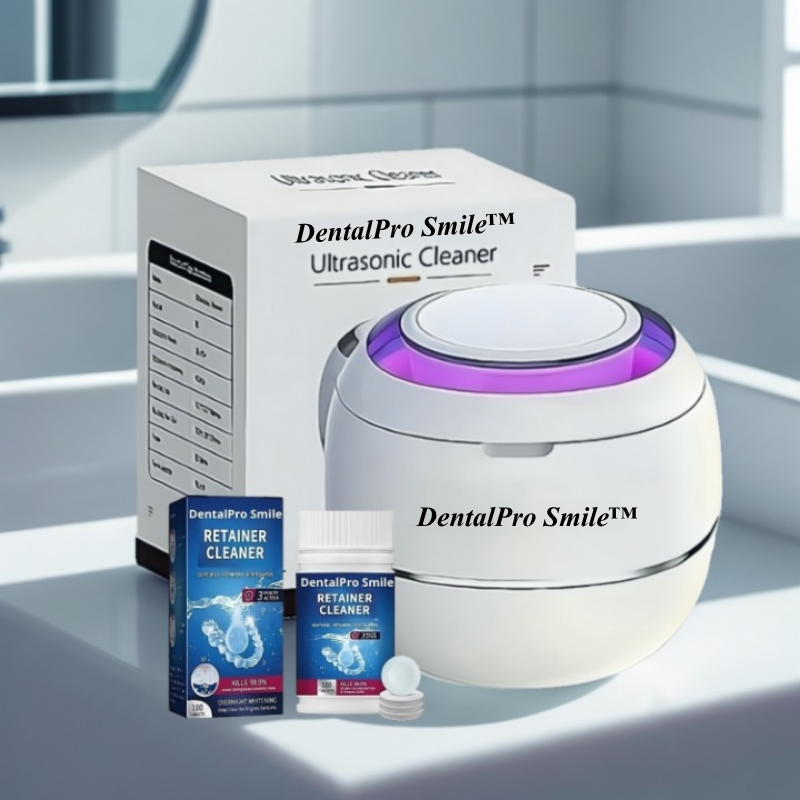
The ultrasonic cleaner — The most effective method for dentures
Ultrasonic cleaning is recognized in dental literature as the most effective method for removing biofilm and buildup from dentures without damaging the materials.
A study published in the Journal of Prosthetic Dentistry (2021) showed that ultrasonic cleaning removes significantly more bacterial and fungal biofilm from dentures than manual brushing, without creating micro-scratches on the resin.
Why ultrasonics are superior:
Ultrasonic cavitation generates millions of microbubbles that simultaneously reach all surfaces of the denture — including concave areas, crevices, and micropores inaccessible to a brush. Cleaning is therefore complete and uniform, with no mechanical pressure.
Ultrasonic protocol for dentures:
- Fill the tank with lukewarm water
- Optionally add 1 dissolved cleaning tablet
- Fully immerse the denture
- Start the cycle (5 minutes)
- Rinse thoroughly with clean water
- Leave it soaking in clean water until the next morning
Cleaning tablets — How to use them correctly
Effervescent cleaning tablets release oxidizing agents that disinfect the denture surfaces. They are effective as a complement to mechanical cleaning — not as a replacement.
Correct use:
- Dissolve in lukewarm water (never hot — risk of warping)
- Soaking time: 15 to 30 minutes for most products (check specific instructions)
- Rinse thoroughly before putting it back in your mouth
- Do not exceed the recommended soaking time
Recommended frequency: once a day, in the evening. Combined with an ultrasonic cycle the same evening, they provide optimal disinfection.
Mucosal care — The forgotten side
Cleaning the denture without cleaning the underlying mucosa is not enough. Bacteria and fungi also colonize the palate and gingival ridges under the denture.
Do this every evening after removing the denture:
- Rinse your mouth with lukewarm water
- Gently massage the palate and ridges with a damp soft toothbrush
- Let your mouth "breathe" overnight (do not wear the denture at night if your dentist recommends it)
Comparison table of cleaning methods
| Method | Biofilm removed | Tartar removed | Candida removed | Denture risk |
|---|---|---|---|---|
| Rinse with water only | 🟡 Partial | ❌ No | ❌ No | ✅ None |
| Toothpaste brushing | 🟡 Partial | 🟡 Partial | 🟡 Partial | 🔴 Scratches |
| Mild soap brushing | ✅ Yes | 🟡 Partial | 🟡 Partial | ✅ None |
| Effervescent tablets | ✅ Yes | ✅ Yes | ✅ Yes | ✅ None |
| Ultrasonic cleaner | ✅ Yes | ✅ Yes | ✅ Yes | ✅ None |
| Ultrasound + tablets | ✅✅ Optimal | ✅✅ Optimal | ✅✅ Optimal | ✅ None |
Denture lifespan — What maintenance changes
An acrylic denture lasts on average 5 to 10 years depending on manufacturing quality and care. Rigorous daily maintenance maximizes this lifespan by preserving the integrity of the resin and preventing calcium buildup that alters the fit of the denture.
The cost of a full denture in France ranges between 1 500€ and 4 000€ with a variable out-of-pocket cost depending on your insurance. (Source: Ameli.fr — dental denture prices 2024)
A few minutes of maintenance per day literally represents hundreds of euros saved over the life of the appliance.
FAQ
Should the denture be removed at night?
The majority recommendation from dental surgeons is to remove the denture at night to let the mucosa "breathe" and reduce the risk of denture stomatitis. Some practitioners allow overnight wear in specific cases. Follow your practitioner’s recommendations.
What should I do if my denture turns pink or brown?
A pink or brown discoloration signals a buildup of stains (tea, coffee, wine) on micro-scratches in the resin. A cycle in an ultrasonic cleaner with tablets can reduce this discoloration. If it persists, your dentist can perform a professional polish.
How often should cleaning tablets be changed?
Use a new tablet each time — do not reuse the used solution. One tablet per soak, once a day.
My denture has warped — what should I do?
Do not try to reshape it yourself. Contact your dental technician or dentist. A warped denture should not be worn — it can cause mucosal lesions.
Conclusion
Daily care of your denture is just as important as brushing your natural teeth — perhaps more so, because a poorly maintained denture directly affects the health of the underlying mucosa and can significantly shorten its lifespan.
The optimal protocol: gentle brushing + daily ultrasonic cycle + cleaning tablets in the evening + mucosal rinsing.
UltraClean Pro™ and FreshTab Pro™ DentalPro Smile™ — designed specifically for denture care. Professional results in 5 minutes a day.
👉 dentalpro-smile.com/fr-fr
RECOMMENDED RELATED ARTICLES:
→ Article 4: Cleaning an Invisalign aligner
→ Article 6: Bad breath — often linked to poorly maintained dentures
→ Article 12: Senior dental care
Informational article only. Does not replace the advice of a dentist. DentalPro Smile™ — 2026.

Leave a comment
This site is protected by hCaptcha and the hCaptcha Privacy Policy and Terms of Service apply.