
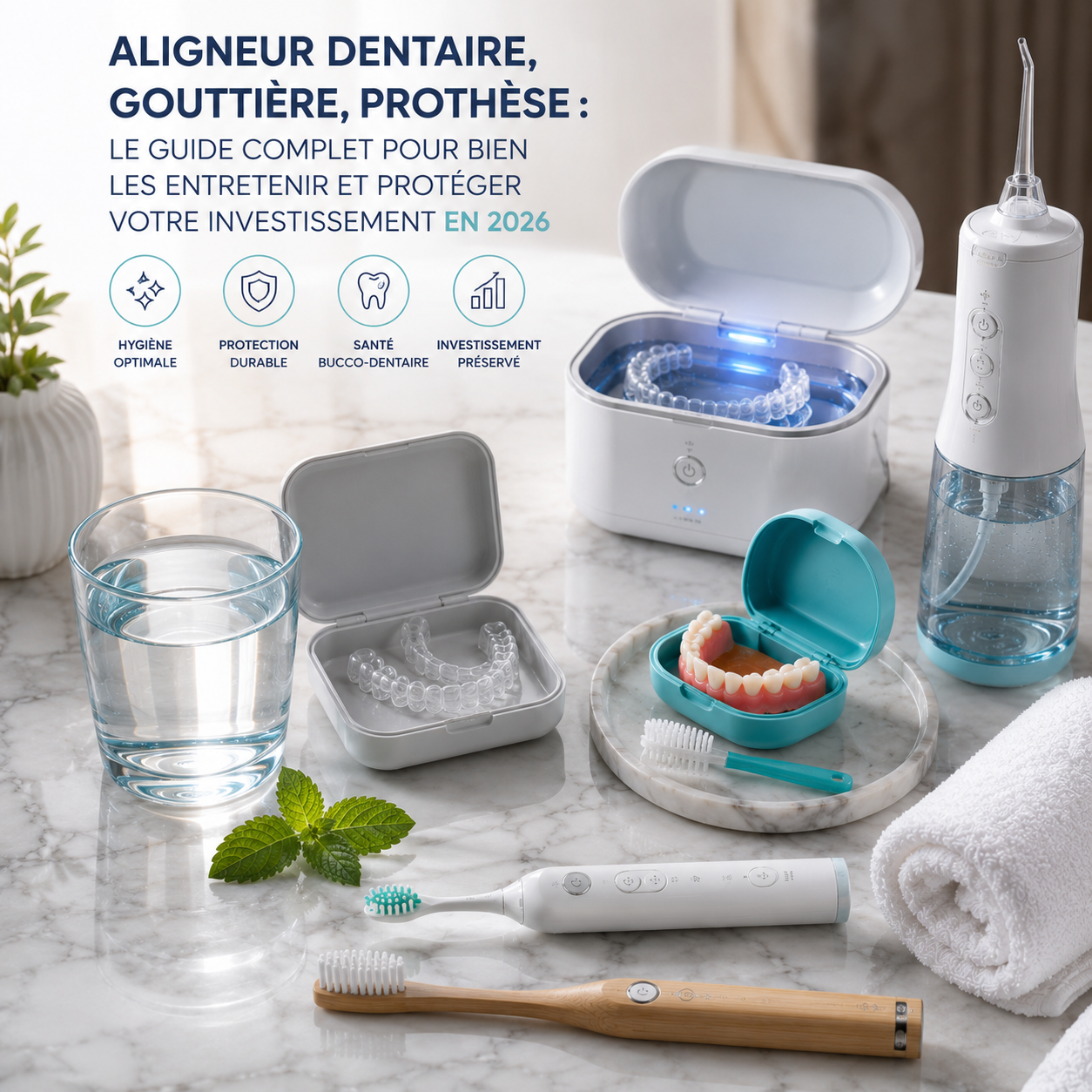
In France, clear aligner treatment for standard corrections generally costs between 3 800€ and 5 500€. For milder cases, Invisalign treatment ranges from 2 500€ to 5 000€ depending on complexity and follow-up.
It's a significant investment. Often the biggest one an adult makes for their oral health.
And yet, most people who wear aligners, trays, or dental prostheses make the same mistake every day: they do not clean their appliance in a truly effective way.
The result? An appliance that turns yellow. A lingering odor despite rinsing. Bacteria reintroduced into the mouth every time it is worn. And in some cases, cavities that develop under the aligner — precisely where you cannot see them forming.
This guide explains why cleaning your dental appliance is just as important as brushing your teeth, what bacteria actually do on your appliance, and how to clean it properly in less than 5 minutes a day.
Understanding what a dental aligner really is — and why its care is critical
The principle of the clear aligner
Dental aligners, also called invisible trays, represent a major advance in orthodontics. They offer a discreet and comfortable alternative to traditional braces for correcting many types of dental malocclusion. The principle is based on applying light, controlled forces to gradually move the teeth.
Invisalign is the pioneering and best-known brand of this type of treatment. The relationship between the two is comparable to that between a "facial tissue" and a "Kleenex". There are now many aligner brands on the French market — Invisalign, Dr Smile, Impress, Joovence, Spark — but the operating principle and maintenance requirements are identical for all of them.
The wear requirement: 22 hours out of 24
The success of the treatment depends on your consistency: it is essential to wear the aligners at least 22 hours out of 24. You should only remove them to eat, drink (anything other than water), and for oral hygiene.
What this requirement means in practice: your aligner spends 22 hours a day in your mouth. It is in constant contact with your saliva, your oral bacteria, and the residue from your meals if you put it back in without brushing your teeth. Under these conditions, the quality of your appliance's daily cleaning is not optional — it is decisive for your dental health.
The problem no one explains to you: what happens on your aligner in 24 hours
Here is what most orthodontists and dentists do not have time to explain to you in detail during your appointments.
Biofilm — your invisible enemy
In just a few hours in your mouth, your aligner develops a biofilm — a bacterial film that adheres to its surface. This biofilm is not visible to the naked eye. It does not disappear with a water rinse. It even resists light brushing with a toothbrush.
This biofilm is made up of the same bacteria that cause your cavities and gum disease — Streptococcus mutans, Lactobacillus, Candida albicans — now lodged between your aligner and your teeth for 22 hours a day.
A study published in the Journal of Prosthetic Dentistry (2021) showed that ultrasonic cleaning removes significantly more bacterial biofilm from removable dental appliances than manual brushing, without damaging the materials.
The risk specific to aligner wearers: "white spots"
Trays limit the teeth's contact with saliva, which plays a remineralizing role. This can encourage the appearance of white spots if hygiene is not perfect.
These white spots — areas of enamel demineralization — are permanent. They do not disappear with whitening. They are a real and documented complication of aligner treatments in patients whose oral hygiene is insufficient during treatment.
Prevention is simple: clean your aligner effectively before putting it back in, and brush your teeth after every meal before reinserting it.
What turns your aligner yellow in just a few days
Several factors speed up the yellowing of clear aligners:
| Factor | Mechanism | Visible time frame |
|---|---|---|
| Coffee and tea | Pigments that cling to biofilm | 2 to 5 days |
| Tobacco | Nicotine + tar + heat | Very fast |
| Red wine | Tannins and anthocyanins | 1 to 3 days |
| Poor cleaning | Calcified biofilm that traps pigments | Gradual |
| Abrasive brushing | Micro-scratches that trap colorants | Cumulative |
⚠️ Key point: aligner yellowing is not just cosmetic. It signals a buildup of biofilm and deposits. A yellow aligner is an aligner that is not being cleaned properly — whatever the reason.
The 4 types of removable dental appliances and their specific care requirements
1. The clear aligner (Invisalign and equivalent brands)
Wear time: 22 hours out of 24 minimum
Replacement: every 1 to 2 weeks depending on the protocol
Material: medical thermoplastic polyurethane (Invisalign: SmartTrack)
Main requirement: preserving transparency + removing biofilm daily
What you should never do with an aligner:
- ❌ Brush it with toothpaste (abrasive — irreversible micro-scratches)
- ❌ Put it in hot water (deformation of the medical plastic)
- ❌ Rinse it only with cold water (ineffective against biofilm)
- ❌ Leave it out in the open when you're not wearing it (drying out + bacteria)
- ❌ Drink coffee or tea with the aligner in your mouth
2. The nighttime bruxism tray
Wear time: 8 to 10 hours per night
Replacement: every 1 to 3 years depending on wear
Material: acrylic resin or hard thermoformed material
Main requirement: buildup of calcified tartar + morning odor
The nighttime tray is worn during sleep — a period when saliva decreases significantly and anaerobic bacteria (which produce bad breath) proliferate. A poorly maintained bruxism tray is one of the most common causes of persistent morning bad breath.
3. The removable dental prosthesis
Wear time: variable depending on the type (partial or full)
Lifespan: 5 to 10 years depending on maintenance
Material: acrylic resin, metal (chrome-cobalt), or a combination
Main requirement: limescale deposits + Candida albicans + staining
You should not brush a prosthesis or aligner with a toothbrush. The abrasives in toothpaste scratch the surface, creating micro-grooves where bacteria accumulate even more easily.
Resin prostheses are particularly porous. Bacteria and fungi settle into their tiny crevices and form stable colonies there that brushing alone cannot reach. Candida albicans — the fungus responsible for denture stomatitis (inflammation of the oral mucosa under the prosthesis) — is present on almost all poorly maintained prostheses after a few weeks.
4. The orthodontic retainer (retention tray)
Wear time: for life — typically at night only after the first few years
Material: flexible clear thermoformed material
Main requirement: maintaining transparency + preventing deformation
After treatment, lifelong retention is essential to maintain the results: teeth have an elastic memory that pulls them back toward their original position (relapse in 50 to 90% of patients without retention).
A poorly maintained retainer that deteriorates prematurely means having to remake it — at a significant cost, and with the risk that the teeth may have shifted during the period without retention.
The correct method for cleaning each type of appliance
What most wearers do — and why it's not enough
| Common method | What it removes | What it does NOT do |
|---|---|---|
| Rinsing with cold water | Visible food residue | Bacterial biofilm, tartar, fungi |
| Brushing with a toothbrush + toothpaste | Part of the surface biofilm | Deep areas, tiny crevices — and it creates scratches |
| Effervescent tablets alone | Surface bacteria | Deep biofilm in micro-pores |
| No cleaning (put back in directly) | Nothing | Everything |
The method recommended by clinical studies: ultrasonic cavitation
Ultrasonic cleaning is based on a physical phenomenon called cavitation : very high-frequency sound waves (typically 40 000 Hz) create millions of micro-bubbles in the water that burst, releasing intense mechanical energy. This energy reaches all surfaces of the immersed object simultaneously — including the tiny crevices that are completely inaccessible to a brush.
The result: complete removal of biofilm, limescale deposits, fungi, and bacteria in 3 to 5 minutes — without mechanical contact, without scratching the surface, and without harsh chemicals.
The recommended complete cleaning protocol
Daily protocol (morning — upon waking, before putting the aligner back in):
| Step | Action | Duration | Tool |
|---|---|---|---|
| 1 | Rinse the aligner with lukewarm water (never hot) | 30 sec | Tap water |
| 2 | Place it in the ultrasonic cleaner with clean water | — | Ultrasonic cleaner |
| 3 | Start the cleaning cycle | 3 to 5 min | Ultrasonic cleaner |
| 4 | Rinse with clean water before putting it back in | 15 sec | Tap water |
Weekly protocol (once a week):
| Step | Action | Duration |
|---|---|---|
| 1 | Ultrasonic cleaner + 1 cleaning tablet dissolved in water | 5 min |
| 2 | Rinse thoroughly with clean water | 30 sec |
| 3 | Visual inspection — check for any deposits | — |
What you should never do — and why
Never put the aligner in hot or boiling water
Aligners are made of medical-grade thermoplastic material. Heat deforms this material. A deformed aligner no longer fits your teeth properly — it loses its orthodontic action and may require costly replacement.
Never use toothpaste to brush the aligner or prosthesis
Toothpaste contains abrasives (calcium carbonate, silica) designed to polish tooth enamel — a hard material. Polyurethane aligners and resin prostheses are much softer. Toothpaste microscopically scratches them with every brushing, creating micro-grooves invisible to the naked eye but perfectly usable by bacteria.
Never leave the aligner out in the open when you're not wearing it
An aligner exposed to air dries out. It also attracts ambient bacteria. Always store it in its case — clean and dry.
Never use bleach or pure alcohol to disinfect
These products degrade the material of aligners and prostheses and may leave dangerous chemical residues if the appliance is not rinsed properly before being put back in the mouth.
Frequently asked questions from aligner and prosthesis wearers
How many times a day should I clean my aligner?
Ideally, every time you remove it — that is, before every meal and after brushing your teeth at night. At a minimum: one complete cleaning in the morning upon waking before putting it back in, and a thorough rinse after every meal. One cycle in the ultrasonic cleaner every morning is the minimum recommended for effective results.
My aligner has turned yellow despite cleaning — is that normal?
Slight progressive yellowing over several weeks can be normal depending on your diet. Rapid yellowing within a few days signals insufficient cleaning or consumption of staining drinks (coffee, tea, wine) with the aligner in your mouth — which should be avoided. You should also know that cigarette smoke tends to stain aligners. If the yellowing persists despite proper cleaning, report it to your practitioner.
Are over-the-counter effervescent tablets enough?
They are useful as a supplement but not sufficient on their own. Effervescent tablets disinfect the outer surfaces but do not penetrate the micro-pores of the resin or polyurethane where deep bacterial colonies are lodged. Combined with a cycle in an ultrasonic cleaner, they provide the most complete combination for professional-level cleaning at home.
Can I drink water with my aligner in my mouth?
You should only drink water with aligners in your mouth. Sugary, acidic, or staining beverages (coffee, tea) should be avoided. Still water at room temperature is the only drink compatible with wearing an aligner.
My aligner smells bad despite rinsing — what should I do?
A persistent odor signals the presence of anaerobic bacteria in the appliance's micro-pores — not removed by rinsing. A full cycle in an ultrasonic cleaner with a suitable cleaning tablet removes these colonies deep down. If the odor persists after 3 to 5 days of proper cleaning, consult your practitioner to check the condition of the appliance.
How much does it cost to replace a lost or damaged aligner?
Invisalign Teen is specifically designed with wear indicators and a guarantee of 6 free replacement aligners in case of loss. For adults, the cost of replacing an aligner varies depending on the brand and the practitioner — generally between 50€ and 200€ per tray depending on complexity. Proper care that preserves the appliance helps avoid these unexpected costs.
Should I clean the aligner storage case?
Absolutely — and it's the most forgotten step. A case that is not cleaned regularly accumulates the same bacteria as the aligner itself, and reintroduces them onto the clean appliance every time it is stored. Wash the case with soapy water at least 2 times a week and let it air-dry before using it.
The mistake 80% of wearers make after treatment: neglecting retention
Orthodontic treatment is finished. Your teeth are aligned. You think you've crossed the finish line.
In reality, you have just entered the longest — and most critical — phase of treatment.
After treatment, lifelong retention is essential to maintain the results: teeth have an elastic memory that pulls them back toward their original position (relapse in 50 to 90% of patients without retention). Two forms: nighttime Vivera tray (8 to 10 hours per night for life) or a bonded lingual wire behind the incisors.
The nighttime retainer tray is worn for less time than treatment aligners — but it must be cared for just as carefully. A neglected retainer tray can deteriorate prematurely, requiring replacement — and if the teeth have shifted during the period without retention, potentially a new partial treatment.
The cost of replacing a retainer vs the cost of daily maintenance: there is no comparison.
Summary: what you need to remember
A dental appliance — aligner, tray, prosthesis, retainer — represents an investment of several hundred to several thousand euros. It stays in direct contact with your mouth for up to 22 hours a day. It harbors the same bacteria responsible for your cavities and gum disease.
Its care is not optional. It is a direct extension of your oral hygiene.
3 rules to remember:
✅ Clean your appliance daily — rinsing alone is not enough, brushing with toothpaste is counterproductive, an ultrasonic cycle = the optimal standard
✅ Never put an aligner back onto unbrushed teeth — you trap bacteria and food residue under the appliance for 22h
✅ Protect your retainer as seriously as your treatment — it is what guarantees that the results last your whole life
At DentalPro Smile™, we have designed care solutions specifically for aligner, tray, and dental prosthesis wearers — effective in 3 to 5 minutes, without scratching, and without harsh chemicals.
Discover our dental appliance care solutions → Free delivery · 1-year warranty
Sources cited and verifiable in this article:
— orthodontie-paris.org — Guide to dental aligner treatment 2025
— eztain.com — Dental aligner: prices in France and 2025 comparison (updated May 2026)
— dentalog.fr — Best dental aligner 2026: complete comparison
— dentalog.fr — Glossary: dental aligner — complete guide
— dentego.fr — Invisalign: guide and wear protocol
— Journal of Prosthetic Dentistry, 2021 — Ultrasonic cleaning of dental prostheses
— Journal of Clinical Periodontology — Interdental cleaning & biofilm reduction
— owandy.fr — Alignment trays: history and biomechanics
Article written by the DentalPro Smile™ team — 2026. Content intended for informational and educational purposes only. Does not replace the advice or diagnosis of a dentist or orthodontist. Consult your practitioner for a personalized assessment.

Leave a comment
This site is protected by hCaptcha and the hCaptcha Privacy Policy and Terms of Service apply.