
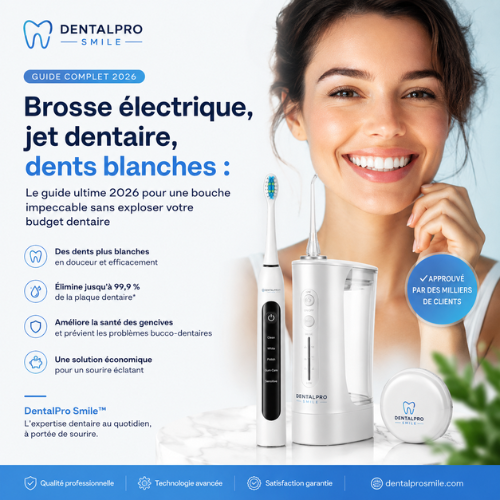
You spend between €200 and €600 per year at the dentist. Part of that amount could have been avoided.
Between 33% and 50% of French adults have at least one decayed tooth requiring treatment. Half of adults over the age of 35 suffer from some form of periodontal disease. These oral and dental conditions affect a large part of the population, with a significant impact on overall health, despite the existence of ways to prevent them through appropriate preventive measures. Toothbrush
The truth that few people hear clearly: the vast majority of these problems can be prevented from your bathroom.
Not with miracle cures. Not with outrageously expensive products. With the right tools, used correctly, in the right order.
The ultimate guide is the only one you'll need to read in 2026 on dental hygiene. It covers the sonic electric toothbrush, the water flosser, the ultrasonic cleaner, natural whitening, the complete family routine — and how all of this translates into visible results in 7 days, real savings over 10 years, and a smile you can finally wear with complete confidence.
Why Your Current Dental Care Routine Isn't Working — The Truth in Numbers
You brush your teeth twice a day. That's good. But a manual toothbrush used in the conventional way only effectively cleans 60 to 70% of tooth surfaces.
The remaining 30% to 40%—interdental spaces, gingival sulcus, and the lingual surfaces of the molars—accumulate bacterial plaque every day without being disturbed.
Among adults, between 33% and 50% have at least one decayed tooth requiring treatment, while one third suffer from dental erosion. Toothbrush
The cycle experienced by 90% of French adults:
Incomplete brushing (60-70% of surfaces)
→ Plaque in the remaining 30-40%
→ Calcification within 24-72h → Tartar
→ Gingival inflammation
→ Bleeding, bad breath, cavities
→ Dentist appointment + invoice
→ Incomplete brushing → Start again
The outcome of this cycle does not require changing dentists. It requires changing tools.
The 4 tools that transform your dental hygiene — Ranked by impact
Three trends dominate the oral care market in France in 2026: therapeutic products dedicated to tooth sensitivity and gums, and the strong comeback of whitening, highly sought after by young people because it symbolizes strength and confidence. Sensient Beauty
Here are the four tools that meet these trends — and your real needs.
The No. 1 Tool — The Sonic Electric Toothbrush: Why It Changes Everything
What exactly is a sonic brush?
A sonic toothbrush generates between 30,000 and 45,000 vibrations per minute. These vibrations produce two simultaneous effects that a manual toothbrush cannot replicate.
The direct mechanical effect: the bristles remove plaque from all accessible surfaces with a frequency and consistency impossible to maintain manually.
The hydrodynamic effect: the vibrations create micro-turbulence in the oral fluid that dislodges plaque in nearby areas not directly reached by the bristles.
The electric toothbrush offers rotating or oscillating movements that allow thorough cleaning with every stroke, promoting whiter teeth and healthier gums. businesswire
Sonic toothbrush vs. manual toothbrush — What studies show
| Criterion | Manual brush | Sonic toothbrush |
|---|---|---|
| Cleaned surfaces | 60-70% | 85-95% |
| Plaque removal | Reference | +21% vs manual |
| Gingivitis reduction | Reference | Superior |
| Extrinsic stains | Partial | Clearly superior |
| Regular movement | Depends on the user | Automated |
| Effective duration | Often < 60 sec | 2 min guided by timer |
How to Choose Your Sonic Toothbrush in 2026 — The 6 Criteria That Really Matter
Criterion 1 — Vibration frequency
Minimum 30,000 vibrations/min for a true hydrodynamic effect. Models with 40,000-45,000 vibrations/min offer maximum performance.
The number of modes criterion 2
A quality toothbrush offers at least 3 modes: Daily Cleaning, Sensitive Gums, Whitening. Premium models add Polishing and Gum Massage.
Criterion 3 — Autonomy
Minimum 14 days for comfortable home use. The best brushes last up to 30 days on a single charge.
The pressure sensor
Essential if you tend to press too hard — which gradually wears down enamel. The sensor alerts you when the pressure exceeds the safe threshold.
Criterion 5 — The 2-minute timer
Non-negotiable. Without a timer, 80% of adults stop before 60 seconds. With a quadrant signal every 30 seconds: 4 quadrants × 30 seconds = 2 perfect minutes.
Criterion 6 — The availability of replacement heads
Replace every 12 weeks. Heads costing €20 each and impossible to find represent a major hidden cost. (Source: American Dental Association — ada.org)
The correct technique — What no one really explains to you
With a sonic electric toothbrush, you don't scrub. You guide.
- Apply the toothpaste to the dry head before putting it in your mouth
- Place at a 45° angle to the gingival margin
- Light it in your mouth — not before (prevents splashing)
- Guide slowly — 2 to 3 seconds per tooth
- Do not press down — let the weight of the brush create the contact
- Follow the timer — 30 seconds per quadrant
- Spit out without rinsing — let the fluoride work for 30 minutes
For children — An even greater issue
Among children, 11% of those in the final year of kindergarten and 12% of Year 6 pupils have at least one untreated decayed tooth. Toothbrush
An electric toothbrush specifically designed for children (ultra-small head, gentle vibrations, built-in timer) radically transforms their willingness to brush. Brushing goes from being a chore to a ritual — which is the only condition for long-term success.
Recommended age: For ages 3 and up, under parental supervision, with a brush labeled for the age group.
👉 The PureBrush Pro™ from DentalPro Smile™ — 45 000 vibrations/min, 5 modes, 30 days of battery life, approved by dentists.
👉 The KidSmile Pro™ — designed for ages 3 to 15, ultra-soft head, 2-minute timer, IPX7.
The No. 2 Tool — The water flosser: the tool revolutionizing interdental cleaning
What your brush can't reach
The spaces between your teeth account for around 40% of the total tooth surface area. Your toothbrush—even the best sonic toothbrush on the market—cannot physically reach them.
The water flosser targets particles and bacteria trapped between the teeth and below the gumline, areas that are difficult to reach with a regular toothbrush. businesswire
Without daily interdental cleaning, you ignore 40% of your mouth every day.
How the oral irrigator works
The oral irrigator can make dental cleaning more pleasant, encouraging a better routine, with gum stimulation that can reduce inflammation, contributing to periodontal health. Price.net
The pulsed jet creates a simultaneous rinsing and mechanical loosening effect — without direct contact with the gum tissue. That is why it is particularly suitable for sensitive or inflamed gums.
Water flosser vs dental floss — The truth in 2026
| Criterion | Dental floss | Water flosser |
|---|---|---|
| Interdental areas | ✅ If technically correct | ✅ Always |
| Below the gumline | 🟡 Difficult | ✅ Naturally |
| Ring holders | ❌ Laborious | ✅ Ideal |
| Bridge wearers | ❌ Bridge wire required | ✅ Simple |
| Dental implants | Caution | ✅ Recommended |
| Ease of use | ❌ Technique to master | ✅ Intuitive |
| Regularity of use | 🔴 Frequently abandoned | ✅ Maintained |
| Cost over 10 years | 🔴 Recurring | ✅ Almost zero |
The conclusion: for most French adults who struggle to maintain a regular flossing routine, the water flosser is superior in practice.
Essential criteria for choosing your water flosser
It is recommended to choose a device with several pressure levels to suit your sensitivity, and to prefer a model that comes apart easily for cleaning. Prix.net
- Levels of pressure: minimum 3, ideally 5 — to suit sensitive gums as well as experienced users
- Capacité du réservoir: minimum 200 ml — 300 ml is ideal for treating the entire mouth without refilling
- Water resistance IPX7: usable in the shower — optimal hygiene and maximum practicality
- Tips: standard + orthodontic + periodontal according to your profile
The 5-step technique
- Fill with lukewarm water (never cold if you have sensitive gums)
- Start at the minimum pressure — gradually increase over 10 days
- Lean over the sink, mouth slightly open
- Turn at 90° toward the tooth-gum junction
- Follow the gumline — 2 to 3 seconds per space
Expected results: reduced bleeding in 14 days, noticeably improved breath in 7 days.
👉 The HydroJet Pro™ from DentalPro Smile™ — IPX7 usable in the shower, 5 pressure levels, 300ml tank, approved by dentists.
The No. 3 tool — The ultrasonic cleaner: essential for aligners, dentures, and mouthguards
The problem no one explains to you
Your Invisalign aligner spends 22 hours a day in your mouth. Your dental appliance, up to 16 hours. Your anti-bruxism splint, 8 hours a night.
These devices develop a bacterial biofilm within a few hours — the same one responsible for your cavities and gum disease. A rinse with water does not remove it. Brushing with toothpaste scratches the surface and makes the problem worse.
Dental ultrasonic cleaners are designed to easily sanitize dentures and aligners, effectively removing tartar and bacteria. Oral-B
The real effects of ultrasonic cavitation
40,000 Hz in water. Millions of micro-bubbles burst, releasing mechanical energy across every surface of the immersed device—including the tiny crevices that no brush can physically reach.
Result: a complete clean in 3 to 5 minutes, with no mechanical contact, no scratching, and no harsh chemicals.
For whom is the ultrasonic cleaner essential?
| Profile | Need |
|---|---|
| Invisalign aligner wearer | 🔴 Essential |
| Denture wearer | Essential |
| Bruxism splint wearer | 🔴 Essential |
| Wearer of a removable orthodontic appliance | 🔴 Essential |
| Adult without braces | Useful as a supplement |
The optimal ultrasound protocol
Daily (morning):
- Immerse the device in lukewarm water
2. Start the ultrasonic cycle (3-5 minutes)
3. Rinse thoroughly
Put back in your mouth on clean teeth
Weekly:
- Ultrasound + 1 dissolved cleaning tablet
2. 5-minute cycle
3. Thorough rinsing
4. Visual inspection
👉 The UltraClean Pro™ and the UltraClean Pro+™ DentalPro Smile™ — 5-minute cycle, 40 000 Hz ultrasonic technology, compatible with aligners, dentures, and jewelry.
Outil No. 4 — The tongue scraper: the forgotten solution for bad breath
The truth about bad breath
85 to 90% of bad breath cases originate in the mouth. And in the majority of these cases, the tongue is the main source — not the teeth.
The dorsal surface of the tongue harbors colonies of anaerobic bacteria that produce volatile sulfur compounds. These bacteria live in the tongue’s crypts, out of reach of your toothbrush.
No mouthwash eliminates them permanently. They come back in less than an hour.
What works
A stainless steel tongue scraper, used every morning, measurably reduces the bacterial load on the tongue. Noticeable results from day 3 to day 7.
4-step technique:
- Pull the tongue out as far as possible
- Place the scraper as far away as possible
- Exert light pressure — bring forward
- Repeat 3 to 5 times — rinse between each pass
👉 The CleanTongue Pro+™ DentalPro Smile™ — food-grade stainless steel, anatomical U-shape, lasts for years.
The complete 12-minute routine — The protocol that changes everything
Here is the optimal daily routine — based on the recommendations of French oral health professional societies.
🌅 Morning — 5 minutes
| Step | Tool | Duration | Benefit |
|---|---|---|---|
| 1 | Tongue scraper | 30 sec | Eliminates nighttime bacteria → instantly fresh breath |
| 2 | Sonic brushing | 2 min | Plaque + discoloration on all surfaces |
| 3 | Water flosser | 2 min | Interdental spaces + gumline area |
| 4 | Do not rinse | — | Active fluoride on enamel for 30 minutes |
Night — 7 minutes
| Step | Tool | Duration | Benefit |
|---|---|---|---|
| 1 | Cleaning the device | 5 min (parallel) | Biofilm eliminated → bacterial reintroduction stopped |
| 2 | Sonic brushing | 2 min | Evening plaque before nightfall |
| 3 | Water flosser | 2 min | Fermentable residues eliminated before 8 p.m. |
What you actually gain — The calculation over 10 years
Without a complete routine (the current situation for the majority)
| Expense | Annual | Over 10 years |
|---|---|---|
| 2 cleanings/year (out-of-pocket cost) | 34€ | 340€ |
| Fillings (cavities) | 30-100€ | 300-1 000€ |
| Complex care | Variable | 500-2 000€ |
| Estimated total | 1 140€ - 3 340€ |
With a routine DentalPro Smile™
| Expense | Annual | Over 10 years |
|---|---|---|
| Complete equipment (one-time investment) | — | 150-250€ |
| Brush heads + consumables | 50€ | 500€ |
| 1 scaling/year | 17€ | 170€ |
| Estimated total | 820€ - 920€ |
Potential savings: 320€ to 2 420€ over 10 years.
⚠️ Indicative estimates. Results vary depending on the individual oral profile.
The 8 mistakes that are sabotaging your dental hygiene — And how to fix them
Error 1 — Rinse immediately after brushing
The rinsing removes the fluoride before it can act on the enamel. Spit without rinsing. (Source: HAS — has-sante.fr)
Error 2 — Scrubbing with an electric toothbrush as if it were a manual toothbrush
She vibrates — guide it, don't scrub. Scrubbing wears away the enamel.
Mistake 3 — Change the head every 6 months
The ADA recommends every 12 weeks. Splayed bristles lose 30% effectiveness.
Error 4 — Brushing your teeth 30 minutes after an acidic meal
The enamel is temporarily softened. Wait 30 to 60 minutes after fruit juice, soda, or wine.
Error 5 — Brushing your denture with toothpaste
The toothpaste is abrasive — it scratches the resin and worsens bacterial buildup. Ultrasonic cleaner + tablets only.
Error 6 — Ignore the language
85-90% of bad breath comes from there. Yet fewer than 30% of adults clean it daily.
Error 7 — Using a water flosser at maximum pressure right from the start
Always start at the minimum. Increase gradually over 7 to 10 days.
Error 8 — Using activated charcoal to whiten teeth
The ADA has explicitly stated that it cannot recommend charcoal toothpastes due to their abrasiveness on enamel. (Source: Journal of the American Dental Association, 2017)
White Teeth Naturally — What Really Works vs. What’s Dangerous
✅ What works
Sonic brushing in White or Polishing mode
Extrinsic stains (coffee, tea, wine) build up on plaque. A high-frequency sonic toothbrush removes them effectively. Visible results in 4 to 8 weeks.
Professional scaling + polishing
The most effective method for extrinsic staining. Included in the standard scaling.
❌ What is dangerous
Lemon juice — pH 2-3 — irreversibly erodes enamel
Active charcoal — abrasive — gradually scratches the enamel
Apple cider vinegar — acidic — same problem as lemon
The golden rule: any "whitening" method that removes enamel is counterproductive in the long term. The yellowish dentin beneath the enamel becomes more visible as the enamel thins.
The action plan — Transform your routine in 30 days
Week 1 — The Foundations
| Day | Action | Expected result |
|---|---|---|
| J1 | Install sonic brushing + tongue scraper | First sensation of long-lasting freshness |
| Day 2-Day 7 | Morning + evening routine without exception | Installing habit in progress |
Week 2 — Optimization
| Day | Action | Expected result |
|---|---|---|
| J8 | Add water flosser (minimum pressure) | Interdental spaces cleaned |
| J14 | Assessment: reduced bleeding? | Normally yes — in 2 weeks |
Week 3–4 — The first visible results
- Improved breath noticeably ✅
- Reduced gum bleeding ✅
- Sensation of smoother teeth ✅
- First improvements in light coloring ✅
Frequently Asked Questions — What Google Asks You About Dental Hygiene
What is the best electric toothbrush in 2026?
The best toothbrush is the one that matches your specific profile — not the most expensive one. For sensitive gums: Sensitive mode is essential. For stains: White mode. For children: ultra-small head + gentle vibrations designed for them. For eco-responsibility: bamboo handle with sonic technology identical to plastic models.
Can a water flosser replace dental floss?
For most adults, yes — and often with better results in real-life practice, because the technique is more intuitive and compliance is better. For people with braces, bridges, and implants: the water flosser is clearly superior. Combining the two remains the most clinically comprehensive option.
How to get whiter teeth naturally?
By regular sonic brushing in polishing mode—effective on extrinsic staining (coffee, tea, wine) in 4 to 8 weeks. Avoid activated charcoal, lemon, and vinegar—abrasive or acidic, they erode enamel and worsen yellowing in the long term.
How often should you clean your Invisalign aligner?
Ideally at each removal — 3 to 4 times a day. At a minimum: one ultrasonic cleaning cycle in the morning and one in the evening. A poorly cleaned aligner reintroduces into your mouth the bacteria responsible for cavities for 22 hours a day — with a real risk of permanent "white spots" on the enamel.
Bleeding gums — what to do quickly?
Bleeding indicates gum inflammation caused by plaque in the spaces between the teeth. Immediate solution: add an oral irrigator to your evening routine (minimum pressure to start). Expected results: a 50% reduction in bleeding within 2 weeks. If bleeding persists after 4 weeks of a rigorous routine: consult your dentist.
Can good oral hygiene help save on dental care?
Yes — effective home prevention reduces the frequency and intensity of curative care. A well-prepared scale and polish costs less and takes less time than a scale and polish with significant buildup. Cavities detected early cost 10 to 20 times less to treat than advanced cavities. The equipment DentalPro Smile™ represents a one-time investment whose return on investment is measured over 2 to 5 years.
Conclusion — The smile you deserve starts today
You now have all the information a dentist would give you during a consultation — without the €80 consultation fee.
The sonic brush for your tooth surfaces. The water flosser for your interdental spaces. The ultrasonic cleaner for your appliances. The scraper for your tongue.
These four tools together cover 100% of the blind spots in your current oral care routine. In 12 minutes a day.
The question is no longer "is it worth it?" The question is "how much is it costing me not to do it?"
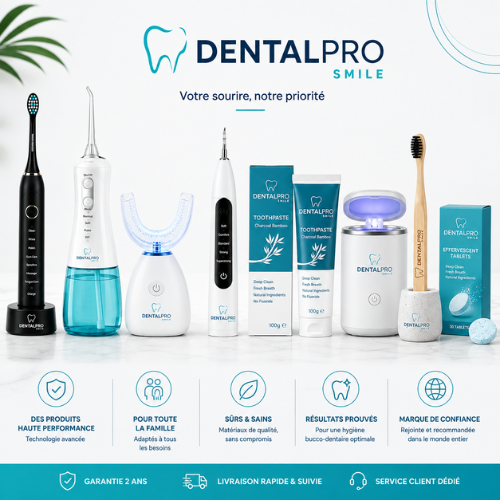
Discover the full DentalPro Smile™ range
Sonic toothbrush · Water flosser · Ultrasonic cleaner · Scraper · Children · Bamboo
→ +32,000 satisfied customers in Europe
→ ★★★★★ 4.8/5 · 1 716 verified reviews
→ Free delivery · 1-year warranty · Visible results in 7 days or your money back
Sources:
— paymed.pro — Oral health, a major issue in France (February 2026)
— pointsdevente.fr — Oral hygiene: innovation is driving the market (June 2024)
— meilleurs.fr — Electric toothbrush with water flosser comparison 2026
— futura-sciences.com — Best water flossers 2026
— Journal of the American Dental Association — Charcoal toothpastes, 2017
— American Dental Association — Toothbrush replacement guidelines: ada.org
— HAS — Oral health prevention recommendations: has-sante.fr
Article intended for informational purposes only. Does not replace the advice of a dentist. DentalPro Smile™ — 2026.

Leave a comment
This site is protected by hCaptcha and the hCaptcha Privacy Policy and Terms of Service apply.